

Key Takeaways
What You Need Before You Start
Reading a Nutrition Facts label accurately requires only a basic understanding of what macronutrients are. If you want a deeper foundation first, see The Complete Guide to Understanding Macronutrients before diving in here.
What you will need
The steps below walk through a standard FDA-formatted Nutrition Facts panel, the version required on most packaged foods sold in the United States. Keep a real food package nearby so you can follow along with an actual label.
Packaged food with a Nutrition Facts label
Provides a real label to reference while following each step — makes the walkthrough concrete rather than abstract.
Calculator (phone or basic)
Used to scale macronutrient values when you consume more or less than one labeled serving.
Step-by-Step: Finding Macronutrients on the Label
Follow these steps in order — each one builds on the last. Skipping the serving size step is the most common reason people misinterpret what they're eating.
Find and read the serving size first
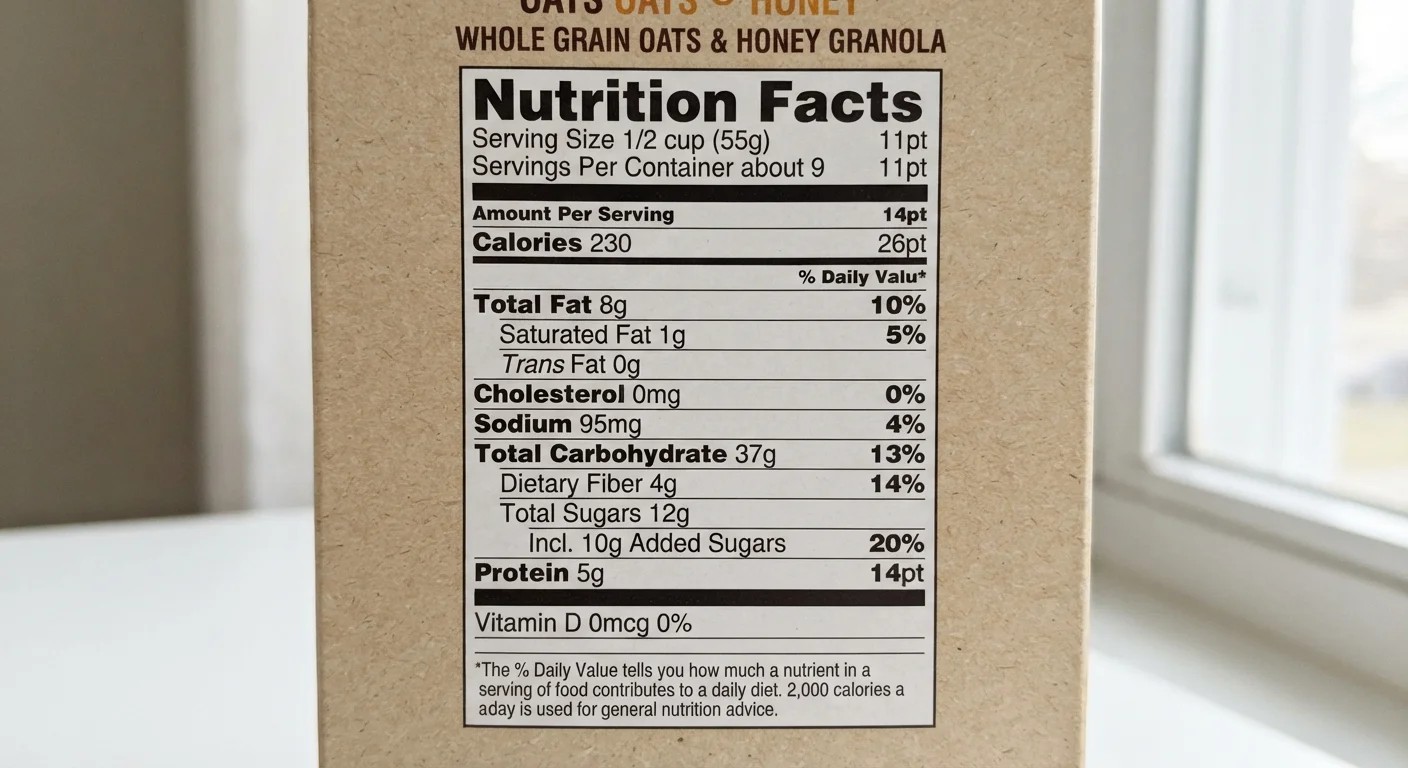
At the very top of the Nutrition Facts panel, just below the bold "Nutrition Facts" header, you'll see Serving Size and Servings Per Container. Every number on the label — including all macronutrient values — applies to one serving, not the entire package.
If a bag of chips lists a serving size of 1 oz (about 28 g) and contains 3 servings, eating the entire bag means multiplying every value by three.
Locate Total Fat and its sub-items
Scan down to the bold line that reads Total Fat, followed by the gram amount. Directly beneath it, indented, you'll find:
- Saturated Fat — in grams and %DV
- Trans Fat — in grams only (no %DV, because there is no recommended intake level)
Unsaturated fats are not listed as a separate line; they're implied by the difference between total fat and the sum of saturated plus trans fat grams.
Locate Total Carbohydrate and its sub-items
The next bold line is Total Carbohydrate. Indented beneath it:
- Dietary Fiber — in grams and %DV
- Total Sugars — in grams (no %DV)
- Includes X g Added Sugars — in grams and %DV (further indented beneath total sugars)
Total Carbohydrate accounts for all carbs: fiber, natural sugars, added sugars, and starches. Starches are not listed separately — they're the remainder after subtracting fiber and total sugars from total carbs.
Locate Protein
The bold Protein line appears directly below total carbohydrate. It shows only the gram amount per serving. Unlike fat and carbohydrates, protein carries no sub-items and, for most packaged foods, no %DV column entry.
The FDA requires a %DV for protein only when a product makes a protein-related claim (such as "high in protein") or is marketed specifically to children under four years of age.
Use the %DV column as a benchmark, not a prescription
The % Daily Value (%DV) column on the right side of the label shows what percentage of a daily nutrient target is met by one serving, based on a 2,000-calorie reference diet. Use it as a rough directional guide:
- 5% DV or less per serving = low in that nutrient
- 20% DV or more per serving = high in that nutrient
Whether high or low is desirable depends on the nutrient and your personal health context. For example, a high %DV for dietary fiber is generally favorable, while a high %DV for saturated fat may warrant attention for certain individuals.
Understanding Subtypes and Why They Matter
Each macronutrient line on the label carries important detail in its sub-items. Under Total Fat, you'll find saturated fat and trans fat listed separately. Dietary guidelines generally suggest limiting saturated fat and avoiding trans fat where possible — though the science is more nuanced than the old "fat is bad" framing. For a clear comparison of fat types, see Saturated, Unsaturated, and Trans Fats: A Side-by-Side Look.
Under Total Carbohydrate, dietary fiber and total sugars appear as sub-items. Added sugars — those incorporated during processing rather than naturally present — are now required to appear as a further indented line beneath total sugars. This distinction matters because naturally occurring sugars in whole foods come packaged with fiber and micronutrients, while added sugars typically do not. You can explore more about how food processing affects what labels don't capture in Whole Foods vs. Processed Foods: What the Labels Don't Tell You.
Protein has no required sub-items and, for most foods, carries no %DV. That's intentional: protein requirements vary considerably based on age, body size, activity level, and health conditions. For context on how those needs shift over a lifetime, see How Macronutrient Needs Shift Across Different Life Stages.
Cross-Reference the Ingredient List
The Nutrition Facts panel tells you how much of each macronutrient a food contains, but the ingredient list tells you where those nutrients come from. Reading both together gives a more complete picture of food quality. For instance, two products may have identical total carbohydrate grams but very different ingredient profiles — one based on whole grains, the other on refined flour and added sugars.
Putting the Numbers in Context
The %DV column gives you a shortcut for gauging whether a food is high or low in a particular nutrient relative to a 2,000-calorie daily reference. A general rule of thumb used in nutrition education: 5% DV or less is considered low, while 20% DV or more is considered high for a given nutrient.
Keep in mind that 2,000 calories is a population-level reference point, not a personal target. Your actual macronutrient needs depend on factors including your size, activity level, and any health conditions you manage. Always consult a registered dietitian or qualified healthcare provider before making significant changes to your diet, especially if you have an underlying health condition.
A quick reference for macronutrient calorie density: fat provides 9 calories per gram, while both carbohydrates and protein provide 4 calories per gram. These numbers explain why fat-rich foods are calorie-dense even in small portions. For a full lookup of calorie density, functions, and food sources, see the Macronutrient Quick-Reference guide.
Finally, it's worth separating label literacy from the myths that often surround macros. If you've heard that carbs are inherently fattening or that all dietary fat should be avoided, see Macronutrient Myths That Nutrition Science Has Since Clarified for a science-grounded correction.
This article is for informational purposes only and is not a substitute for professional medical or dietary advice. Consult a qualified healthcare professional for guidance specific to your health needs.