

Key Takeaways
Our Verdict
Unsaturated fats — both monounsaturated and polyunsaturated — are broadly supported by nutritional science as the most favorable for heart health and daily consumption. Saturated fats are not inherently harmful in moderate amounts, but current dietary guidance recommends keeping them limited. Artificial trans fats carry the clearest documented risks and are best minimized wherever possible.
| Best for | Recommended |
|---|---|
| Everyday dietary fat choices for heart health | Unsaturated fats |
| Those seeking whole-food sources of fat with minimal processing | Unsaturated fats from nuts, seeds, and fish |
| Cooking at high heat in small amounts | Saturated fats (used sparingly) |
| Fats to minimize or avoid | Artificial trans fats |
What Makes a Fat Saturated, Unsaturated, or Trans?
Dietary fats are all built on the same basic scaffold: chains of carbon atoms bonded to hydrogen atoms. What differs — and what determines the fat's classification — is how those bonds are structured.
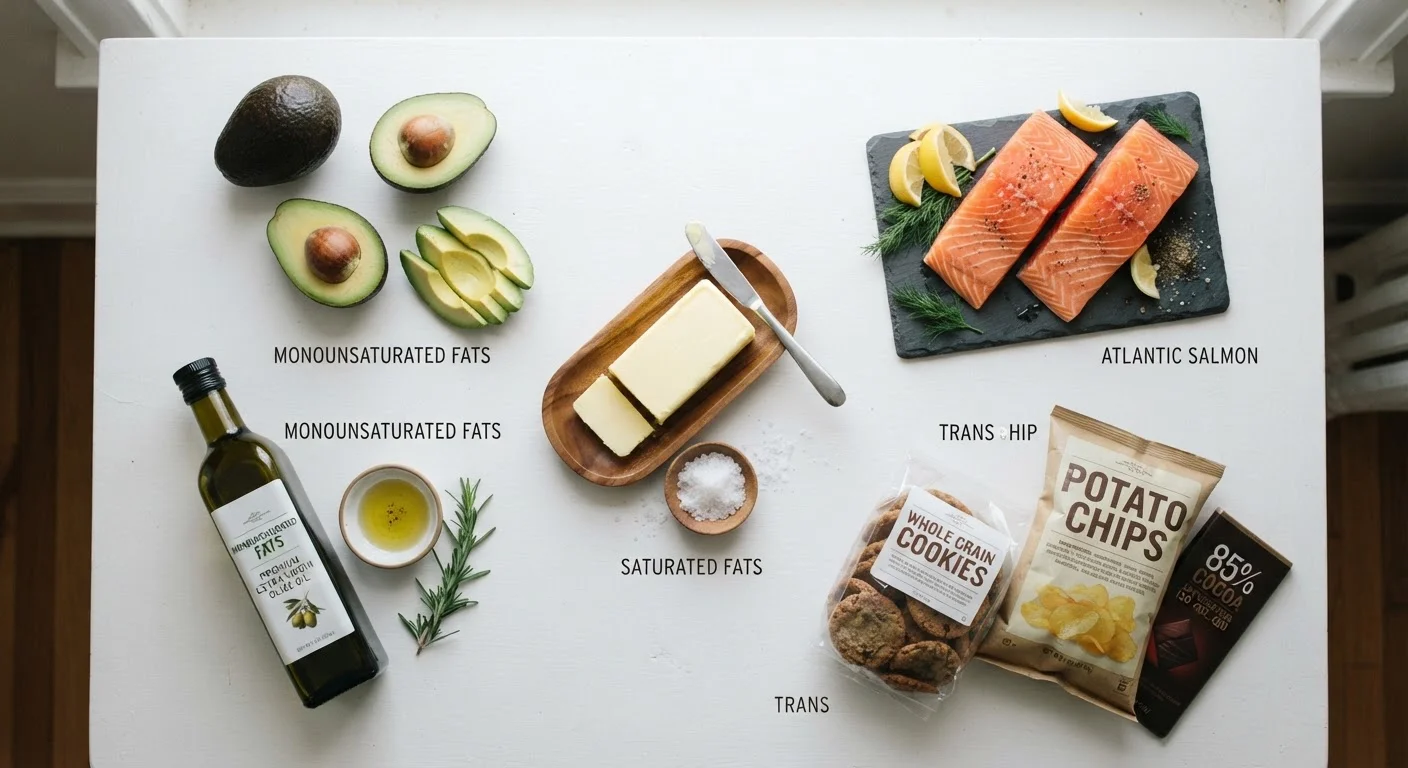
Saturated fats have carbon chains fully "saturated" with hydrogen atoms, meaning no double bonds exist between carbons. This structure makes them solid at room temperature (think: butter, lard, coconut oil). Major food sources include red meat, full-fat dairy, and some tropical oils.
Unsaturated fats contain one or more double bonds in the carbon chain, which introduces a slight bend in the molecule. This bend prevents tight packing, keeping the fat liquid at room temperature. Monounsaturated fats (one double bond) are found in olive oil and avocados; polyunsaturated fats (multiple double bonds) appear in fatty fish, walnuts, and flaxseed.
Trans fats can arise naturally in small amounts in ruminant animals (beef, dairy), but the form of greatest health concern is artificial trans fat, created through partial hydrogenation — an industrial process that adds hydrogen to liquid vegetable oil to make it solid and shelf-stable. The U.S. Food and Drug Administration removed partially hydrogenated oils from the list of generally recognized as safe ingredients, effectively phasing them out of most processed foods.
How Each Fat Type Affects the Body
Understanding fat chemistry matters because these structural differences translate directly into how the body metabolizes each type.
Saturated fat and its effect on blood cholesterol has been studied extensively. Current evidence suggests that replacing saturated fat with unsaturated fat tends to improve the ratio of LDL (low-density lipoprotein) to HDL (high-density lipoprotein) cholesterol, which is linked to cardiovascular health. However, research also shows that what you replace saturated fat with matters — swapping it for refined carbohydrates, for example, offers little benefit.
Unsaturated fats, particularly omega-3 polyunsaturated fatty acids found in fatty fish and walnuts, are associated with reduced inflammation and improved blood lipid profiles in multiple large studies. Monounsaturated fats, abundant in olive oil, are a cornerstone of the Mediterranean dietary pattern, which is among the most studied and consistently supported eating patterns for cardiovascular and metabolic health.
Artificial trans fats present a different picture. Research has consistently linked them to elevated LDL cholesterol, reduced HDL cholesterol, and increased inflammation — a combination associated with heightened cardiovascular disease risk. This evidence base was a key driver behind regulatory action in the United States.
| Saturated Fat | Unsaturated Fat | Artificial Trans Fat | |
|---|---|---|---|
| Physical state at room temp | Solid | Liquid | Solid or semi-solid |
| Common food sources | Butter, red meat, dairy | Olive oil, fish, nuts, avocados | Partially hydrogenated oils |
| Effect on LDL cholesterol | May raise LDL | Generally lowers LDL | Raises LDL significantly |
| Effect on HDL cholesterol | Variable | May raise HDL | Lowers HDL |
| U.S. regulatory status | Permitted; limit advised | Permitted; encouraged in guidelines | Largely banned (artificial form) |
| Current dietary guidance | Limit to less than 10% of calories | Prioritize in place of saturated fat | Minimize or eliminate |
For a practical guide on spotting these fats on packaged foods, see how macronutrients appear on a nutrition label.
Putting Fat Types Into Everyday Context
Knowing the science is useful, but applying it at the grocery store or dinner table is what actually shapes dietary outcomes.
- Cook with oils thoughtfully. Olive oil and avocado oil are practical choices for most cooking methods. Butter and coconut oil, higher in saturated fat, work well in small amounts but shouldn't dominate daily cooking.
- Check labels for trans fat loopholes. Even if a product states "0g trans fat," it may contain up to 0.5 grams per serving under FDA rounding rules if partially hydrogenated oils appear in the ingredient list. Scanning ingredients remains worthwhile.
- Whole food sources first. Getting unsaturated fats from walnuts, salmon, sardines, avocados, and seeds delivers additional nutrients — fiber, protein, vitamins — that isolated oils or supplements don't fully replicate.
- Context over single nutrients. Overall dietary patterns matter more than any single fat source. A diet rich in whole plants, lean proteins, and minimally processed foods naturally limits problematic fats without requiring precise tracking.
Fat type also influences how your body absorbs certain vitamins. Fat-soluble nutrients in particular depend on dietary fat for absorption — see how fat-soluble and water-soluble vitamins differ for more on that relationship.
It's worth noting that dietary fat, of any type, does not directly translate into stored body fat — that process is more complex and involves overall energy balance. For a deeper look at how body fat is classified and stored, explore the differences between visceral and subcutaneous fat.
This article is for general informational and educational purposes only and is not a substitute for personalized medical or dietary advice. Consult a qualified healthcare professional or registered dietitian for guidance specific to your health needs.