

Key Takeaways
Option A
Fat-Soluble Vitamins
The long-term reserve vitamins your body stores for future use.
Best for: Understanding which vitamins accumulate in tissue and require dietary fat for absorption.
Option B
Water-Soluble Vitamins
The daily-use vitamins that circulate freely and flush out regularly.
Best for: Understanding which vitamins need consistent daily replenishment through food.
If you eat infrequently or follow very low-fat diets
Fat-Soluble Vitamins
Pay particular attention to fat-soluble vitamin intake, since both absorption and storage can be compromised without adequate dietary fat.
If you're managing stress, high physical activity, or frequent illness
Water-Soluble Vitamins
B vitamins and vitamin C are rapidly depleted under physiological stress, making consistent daily intake from food especially important.
If you're considering high-dose vitamin supplements
Water-Soluble Vitamins
Excess water-soluble vitamins are mostly excreted, while overloading fat-soluble vitamins — especially A and D — can build to harmful levels. Always consult a healthcare professional before supplementing.
If you want to understand vitamin D and calcium absorption
Fat-Soluble Vitamins
Vitamin D is fat-soluble and works alongside dietary fat and minerals; understanding its category explains why deficiency is common even with adequate sun exposure.
What Sets These Two Categories Apart
All vitamins are organic compounds your body needs in small amounts to function properly — but the way they're absorbed, transported, and managed differs dramatically based on one chemical property: whether they dissolve in fat or water.
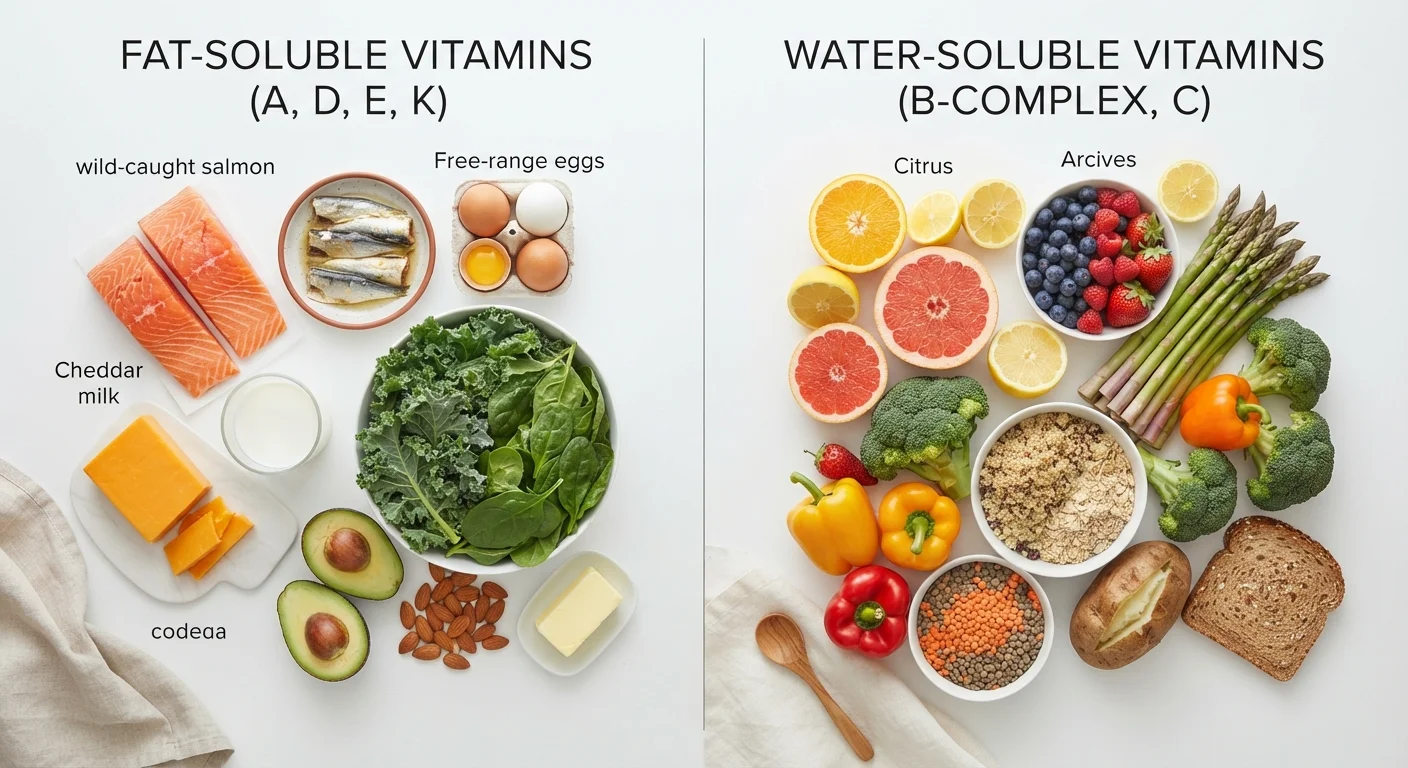
Fat-soluble vitamins — vitamins A, D, E, and K — dissolve in lipids (fats). They're absorbed alongside dietary fat in the small intestine and then transported through the lymphatic system before entering the bloodstream. Because they can be stored in fatty tissue and the liver, your body builds reserves it can draw on over days or weeks.
Water-soluble vitamins — vitamin C and the eight B vitamins (thiamine, riboflavin, niacin, B6, folate, B12, biotin, and pantothenic acid) — dissolve in water. They pass directly into the bloodstream during digestion and circulate freely. Because they aren't stored in meaningful quantities, they're excreted through urine when consumed in excess, meaning regular dietary replenishment is essential.
To understand how vitamins relate to minerals as a broader nutrient category, see our guide to vitamins vs. minerals.
| Criterion | Fat-Soluble Vitamins | Water-Soluble Vitamins |
|---|---|---|
| Vitamins included | A, D, E, K | C and all 8 B vitamins |
| Dissolves in | Dietary fat / lipids | Water |
| Absorption route | Lymphatic system with fat | Directly into bloodstream |
| Body storage | Stored in fat tissue and liver | Not stored long-term |
| Replenishment frequency | Less frequent; reserves buffer intake | Needed regularly from diet |
| Excess handling | Accumulates; toxicity risk at high doses | Mostly excreted in urine |
| Key food sources | Fatty fish, eggs, dairy, leafy greens | Fruits, vegetables, whole grains, legumes |
| Cooking sensitivity | Relatively stable in cooking | Easily lost through heat and water |
Absorption, Storage, and Toxicity: The Practical Differences
The fat-soluble category's dependence on dietary fat has real everyday implications. Eating vitamin-rich vegetables — like spinach (vitamin K) or sweet potatoes (beta-carotene, a vitamin A precursor) — with a small amount of fat significantly improves absorption. A salad dressed with olive oil, for example, is genuinely more nutritious than one eaten plain when fat-soluble vitamins are involved. This is also why the type of fat you eat matters beyond just calories — healthy fats support micronutrient absorption.
The storage capacity of fat-soluble vitamins is both an advantage and a caution. On one hand, a well-nourished person has reserves that buffer short periods of low intake. On the other hand, consistent high-dose supplementation — particularly of vitamin A or vitamin D — can push stored levels into ranges associated with adverse effects, a condition called hypervitaminosis. Water-soluble vitamins carry a much lower risk of accumulation toxicity for most people, though extremely high supplemental doses of certain B vitamins (notably B6 and niacin) can still cause harm.
Because water-soluble vitamins move quickly through the body, factors like cooking methods, food processing, and even the water used to boil vegetables can leach them away. Steaming or roasting tends to preserve more B vitamins and vitamin C than boiling. Freshness matters too — prolonged storage reduces water-soluble vitamin content in produce.
~42%
U.S. adults with vitamin D insufficiency
Research published in Nutrition Research estimated that roughly 42% of U.S. adults have insufficient vitamin D levels, reflecting the challenges of obtaining adequate amounts of this fat-soluble vitamin.
~1 in 6
U.S. adults with inadequate vitamin C intake
National dietary survey data suggests a notable share of American adults fall short of recommended vitamin C intake, underscoring the importance of regular fruit and vegetable consumption.
Up to 40%
B vitamin loss from boiling vegetables
Studies on cooking methods indicate that boiling can leach up to 40% of water-soluble B vitamins from vegetables compared to steaming or roasting.
For a closer look at how certain vitamins work more effectively in combination, explore our article on nutrients that work better together.
Everyday Eating Strategies for Both Categories
A varied, whole-food diet remains the most reliable way to meet needs across both vitamin categories. Here's how to think about each in practical terms:
- For fat-soluble vitamins: Pair colorful vegetables with a source of healthy fat at most meals. Include fatty fish, eggs, and dairy regularly for vitamins D and A. Leafy greens supply vitamin K consistently. If you follow a very low-fat dietary pattern, discuss absorption with a registered dietitian.
- For water-soluble vitamins: Prioritize frequency and variety — fruits, vegetables, whole grains, legumes, and lean proteins spread across the day keep levels steady. People following plant-based diets should pay particular attention to vitamin B12, which is found almost exclusively in animal products and may require supplementation under healthcare guidance.
Special populations — including pregnant individuals, older adults, and those with chronic digestive conditions affecting fat absorption — face distinct considerations for both categories. If you fall into any of these groups, consult a qualified healthcare provider before making major dietary changes or starting supplements.
This article is for general informational and educational purposes only and does not constitute medical or dietary advice. Consult a qualified healthcare professional for guidance specific to your health needs.