

Key Takeaways
Option A
Circadian Rhythm
The internal 24-hour clock that times your biology.
Best for: Explaining why you feel alert or drowsy at predictable times of day, regardless of how much sleep you've had.
Option B
Sleep Pressure (Homeostatic Sleep Drive)
The accumulating biological need for sleep the longer you stay awake.
Best for: Explaining why you feel progressively sleepier the longer you've been awake, and why sleep deprivation catches up with you.
If you want to understand why you feel groggy at the same time every afternoon
Circadian Rhythm
The mid-afternoon dip in alertness is a predictable output of your circadian clock, not simply a sign that you need more sleep.
If you're trying to figure out why you can't sleep after a long nap
Sleep Pressure (Homeostatic Sleep Drive)
Napping discharges accumulated adenosine, reducing sleep pressure and making it harder to fall asleep at your usual bedtime.
If you're recovering from jet lag or adjusting to shift work
Circadian Rhythm
Jet lag and shift-work misalignment are primarily circadian disruptions — your clock is out of sync with local time cues.
If you're trying to optimize a nap without ruining your night sleep
Sleep Pressure (Homeostatic Sleep Drive)
Keeping naps short (typically under 30 minutes) preserves enough sleep pressure to ensure strong sleep onset at bedtime.
Two Separate Systems, One Shared Goal
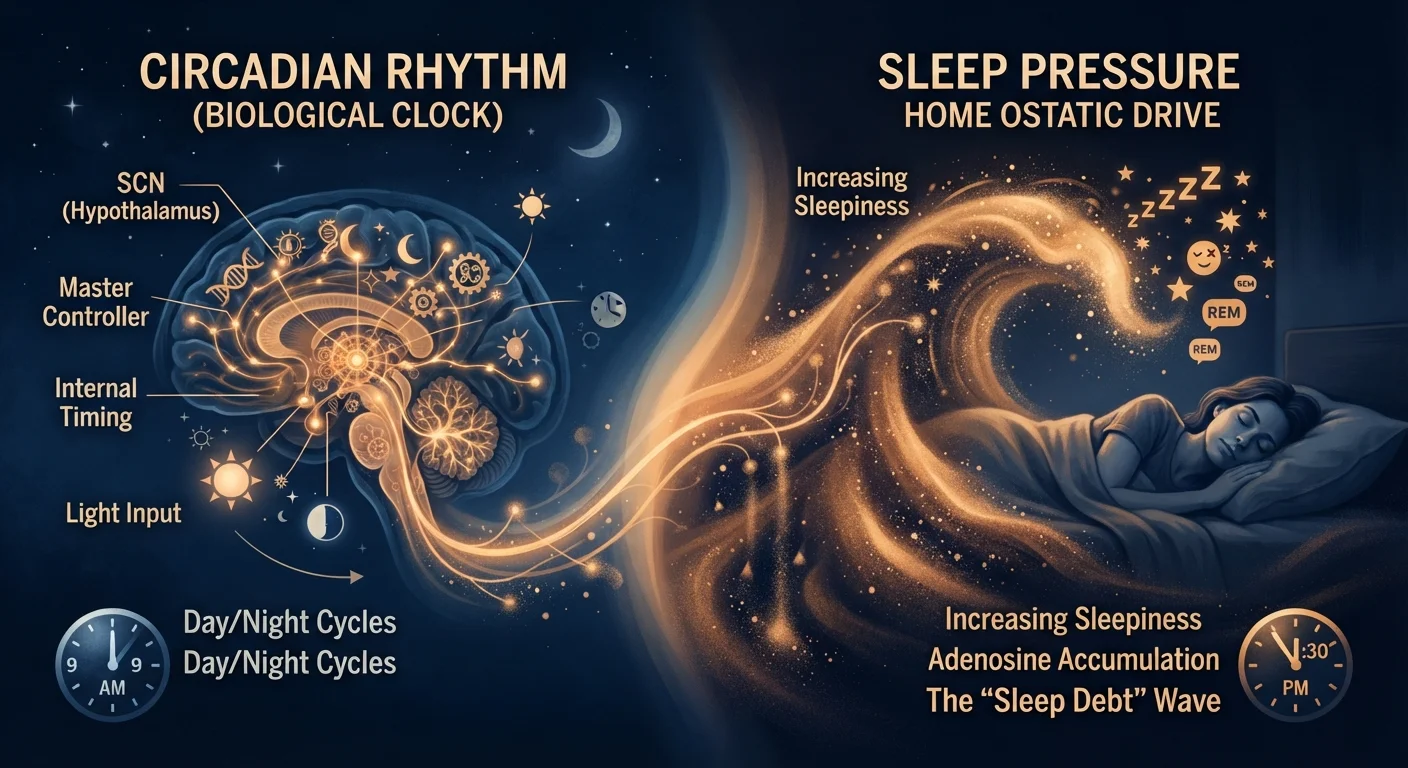
Sleep scientists describe sleep timing as the product of two interacting biological forces, a framework first formalized by Alexander Borbély in 1982 and now central to sleep medicine. Neither system operates alone. Together, they create the precise windows when falling asleep feels natural — and when staying awake becomes a struggle.
Process C — the circadian rhythm — is your internal 24-hour biological clock. Housed primarily in a region of the brain called the suprachiasmatic nucleus (SCN), it coordinates timing signals across nearly every cell in your body. It responds strongly to light, which is why light exposure at different times of day has such a powerful effect on when you feel sleepy or alert.
Process S — homeostatic sleep pressure — operates on a fundamentally different principle. It has nothing to do with time of day. Instead, it tracks how long you've been awake. The longer you're awake, the more a chemical called adenosine accumulates in the brain. Adenosine is a byproduct of neural activity, and as it builds up, it increasingly suppresses wakefulness signals — creating the familiar, mounting heaviness of sleepiness. Sleep clears adenosine; caffeine temporarily blocks its receptors without clearing it.
| Criterion | Circadian Rhythm | Sleep Pressure |
|---|---|---|
| What drives it | Internal biological clock (~24-hr cycle) | Duration of wakefulness |
| Key mechanism | Suprachiasmatic nucleus, melatonin, cortisol | Adenosine accumulation in the brain |
| Primary input | Light-dark cycle | Hours awake since last sleep |
| Disrupted by | Jet lag, shift work, irregular schedules, artificial light at night | Napping, sleep deprivation, caffeine use |
| Resets with | Consistent light exposure and sleep timing | Adequate sleep (adenosine clearance) |
| Explains | Predictable alertness dips and peaks across the day | Why sleepiness grows the longer you stay awake |
How the Two Systems Interact — and Why It Matters
In a well-timed sleep schedule, these two forces complement each other elegantly. During the day, your circadian clock actively promotes wakefulness — it counteracts rising sleep pressure so you don't crash mid-afternoon. By evening, as circadian alerting signals wind down and adenosine reaches its peak, the two systems finally align: sleep onset becomes nearly irresistible.
This is why your circadian rhythm matters beyond just making you feel like a morning or evening person. Research consistently shows that when you sleep — not just how long — influences health outcomes. For a deeper look at that evidence, see why sleep timing matters as much as duration.
When the systems fall out of sync — through circadian rhythm disorders, jet lag, or shift work — you may feel tired but unable to sleep, or alert at entirely the wrong time. Stress compounds this: stress and poor sleep form a reinforcing cycle that disrupts both processes simultaneously.
~24 hrs
Natural period of the human circadian clock
Research shows the intrinsic human circadian period averages slightly longer than 24 hours, requiring daily light cues to stay entrained to the solar day.
~16 hrs
Typical wakefulness before peak sleep pressure
Most adults accumulate sufficient homeostatic sleep pressure for strong sleep onset after roughly 16 hours of continuous wakefulness, according to sleep physiology literature.
30 min
Nap length that limits sleep pressure discharge
The American Academy of Sleep Medicine notes that short naps of around 20–30 minutes can improve alertness without significantly impairing nighttime sleep onset.
Practical Implications: Naps, Late Nights, and Jet Lag
Understanding these two systems reframes common sleep problems in actionable ways.
- Napping strategically: A short nap (generally under 30 minutes) reduces adenosine enough to improve alertness without deeply eroding the sleep pressure you need for bedtime. Longer naps discharge more pressure and can delay sleep onset significantly.
- Late-night second wind: Staying up past your usual bedtime often produces a paradoxical burst of alertness. This is your circadian clock issuing a late-evening wakefulness signal — not a sign that you're no longer tired. Sleep pressure is still high; the circadian signal is temporarily masking it.
- Jet lag recovery: Jet lag is primarily a circadian problem. Your SCN clock hasn't yet adjusted to the new local light-dark cycle. Sleep pressure continues accumulating normally, which is why you may fall asleep — but often at the wrong time and with disrupted architecture.
Good sleep habits that respect both systems — consistent wake times, morning light exposure, and avoiding late naps — reinforce the natural alignment between Process C and Process S.
This article is for informational purposes only and does not constitute medical advice. If you have concerns about chronic sleepiness, insomnia, or other sleep difficulties, consult a qualified healthcare provider.