

Key Takeaways
Circadian Rhythm
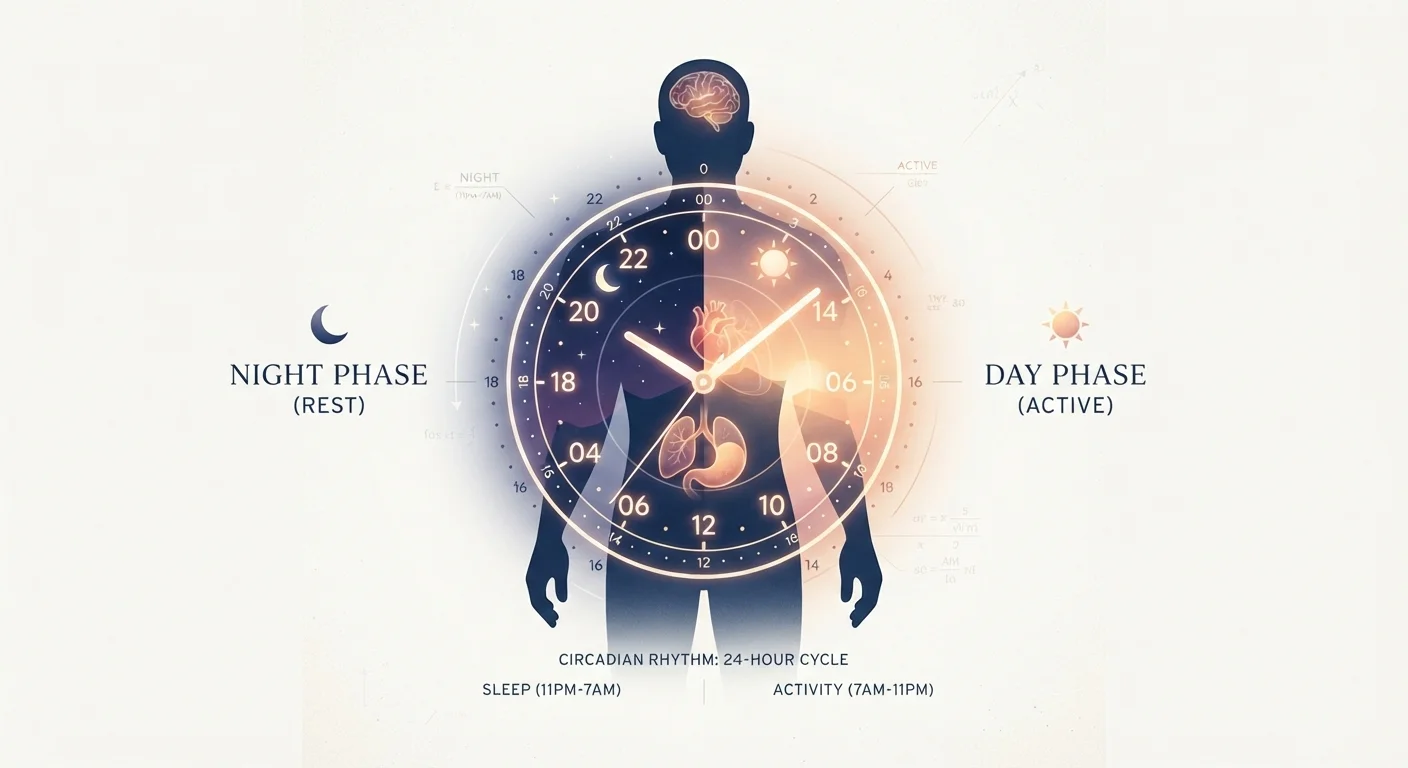
Your circadian rhythm is your body's internal 24-hour biological clock. It regulates the timing of sleep and wakefulness, hormone release, body temperature, digestion, and other essential functions. This cycle is driven by your brain and responds to environmental cues — most powerfully, light and darkness.
The master clock resides in the suprachiasmatic nucleus (SCN), a cluster of roughly 20,000 neurons in the hypothalamus that synchronizes peripheral clocks throughout virtually every organ and tissue in the body.
How Your Body Clock Actually Works
Every cell in your body contains molecular clock machinery — a set of genes and proteins that cycle in roughly 24-hour loops. The SCN coordinates all of these peripheral clocks by responding to light detected by specialized photoreceptors in your eyes. When light hits these receptors, the SCN suppresses melatonin production in the pineal gland, signaling wakefulness. As darkness falls, melatonin rises, core body temperature drops, and your brain begins winding down toward sleep.
This is why light is the single most powerful lever you have over your circadian rhythm. Bright light in the morning anchors your clock earlier; bright light late at night delays it. The cycle also interacts with adenosine — a sleep-pressure chemical that builds up while you're awake — creating a two-process model where your clock and sleep pressure work together to determine when you feel alert or drowsy.
For a deeper look at how when you sleep affects health independently of how much you sleep, see the science of sleep timing.
Why Disruption Goes Beyond Feeling Tired
Most people associate a disrupted circadian rhythm with simple fatigue, but the downstream effects are significantly broader. The American Academy of Sleep Medicine and multiple peer-reviewed bodies of research have linked chronic circadian misalignment with metabolic dysfunction (including altered glucose regulation), immune suppression, mood disorders, and elevated cardiovascular risk.
Shift workers and frequent long-haul travelers are the most studied populations, but even irregular social schedules — sleeping late on weekends and early on weekdays, sometimes called "social jet lag" — produce measurable physiological strain. The body's hormonal and immune systems depend on predictable timing signals; when those signals are inconsistent, coordination breaks down at a cellular level.
~1 in 3
U.S. adults not getting enough sleep
The CDC has reported that roughly one in three American adults regularly sleeps less than the recommended seven hours per night, a pattern closely tied to circadian disruption.
15–20%
U.S. workforce in shift work
Estimates suggest that roughly 15–20% of American workers hold shift-work schedules, a population at significantly elevated risk for circadian misalignment and its associated health consequences.
Circadian disruption can also present as a recognized clinical condition. To understand how misalignment becomes a diagnosable disorder, see the science of circadian rhythm disorders and the broader overview of common sleep disorders.
Evidence-Backed Habits That Support Your Rhythm
Supporting a healthy circadian rhythm doesn't require drastic lifestyle changes. Research consistently points to a handful of behavioral anchors that make a meaningful difference:
- Consistent sleep and wake times: Going to bed and rising at the same time every day — including weekends — is one of the most reliably supported strategies in sleep science for stabilizing your rhythm.
- Morning light exposure: Spending 10–20 minutes outdoors in natural morning light helps anchor your clock and has been associated with earlier, more regular sleep onset.
- Limiting evening blue light: Screens emit short-wavelength light that suppresses melatonin. Reducing exposure in the hour or two before bed is a widely recommended, low-cost intervention.
- Meal timing: Eating at consistent, daytime-aligned times helps reinforce peripheral clocks in digestive organs, supporting overall rhythmic coherence.
- Moderate exercise: Physical activity — particularly in the morning or early afternoon — can strengthen circadian signals, though intense late-night exercise may delay sleep onset in some individuals.
These habits collectively work with your biology rather than against it. Explore the broader sleep science hub for more on the biological foundations of healthy sleep.
This article is for general informational and educational purposes only and is not a substitute for professional medical advice. If you have concerns about your sleep or suspect a sleep disorder, please consult a qualified healthcare provider.