

Key Takeaways
Circadian Rhythm Disorder
A circadian rhythm disorder is a condition in which a person's internal biological clock is misaligned with the external day-night cycle or with the timing demands of daily life. This misalignment causes chronic difficulties falling asleep, staying asleep, or waking at conventional times. The result is often persistent fatigue, impaired function, and reduced quality of life.
These disorders are formally classified by the American Academy of Sleep Medicine (AASM) under the broader category of circadian rhythm sleep-wake disorders (CRSWDs), each defined by distinct patterns of clock-phase disruption or dysfunction.
What Makes a Clock Run Wrong
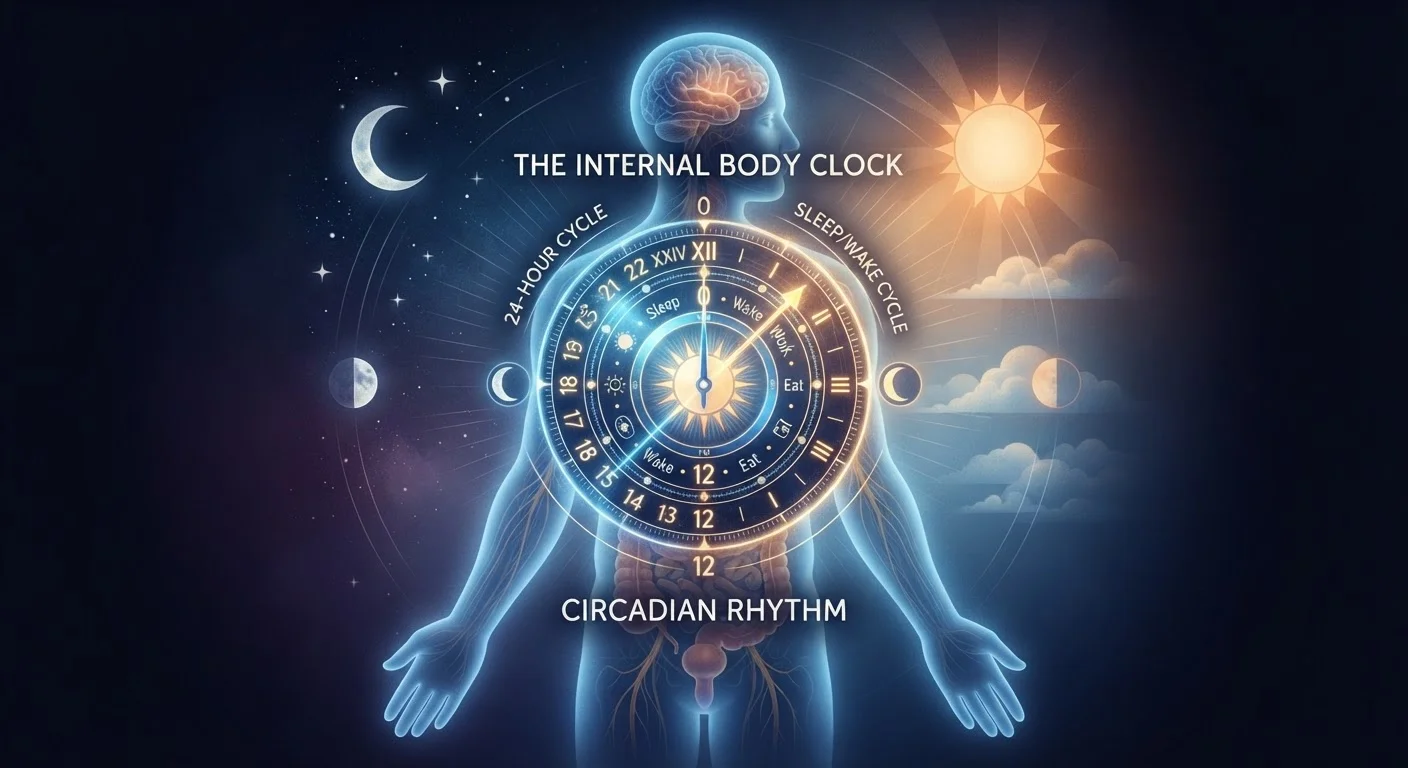
Every cell in the human body contains molecular machinery that runs on roughly a 24-hour cycle. This internal timekeeper — the circadian rhythm — is anchored primarily by light detected by the retina, which signals the brain's suprachiasmatic nucleus (SCN) to coordinate the release of hormones like melatonin and cortisol. When this system functions normally, it promotes alertness during the day and sleep at night.
Circadian rhythm disorders arise when the internal clock drifts out of sync with environmental time or with a person's required schedule. To understand how the clock goes wrong, it helps to first understand how it works. See our complete guide to how the circadian rhythm regulates sleep and wakefulness for the foundational science.
Disruption can stem from several sources: genetics that shift the natural sleep phase earlier or later, insufficient or mistimed light exposure, irregular schedules, or neurological changes associated with aging or blindness. The underlying biology is the same — the clock is ticking, but not in harmony with the outside world.
Chronotype vs. Disorder: An Important Distinction
Not every person who prefers late nights or early mornings has a circadian rhythm disorder. Chronotype — a natural tendency toward morning or evening preferences — exists on a spectrum and is largely genetically determined. A disorder is diagnosed only when the timing preference causes clinically significant distress or functional impairment. If your sleep timing works for your life, it may simply reflect your chronotype rather than a condition requiring treatment.
Recognized Subtypes and Their Patterns
The AASM recognizes several distinct circadian rhythm sleep-wake disorders, each with a characteristic misalignment pattern:
- Delayed Sleep-Wake Phase Disorder (DSWPD): The sleep period is shifted significantly later than conventional times — often 2 a.m. to noon. Affected individuals struggle to fall asleep at typical hours and feel deeply impaired if forced to wake early. It is most common in adolescents and young adults.
- Advanced Sleep-Wake Phase Disorder (ASWPD): The opposite pattern — sleep onset and waking occur unusually early (e.g., 6 p.m. to 2 a.m.). More prevalent in older adults, it has a strong genetic component involving the PER2 and CRY2 genes.
- Non-24-Hour Sleep-Wake Rhythm Disorder (N24): The internal clock free-runs on a cycle slightly longer or shorter than 24 hours, causing sleep timing to drift progressively later each day. It is most common in individuals who are totally blind and lack light input to reset the SCN.
- Irregular Sleep-Wake Rhythm Disorder: Sleep is fragmented into multiple short episodes across the 24-hour period with no clear consolidated nighttime sleep. Often associated with neurodegenerative conditions such as Alzheimer's disease.
- Shift Work Disorder: Chronic misalignment caused by work schedules that conflict with the natural sleep phase, producing insomnia when sleep is needed and excessive sleepiness during work hours.
- Jet Lag Disorder: A temporary misalignment after rapid travel across multiple time zones. The internal clock has not yet adjusted to the destination's light-dark cycle.
~0.15%
Prevalence of Delayed Sleep Phase Disorder in adults
Population estimates from sleep research suggest DSWPD affects approximately 0.13–0.17% of the general adult population, with higher rates among adolescents.
~20%
U.S. workers on shift or irregular schedules
According to the Bureau of Labor Statistics, roughly one in five American workers operates outside standard daytime hours, placing them at elevated risk for shift work disorder.
Up to 70%
Totally blind individuals with N24 disorder
Research published in sleep medicine literature indicates that the majority of totally blind people experience some form of circadian misalignment, with Non-24 being the most common presentation.
Recognizing Symptoms Beyond Sleepiness
Circadian rhythm disorders do more than make people tired at inconvenient times. Because the body clock coordinates metabolism, immune function, mood regulation, and cognition, misalignment produces a wide symptom constellation. Affected individuals may experience difficulty concentrating, mood disturbances, gastrointestinal problems, and reduced performance on cognitive tasks — symptoms that can be mistakenly attributed to other conditions.
Importantly, the severity of these symptoms depends heavily on how rigidly daily obligations conflict with the person's displaced clock. Someone with DSWPD who works from home on a flexible schedule may have minimal impairment; the same person required to start work at 7 a.m. may struggle severely. Our companion article on signals your body uses to flag sleep disorders covers how daytime symptoms can point toward an underlying sleep condition.
If these patterns sound familiar, consulting a healthcare provider is an important first step. Circadian rhythm disorders are diagnosable and treatable — and the broader science of sleep continues to expand our understanding of how best to intervene.
This article is for general informational and educational purposes only and does not constitute medical advice. If you are experiencing persistent sleep difficulties or related symptoms, please consult a qualified healthcare professional for personalized evaluation and guidance.