

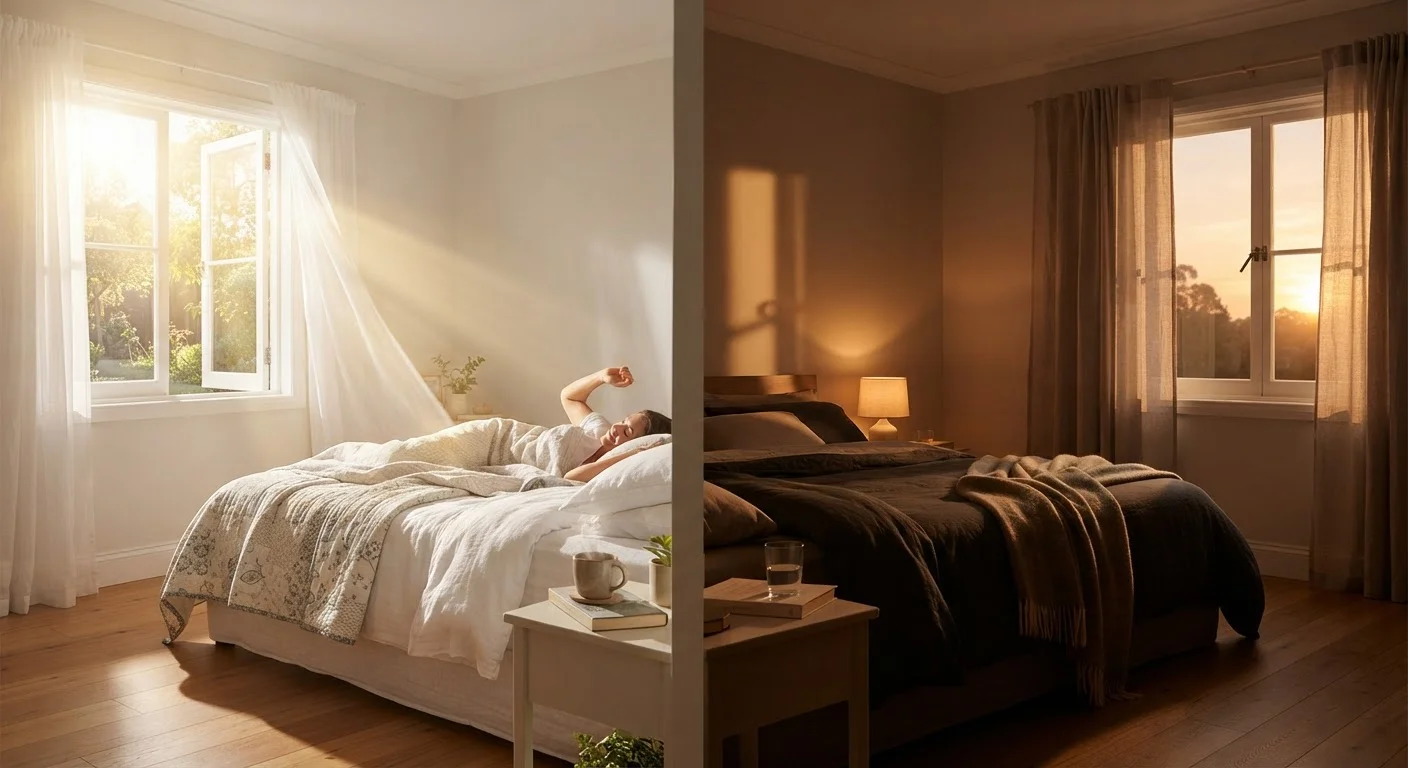
Key Takeaways
Option A
Morning Light
The biological wake-up call that anchors your internal clock.
Best for: People who want to fall asleep earlier, wake up more easily, or reset a drifting sleep schedule.
Option B
Evening Light
The sleep-suppressing signal that delays your body's wind-down process.
Best for: Understanding why late-night screen use, bright indoor lighting, or long summer evenings make it harder to fall asleep on time.
If you struggle to fall asleep at a consistent time each night
Morning Light
Getting bright light exposure within an hour of waking anchors your circadian clock, making your body's sleep drive arrive more reliably at the same time each evening.
If you want to understand why you feel wired at bedtime
Evening Light
Bright or blue-enriched evening light suppresses melatonin production, keeping your brain in an alert state well past a natural wind-down window.
If you work irregular or night shifts
Morning Light
Strategic morning light exposure is one of the primary tools sleep researchers study for helping shift workers partially realign their disrupted internal clocks.
If you want to protect your sleep without major lifestyle changes
Evening Light
Simply reducing exposure to bright, blue-spectrum light in the two hours before bed—by dimming lights or enabling screen night modes—requires minimal effort but can meaningfully ease sleep onset.
Why Light Is Your Brain's Primary Time Signal
Your body runs on a roughly 24-hour internal clock called the circadian rhythm. This clock governs not just sleep, but hormone release, core body temperature, digestion, and mood. Of all the environmental cues that keep this clock accurate, light is by far the most powerful.
Specialized cells in the retina called intrinsically photosensitive retinal ganglion cells (ipRGCs) detect light and send signals directly to the brain's master clock—the suprachiasmatic nucleus (SCN) in the hypothalamus. Crucially, this system is most sensitive to short-wavelength, blue-spectrum light, which is abundant in both natural sunlight and many modern LED screens and lighting sources.
The SCN uses these light signals to calibrate the release of melatonin, the hormone that signals nighttime to the body. Understanding how morning and evening light pull this system in opposite directions is the foundation of evidence-backed sleep hygiene. For a deeper look at the two biological systems governing sleep timing, see circadian rhythms vs. sleep pressure.
Morning Light: Anchoring the Clock and Building Sleep Drive
Bright light exposure in the morning—ideally within one to two hours of waking—delivers a strong alerting signal that sets the phase of the circadian clock. Research published in journals including Current Biology and supported by the American Academy of Sleep Medicine (AASM) consistently shows that morning light:
- Suppresses residual melatonin, accelerating the transition to full daytime alertness
- Advances the circadian phase, making the body's sleep-onset drive arrive earlier in the evening
- Improves mood and daytime cognitive performance in multiple controlled studies
Outdoor light is considerably more effective than indoor lighting—even on an overcast day, natural light typically delivers 1,000–10,000 lux, compared with 100–500 lux in a well-lit indoor room. Even 10–30 minutes of outdoor exposure appears sufficient to produce measurable circadian effects in healthy adults.
1,000–10,000 lux
Typical outdoor light intensity on a cloudy day
Research on circadian biology consistently shows natural outdoor light delivers far more illuminance than indoor environments, even under overcast skies.
~90 min
Average melatonin onset delay from evening light
Studies by Harvard's Division of Sleep Medicine found that exposure to room-level light before bedtime can suppress and delay melatonin onset by approximately 90 minutes.
1–2 hrs
Circadian clock shift from weekend light irregularity
Research published in Current Biology indicates that inconsistent light and sleep schedules across weekdays and weekends can shift internal clock timing by one to two hours.
This is especially relevant for people whose sleep timing has drifted later—a pattern known as delayed sleep phase. Morning light is one of the primary behavioral tools chronobiologists use to shift sleep timing earlier. For context on why timing matters beyond total sleep hours, see the science of sleep timing.
Evening Light: Delaying Melatonin and Disrupting Wind-Down
Where morning light anchors and advances the clock, bright light in the evening does the opposite—it delays the circadian phase and suppresses the natural rise of melatonin that ordinarily begins one to two hours before habitual sleep time.
Researchers Charles Czeisler and colleagues at Harvard Medical School have published extensively on how evening light exposure—including light from screens—can shift melatonin onset later and shorten melatonin duration, effectively tricking the brain into thinking sunset hasn't occurred yet.
| Criterion | Morning Light | Evening Light |
|---|---|---|
| Effect on melatonin | Suppresses residual melatonin; promotes alertness | Delays melatonin onset; prolongs alertness |
| Circadian phase effect | Advances sleep timing earlier | Pushes sleep timing later |
| Key wavelength of concern | Blue spectrum (beneficial in AM) | Blue spectrum (disruptive in PM) |
| Ideal light intensity | 1,000+ lux (outdoor exposure preferred) | Below 10 lux ideally; dim, warm-toned sources |
| Practical source | Sunlight, bright outdoor environments | Screens, LED overhead lighting |
| Effect on sleep onset | Promotes earlier, more consistent sleep onset | Delays sleep onset even when physically tired |
| Consistency impact | Anchors clock; reduces social jet lag | Irregular exposure worsens schedule drift |
The practical implication: brightly lit kitchens, living rooms, and devices in the two hours before bed can meaningfully delay sleep onset, even when a person feels subjectively tired. Blue-enriched sources—LED overhead lighting, smartphone and tablet screens—are the most potent suppressors. Warmer, dimmer lighting in the 2,700–3,000 Kelvin range produces a less pronounced melatonin-suppressing effect.
How you structure the end of your day matters enormously for sleep. Evening routines vs. morning routines explores how the hours before bed may deserve as much deliberate attention as any morning habit.
Putting It Into Practice: Simple Adjustments With Meaningful Impact
Balancing morning and evening light doesn't require expensive equipment or rigid schedules. The core evidence-backed principles are straightforward:
- Seek outdoor light in the morning. A short walk, coffee on the porch, or even sitting near a bright window within an hour of waking sends a strong anchoring signal to the SCN.
- Dim your environment after sunset. Switching to floor lamps, using warm-color bulbs, or enabling night mode on devices from two hours before bed reduces circadian phase delay.
- Be consistent. Irregular light exposure on weekends can shift the internal clock by one to two hours—sometimes called social jet lag—making Monday mornings harder for reasons beyond just lost sleep.
For those with shift work schedules—where light exposure is frequently misaligned with the clock—these adjustments become even more nuanced. What shift work does to the body's internal clock covers what sleep science suggests for that specific challenge.
Light Therapy Devices: A Note
Commercially available light therapy boxes (typically 10,000 lux) are sometimes used to complement morning light exposure, particularly in winter months or for people with limited outdoor access. Their use for sleep and mood concerns has evidence support, but appropriate timing, duration, and suitability vary by individual circumstance. Anyone considering a light therapy device for a specific sleep or mood condition should discuss it with a healthcare provider first.
This article is for general informational purposes only and is not a substitute for personalized medical advice. If you experience persistent difficulty sleeping, consult a qualified healthcare provider or a board-certified sleep medicine specialist.