

Key Takeaways
Option A
Visceral Fat
The deeper, metabolically active fat surrounding internal organs.
Best for: Understanding health risk factors related to fat stored inside the abdominal cavity.
Option B
Subcutaneous Fat
The familiar, surface-level fat found just beneath the skin.
Best for: Understanding the fat you can feel and pinch, which serves important protective and energy functions.
If you want to understand which fat type carries greater metabolic risk
Visceral Fat
Research consistently links elevated visceral fat to insulin resistance, inflammation, and cardiovascular risk factors - making it the more clinically significant of the two.
If you are exploring body composition measures with your healthcare provider
Visceral Fat
Visceral fat estimates from waist circumference or imaging provide clinically actionable information that standard weight or BMI measures may miss.
If you want to understand the fat you can physically see or feel
Subcutaneous Fat
Subcutaneous fat is the layer directly under your skin and is the type most visible to the eye or felt when pinching - it is normal and serves important physiological functions.
If you are focused on general healthy weight concepts without a specific clinical concern
Subcutaneous Fat
For most people without significant abdominal obesity, subcutaneous fat is the dominant body fat type and its presence at typical levels is not considered a health concern.
Where Each Type of Fat Lives
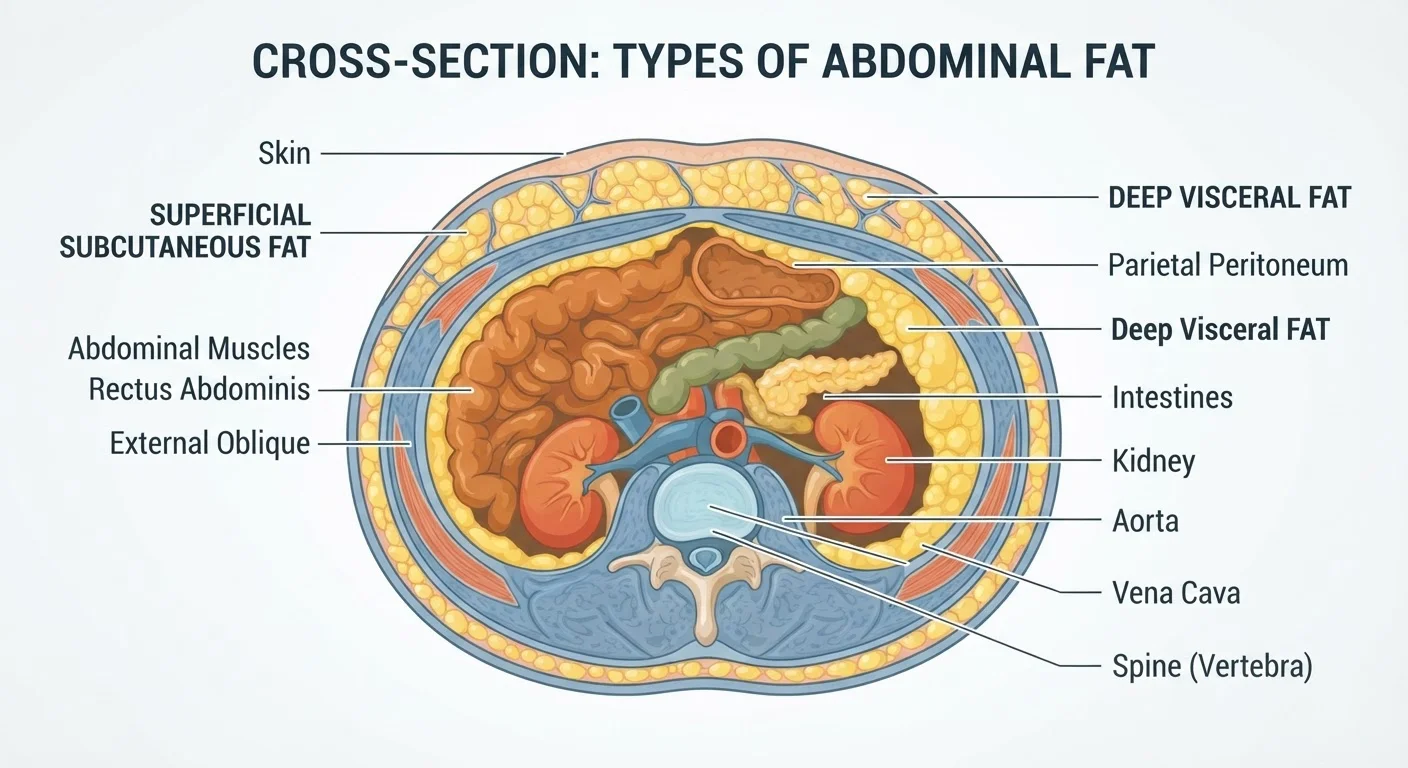
Body fat - technically called adipose tissue - is not uniform. It is organized into distinct compartments with different locations, structures, and biological roles.
Subcutaneous fat is stored in the layer of tissue directly beneath the skin. You can find it across the body: on the abdomen, thighs, hips, upper arms, and buttocks. It is the fat you can pinch between your fingers. Most of the body's total fat mass is subcutaneous, and it serves genuine physiological purposes - storing energy, insulating the body against temperature changes, and cushioning underlying structures.
Visceral fat, by contrast, lies deep inside the abdominal cavity, wrapping around organs including the liver, pancreas, and intestines. It is not visible from the outside and cannot be felt on the surface. Because of where it sits, visceral fat is sometimes described as "intra-abdominal fat." A person can carry a meaningful amount of visceral fat while having a normal body weight - a pattern researchers sometimes call "metabolically obese, normal weight."
Understanding this distinction matters because location influences function. For a broader look at how body composition is measured, see BMI, body fat percentage, and waist circumference.
How They Differ Metabolically
The most important differences between visceral and subcutaneous fat are metabolic - that is, how each type behaves chemically and how it interacts with the body's systems.
| Criterion | Visceral Fat | Subcutaneous Fat |
|---|---|---|
| Location | Deep in abdominal cavity, around organs | Beneath the skin across the body |
| Visibility | Not visible or palpable externally | Visible and can be pinched |
| Metabolic activity | High; releases cytokines and fatty acids readily | Lower; slower fatty acid release |
| Link to metabolic risk | More strongly associated with insulin resistance and cardiovascular markers | Less strongly linked at typical levels |
| Practical measurement | Estimated via waist circumference or imaging | Measured via skinfold calipers or body fat percentage tools |
| Proportion of body fat | Minority of total fat mass in most people | Majority of total body fat mass |
Visceral fat is considerably more metabolically active than subcutaneous fat. Its cells release higher levels of inflammatory proteins called cytokines and free fatty acids directly into the portal vein, the blood vessel that drains into the liver. This proximity to the liver means visceral fat can interfere with insulin signaling and lipid processing more directly than fat stored elsewhere. Research has associated excess visceral fat with elevated risks of insulin resistance, type 2 diabetes, dyslipidemia (abnormal blood lipid levels), and cardiovascular disease - though association does not establish personal destiny, and many factors influence individual risk.
Subcutaneous fat releases fatty acids more slowly and into general circulation rather than directly to the liver. Some research even suggests that subcutaneous fat in the lower body may have a degree of metabolically protective effect, though this remains an active area of study and should not be oversimplified.
It is also worth noting that body fat - including both types - is not simply stored energy awaiting removal. Fat tissue participates in hormone production, immune signaling, and other functions. For context on the role dietary fat plays in the body's systems, see what dietary fat is and why the body needs it.
Assessing Visceral Fat Without a Scanner
Precisely measuring visceral fat requires imaging technologies - such as CT or MRI scans - that are not routinely available in clinical settings. In practice, waist circumference is the most widely used proxy. Because visceral fat accumulates within the abdomen, a larger waist circumference tends to correlate with greater visceral fat volume, even when overall body weight appears typical.
Waist Circumference Is a Proxy, Not a Diagnosis
Waist circumference thresholds used in clinical guidelines are population-level reference points, not individual diagnostic cutoffs. A measurement above a threshold signals a pattern worth discussing with a healthcare provider - it does not confirm a specific condition or predict a specific outcome. Factors such as height, body frame, and ethnicity can influence how waist circumference relates to visceral fat for any given person.
Healthcare providers also consider waist-to-hip ratio and waist-to-height ratio alongside waist circumference when assessing abdominal adiposity. Each measure has its own strengths and limitations, and no single number tells a complete story about health. The comparison of body composition measures explores these tools in more detail.
Subcutaneous fat, meanwhile, contributes to overall body fat percentage measurements taken via methods such as skinfold calipers or bioelectrical impedance - though these methods also have inherent imprecision. Separating subcutaneous from visceral contribution using standard consumer tools is not reliably possible.
This article is for general informational purposes only and does not constitute medical advice. Speak with a qualified healthcare professional about your individual health status, measurements, or any concerns about body composition.
What Influences Each Fat Type
Both types of fat respond to lifestyle factors, though visceral fat appears more sensitive to certain changes. Research suggests that regular physical activity - particularly aerobic exercise - is associated with reductions in visceral fat even when total body weight changes little. Sleep quality and duration also appear connected to visceral fat accumulation; chronically short sleep is linked to higher intra-abdominal fat in several observational studies.
Dietary patterns, stress hormones (particularly cortisol), age, sex, and genetic predisposition all contribute to where and how much fat the body stores. After menopause, for example, many people experience a shift toward greater abdominal fat deposition, which research attributes partly to changes in estrogen levels. These influences are interconnected, and isolating any single cause is rarely straightforward.
Importantly, efforts to reduce visceral fat are not about eliminating body fat altogether - the body needs fat to function. The goal, from a health perspective, is supporting conditions where disproportionate visceral accumulation is less likely. For a grounded understanding of what fat loss actually involves physiologically, the difference between losing fat and losing weight is a useful companion read.