

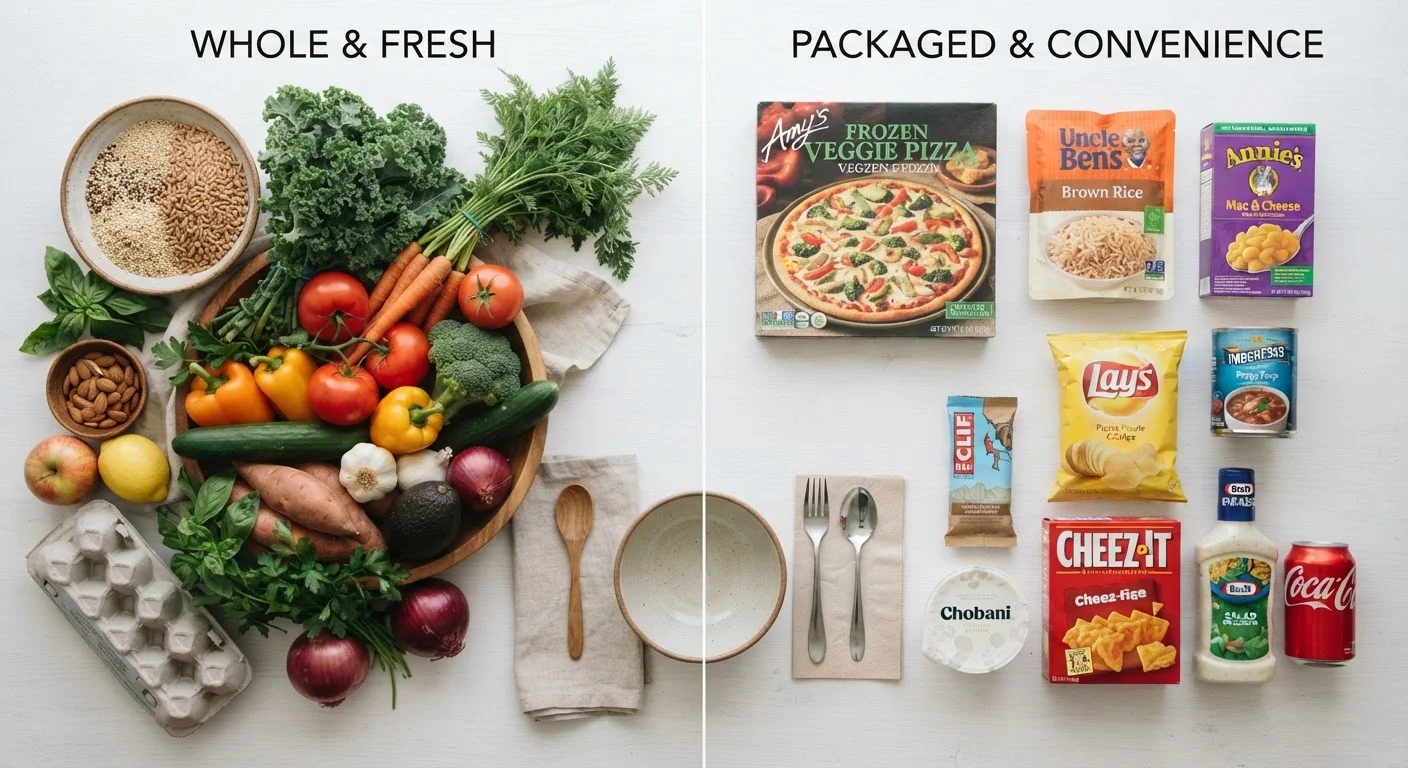
Key Takeaways
Option A
Whole Foods
The minimally altered, nutrient-dense foundation of a healthy diet.
Best for: People aiming to maximize nutrient density and minimize additives in their everyday eating.
Option B
Processed Foods
A broad, often misunderstood category ranging from minimally altered to heavily engineered.
Best for: Busy individuals seeking convenience, though quality varies enormously across the category.
If you want to maximize nutrient density in your daily meals
Whole Foods
Whole foods consistently deliver fiber, micronutrients, and beneficial plant compounds with minimal dilution from additives or refining.
If convenience and time constraints are a real factor in your life
Processed Foods
Minimally processed options like frozen vegetables, canned fish, or plain yogurt offer solid nutrition without requiring extensive preparation time.
If you're trying to reduce added sugar and sodium intake
Whole Foods
Whole foods contain naturally occurring sugars and minerals rather than the high levels of added salt and sugar common in ultra-processed products.
If you're building sustainable long-term eating habits
Whole Foods
Centering meals around whole foods while allowing room for minimally processed options tends to be more realistic and less restrictive than avoiding all packaged items.
The 'Processed' Label Is Doing a Lot of Heavy Lifting
When people hear 'processed food,' they often picture chips, frozen meals, or candy. But the term covers far more ground than that. By a strict definition, almost every food that has been washed, cut, cooked, fermented, or packaged qualifies as processed in some way. Pasteurized milk, bagged spinach, rolled oats, and canned tomatoes all involve some form of processing.
The more useful distinction comes from the NOVA classification system, developed by nutrition researchers, which groups foods into four categories based on the extent and purpose of industrial processing. At one end sit minimally processed foods — think frozen peas or plain roasted nuts. At the other end are ultra-processed foods (UPFs), which are formulated from industrial ingredients and additives largely absent from home kitchens: emulsifiers, artificial flavors, modified starches, and color agents.
Understanding this spectrum matters because the health research doesn't paint all processed foods with the same brush. It's UPFs specifically — not canned chickpeas or plain yogurt — that are most consistently associated with increased risks for chronic conditions in observational studies. Reading a nutrition label carefully can help you spot indicators like added sugar and sodium, but it won't reveal the full degree of industrial processing applied.
Head-to-Head: How They Actually Compare
Comparing whole foods and processed foods in practical terms reveals consistent patterns, though the picture is more nuanced than simple 'good vs. bad' framing.
| Criterion | Whole Foods | Processed Foods |
|---|---|---|
| Fiber content | Generally high; intact from plant structure | Often reduced or removed during refining |
| Added sugars | None (naturally occurring only) | Frequently added; varies widely by product |
| Sodium levels | Naturally low | Often elevated, especially in UPFs |
| Micronutrient density | High; vitamins and minerals largely intact | Variable; may be fortified or depleted |
| Ingredient simplicity | Single or very few ingredients | Can include dozens of additives in UPFs |
| Preparation time | Often requires more cooking or prep | Typically quicker and more convenient |
| Shelf stability | Generally shorter shelf life | Longer; preserved by various methods |
| Cost accessibility | Varies; staples like legumes are affordable | Often low cost, though quality varies |
These differences are real, but they aren't absolute. A minimally processed food like plain canned salmon is nutritionally excellent. A 'whole' food prepared by frying in excess saturated fat shifts the nutritional equation. The processing method and the ingredient list together tell a more complete story than either factor alone.
What Labels Reveal — and What They Hide
Nutrition Facts panels are required to disclose macronutrients, sodium, added sugars, and select vitamins and minerals. That's genuinely useful information. But labels don't tell you how many steps of industrial processing a product underwent, which additives may affect appetite regulation, or how much the food's original matrix — the physical structure that influences how nutrients are absorbed — has been disrupted.
Research suggests that food matrix matters. Eating almonds whole, for example, delivers fewer absorbable calories than consuming equivalent almond flour, partly because intact cell walls slow digestion. Ultra-processing often dismantles this natural structure, which may affect satiety cues differently than eating the same nutrient amounts from whole sources.
A practical habit: scan the ingredients list alongside the Nutrition Facts panel. Shorter lists with recognizable ingredients generally signal less processing. Ingredients like 'modified food starch,' 'maltodextrin,' or lengthy emulsifier lists are markers of higher-level processing that macronutrient numbers alone won't flag.
Building a Realistic Approach That Actually Sticks
Framing food choices as a binary — whole foods good, processed foods bad — sets up an unnecessarily restrictive and often unsustainable standard. A more durable approach focuses on the degree of processing rather than a strict on/off rule.
Practical strategies include anchoring meals around minimally processed whole foods (vegetables, legumes, whole grains, eggs, plain dairy, unprocessed meats) while treating ultra-processed items as occasional rather than everyday choices. Convenience-focused minimally processed foods — frozen vegetables, canned beans, plain Greek yogurt — can be genuine allies for people with limited time or food budgets. Balancing protein sources from both whole and minimally processed foods is one example of this flexible, realistic approach in action.
Sustainable eating habits rarely emerge from elimination — they come from gradual, informed shifts. Choosing whole or minimally processed options most of the time, without demanding perfection, tends to deliver better long-term outcomes than cycling between strict rules and backlash eating.
This article is for general informational and educational purposes only and is not a substitute for professional medical or dietary advice. Consult a qualified healthcare provider or registered dietitian for guidance tailored to your individual health needs.