

Key Takeaways
REM Sleep
REM (Rapid Eye Movement) sleep is a distinct stage of the sleep cycle characterized by fast, random eye movements beneath closed eyelids, vivid dreaming, and high levels of brain activity that closely resemble an awake state. Despite this neural activity, the major voluntary muscles of the body become temporarily paralyzed — a state called atonia. REM sleep typically first appears about 90 minutes after you fall asleep and recurs in progressively longer periods throughout the night.
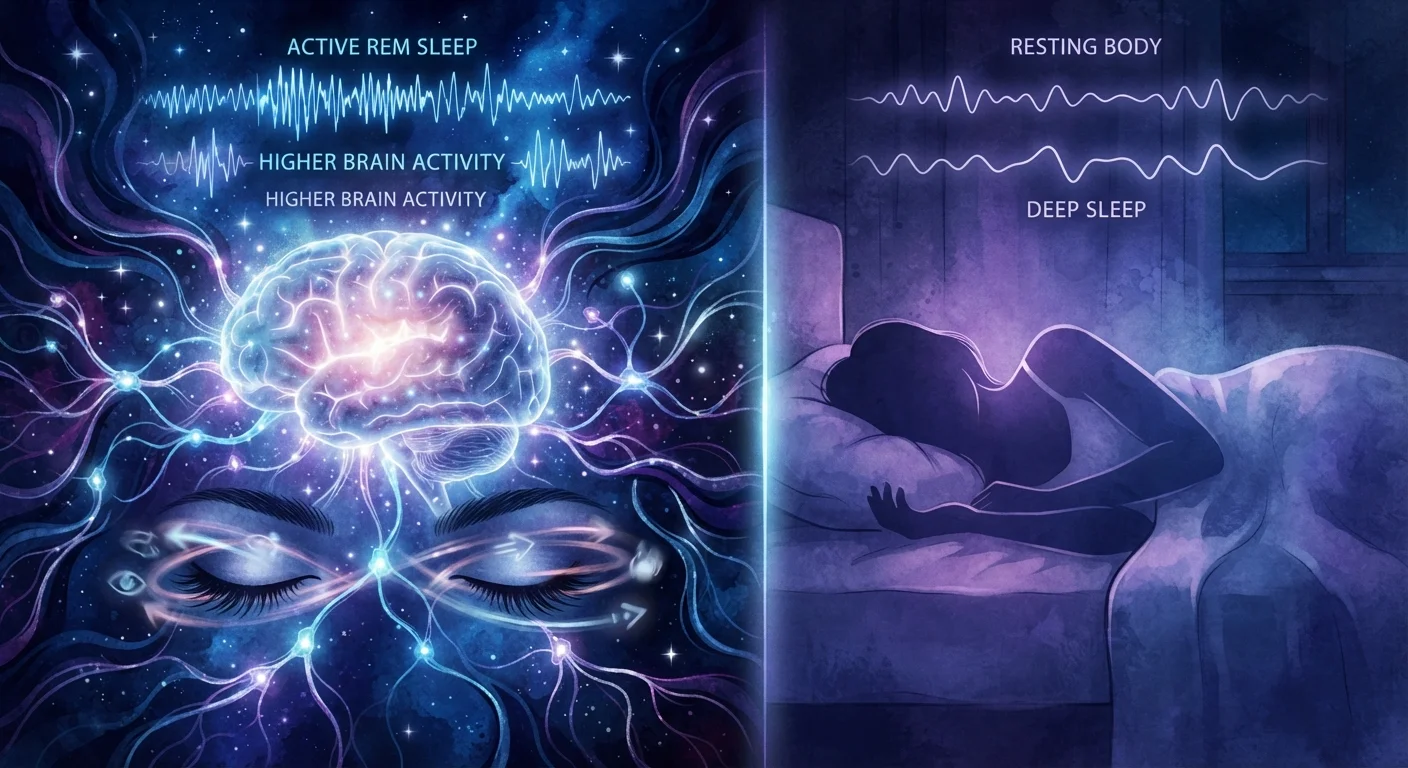
On an electroencephalogram (EEG), REM sleep produces low-amplitude, high-frequency mixed-frequency waves similar to waking brain activity, sharply contrasting with the slow, high-amplitude delta waves seen in deep (N3) sleep.
What Makes REM Sleep So Unusual
Of the four stages in a typical sleep cycle, REM stands apart for a striking paradox: your brain behaves as though you're wide awake, while your body is effectively immobilized. This combination puzzled researchers when it was first formally described by Nathaniel Kleitman and Eugene Aserinsky at the University of Chicago in 1953, and it continues to be one of the most actively studied phenomena in sleep science.
To understand REM in context, it helps to know where it fits into the broader architecture of a night's sleep. Each 90-minute cycle moves through lighter non-REM stages, a period of deep slow-wave sleep, and then into REM. See how all these phases connect in our explainer on the architecture of a night's sleep.
On an EEG, REM brain waves look strikingly similar to those recorded during relaxed wakefulness — a sharp contrast to the slow, synchronized delta waves of deep sleep. Meanwhile, muscle tone across the body's major voluntary muscles drops to near zero, a state researchers call atonia. The eyes, however, dart rapidly beneath the eyelids — giving the stage its name.
Why Your Brain Is So Active — and What It's Doing
The high neural activity of REM is not random noise. Research points to several critical functions being carried out during this stage.
Memory Consolidation and Emotional Processing
REM sleep appears to play a central role in consolidating emotional and procedural memories — helping the brain integrate new experiences and regulate emotional responses. Studies using targeted sleep deprivation have found that people deprived of REM show impaired recall of emotionally charged material and reduced ability to accurately "read" social cues the following day.
Creative Problem-Solving
There is growing evidence that the unusual pattern of brain activation during REM — with strong limbic (emotional) activity but reduced activity in the prefrontal cortex — may foster unconventional, associative thinking. Some researchers hypothesize this is why sleep is commonly linked to creative insights.
Neural Pruning and Synaptic Maintenance
REM may also contribute to refining neural connections — strengthening important pathways while clearing out less-used ones. This is a complementary process to what occurs during deep sleep, which focuses more on physical restoration. For a side-by-side look at these distinct roles, our article on deep sleep vs. REM sleep breaks down the biology in detail.
20–25%
Share of total sleep spent in REM
According to the American Academy of Sleep Medicine, healthy adults typically spend about one-fifth to one-quarter of their nightly sleep in REM stages.
90 min
Time until first REM period begins
REM sleep first emerges approximately 90 minutes after sleep onset in a typical adult sleep cycle.
~50%
Infant sleep time spent in REM
Newborns and young infants spend roughly half their sleep time in REM, suggesting a key role in early brain development.
The Protective Purpose of Muscle Paralysis
Atonia during REM is not a malfunction — it is a carefully regulated protective mechanism. Without it, the body would physically act out the contents of dreams. Signals from a brainstem region called the subcoeruleus nucleus actively suppress motor neurons, preventing movement even as the motor cortex generates movement commands.
When this system breaks down, the result is REM sleep behavior disorder (RBD) — a condition in which individuals physically enact their dreams, sometimes violently. RBD is a recognized medical condition associated with certain neurological risks and requires professional evaluation. It is one of several disorders that can be identified through a formal sleep study; for more on what those measurements reveal, see our guide to reading a sleep study.
On the milder end, the overlap between atonia and waking consciousness explains sleep paralysis — a brief, typically harmless experience of being unable to move while falling asleep or waking up. While alarming in the moment, isolated episodes are common and not usually a sign of an underlying disorder.
How REM Fits Into Your Night — and What Disrupts It
REM sleep is not evenly distributed across the night. The first REM period, usually around 90 minutes after sleep onset, may last only 10–15 minutes. As the night continues, each successive REM period lengthens — which is why the final two hours of an eight-hour sleep window are especially REM-dense. Cutting sleep short consistently deprives the brain of its most REM-rich portion.
Several common factors are known to suppress or fragment REM sleep:
- Alcohol: Even moderate amounts consumed close to bedtime reliably reduce REM in the first sleep cycle.
- Some medications: Certain antidepressants and sedatives alter sleep architecture, including REM proportion. Never adjust medication without consulting a healthcare provider.
- Irregular sleep schedules: Shifting sleep timing disrupts the circadian alignment that supports healthy REM cycling.
- Sleep disorders: Conditions such as obstructive sleep apnea can fragment REM, as the brief arousals caused by breathing interruptions preferentially disrupt this lighter stage. Learn more in our overview of common sleep disorders.
Protect Your Late-Night REM
Because REM periods grow longer toward morning, even trimming 60–90 minutes from your usual sleep time can cut your total REM significantly. Prioritizing a consistent, full-length sleep window — rather than sleeping in on weekends to compensate — is one of the most evidence-supported ways to maintain healthy REM proportion. If you suspect a sleep disorder is disrupting your sleep stages, speak with a healthcare provider.
This article provides general health information and education only, and is not a substitute for professional medical advice. If you have concerns about your sleep health, please consult a qualified healthcare provider.