

Key Takeaways
Option A
Deep Sleep (Slow-Wave Sleep)
The body's primary restoration and repair phase.
Best for: Physical recovery, immune support, and consolidating declarative memories like facts and events.
Option B
REM Sleep
The brain's creative and emotional processing workshop.
Best for: Emotional regulation, procedural memory consolidation, and complex cognitive integration.
If you're focused on physical recovery and immune health
Deep Sleep (Slow-Wave Sleep)
Deep sleep is when growth hormone is released and tissue repair is most active, making it the dominant stage for physical restoration.
If you're concerned about emotional wellbeing and memory for skills
REM Sleep
REM sleep plays a central role in processing emotional experiences and consolidating procedural memories like motor skills and creative problem-solving.
If you want overall cognitive sharpness and resilience
Deep Sleep (Slow-Wave Sleep)
Research associates slow-wave sleep with clearing metabolic waste from the brain via the glymphatic system, which may support long-term cognitive health.
If you experience vivid dreaming or are curious about it
REM Sleep
The majority of vivid, narrative dreaming occurs during REM sleep, when the brain is highly active and emotionally engaged.
What Makes These Two Stages Biologically Distinct
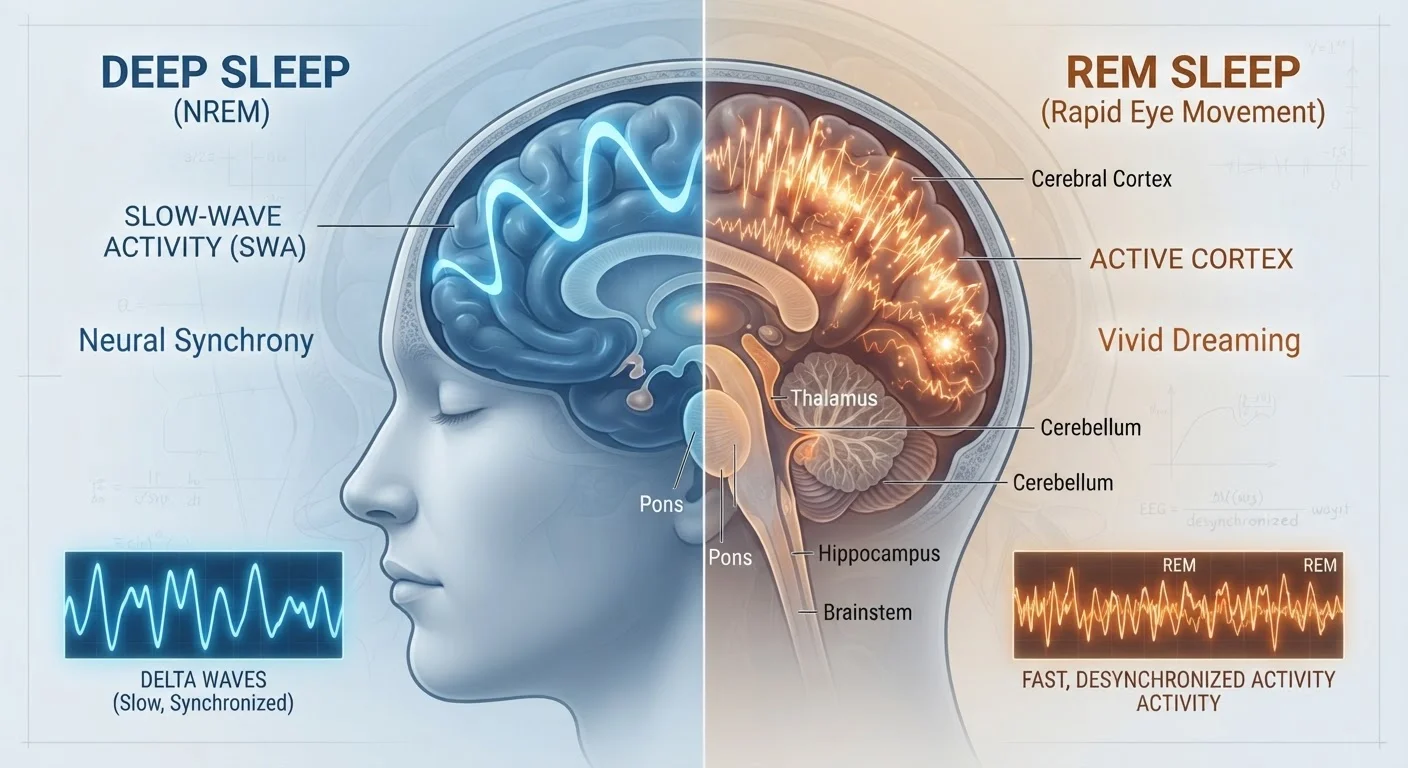
Every night, your brain cycles through several stages of sleep, but two of them stand apart in both their biology and their purpose: deep sleep — formally called slow-wave sleep (SWS) or N3 — and REM sleep. Understanding the differences between them helps explain why a full night of sleep does so much more than simply rest the body. For a broader look at how these stages fit into the overall architecture of a night's rest, see how sleep cycles are structured.
Deep sleep is defined by the presence of large, slow delta waves (0.5–4 Hz) visible on an electroencephalogram (EEG). During this stage, heart rate and breathing slow to their lowest points, body temperature drops, and the brain becomes largely unresponsive to external stimuli — making it the hardest stage to wake someone from.
REM sleep, by contrast, looks almost paradoxical on an EEG: brain wave patterns resemble those of wakefulness, fast and desynchronized. Yet the body enforces a state called atonia — a temporary muscle paralysis — preventing the sleeper from acting out the vivid activity happening in the brain. The eyes dart rapidly beneath closed lids, giving the stage its name.
| Criterion | Deep Sleep (N3) | REM Sleep |
|---|---|---|
| Brain wave pattern | Slow, high-amplitude delta waves | Fast, desynchronized (wake-like) |
| Eye movement | Minimal or none | Rapid, darting movements |
| Muscle tone | Relaxed but responsive | Actively paralyzed (atonia) |
| Dreaming | Rare; non-narrative if present | Vivid, narrative dreams common |
| Primary memory role | Declarative (facts, events) | Procedural and emotional memories |
| Physical restoration | High — growth hormone released | Lower physical restoration role |
| When it peaks | First half of the night | Final hours before waking |
| Arousal threshold | Very difficult to wake | Easier to wake |
Different Jobs: What Each Stage Actually Does
The biological functions of deep sleep and REM sleep are complementary but distinct, and science has grown increasingly precise about what each one contributes.
Deep Sleep: Restoration and Declarative Memory
During slow-wave sleep, the pituitary gland releases the majority of its nightly pulse of growth hormone, which supports cellular repair, muscle maintenance, and metabolic regulation. The immune system also ramps up production of certain cytokines — signaling proteins important for fighting infection and inflammation. Research published in journals such as Nature Neuroscience has highlighted that deep sleep also activates the brain's glymphatic system, a network of fluid-filled channels that clears metabolic waste products — including proteins associated with neurodegenerative disease — from brain tissue.
For memory, deep sleep is especially important for declarative memory: the kind that stores facts, events, and general knowledge. During this stage, memories formed during the day are replayed and transferred from the hippocampus to the cortex for longer-term storage.
REM Sleep: Emotional Processing and Procedural Memory
REM sleep appears to serve a fundamentally different cognitive role. It is when the brain integrates new information with existing knowledge, strengthening procedural memories — such as how to play an instrument or perform a physical skill. It is also understood to be critical for emotional memory processing: REM sleep may help strip the emotional intensity from difficult experiences while preserving the informational content, a function linked to mood regulation.
To explore the neuroscience of this stage in greater depth, see how REM sleep's unusual biology works.
Timing, Distribution, and What Can Disrupt Each Stage
The two stages are not evenly distributed across the night. Deep sleep is heavily front-loaded: most of your slow-wave sleep occurs in the first two or three 90-minute sleep cycles. REM sleep, on the other hand, becomes progressively longer with each cycle, with the most extended REM periods occurring in the final hours before waking. This is one reason that cutting sleep short — say, setting an alarm two hours early — disproportionately reduces REM sleep.
~13–23%
Of total sleep time spent in deep sleep
According to sleep stage research, healthy adults typically spend roughly 13–23% of a night's sleep in slow-wave sleep, with amounts declining with age.
~20–25%
Of total sleep time spent in REM sleep
Healthy adults generally spend approximately 20–25% of their total sleep time in REM sleep, as reported by the American Academy of Sleep Medicine.
Up to 50%
REM reduction from moderate alcohol use
Studies indicate that even moderate alcohol consumption before bed can reduce REM sleep in the first half of the night by up to 50%, disrupting emotional and memory processing.
Several common factors can suppress one or both stages. Alcohol is a well-documented example: while it may help people fall asleep faster, it significantly suppresses REM sleep during the first half of the night. Certain medications — including some antidepressants and sleep aids — also alter stage distribution. Age plays a major role as well; slow-wave sleep declines substantially across adulthood. Learn how sleep architecture shifts across a lifetime for context on these age-related changes.
Sleep disorders can also fragment or eliminate specific stages. Obstructive sleep apnea, for example, frequently disrupts the transitions into deep sleep, while certain medications and disorders affect REM specifically. If you suspect your sleep stages are being compromised, understanding common sleep disorders is a useful starting point before consulting a healthcare provider.
Practically speaking, protecting both stages means prioritizing consistent sleep duration and timing. Evidence-based sleep habits — such as maintaining a regular schedule, limiting alcohol near bedtime, and keeping the sleep environment cool and dark — support the natural progression through both deep and REM stages.
This article is for general informational and educational purposes only and is not a substitute for professional medical advice, diagnosis, or treatment. If you have concerns about your sleep health, please consult a qualified healthcare provider.