

Key Takeaways
Sleep Cycle
A sleep cycle is a repeating sequence of distinct brain and body states that occur throughout a night's sleep. Each cycle lasts roughly 90 minutes and includes both non-REM and REM (rapid eye movement) stages. Most adults complete four to six cycles per night, with each stage serving specific restorative functions for the brain and body.
Sleep architecture is typically visualized using a hypnogram — a graph generated from polysomnography data that plots sleep stage transitions across the night. For more on this terminology, see Key Terms in Sleep Science.
The Four Stages of Sleep
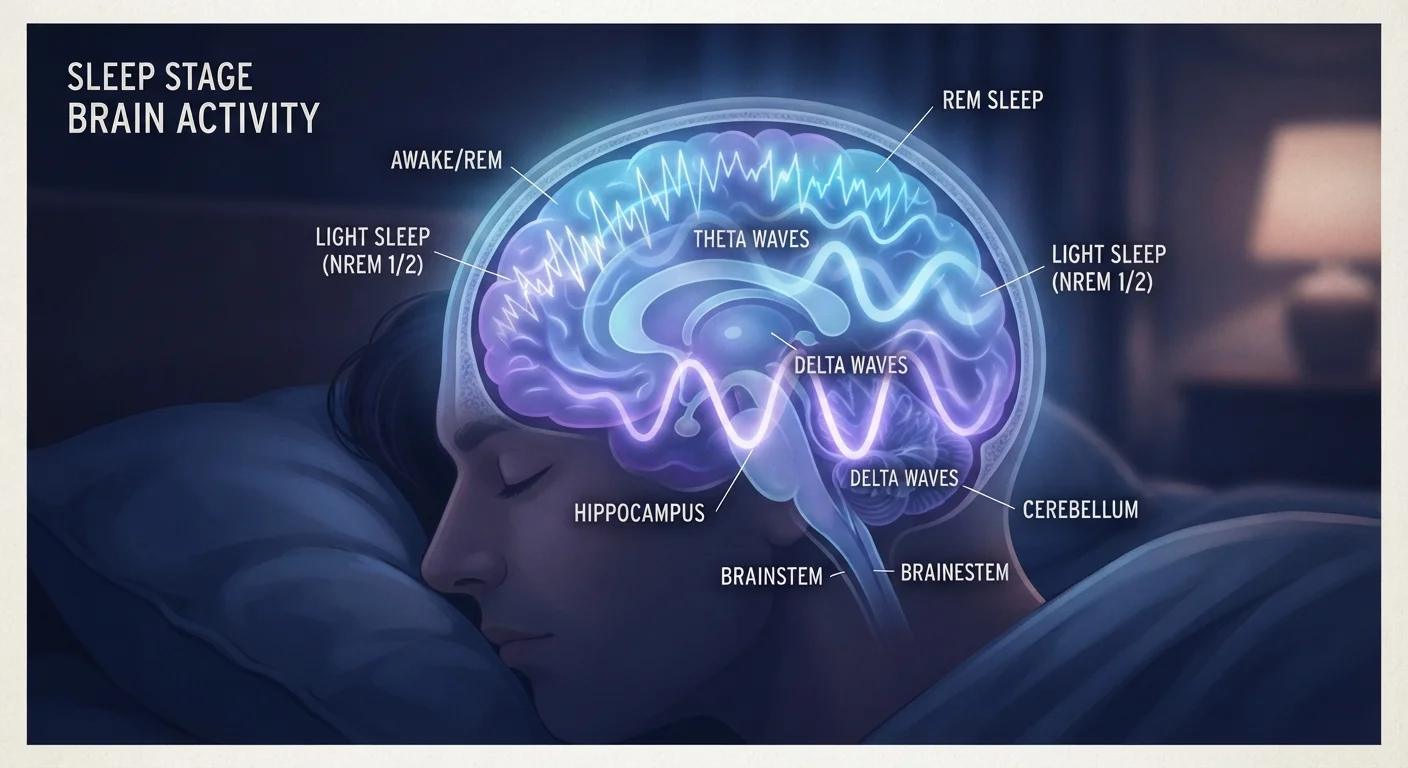
Sleep isn't a single passive state — it's a highly organized biological process divided into four distinct stages, each characterized by unique brain wave patterns, physiological changes, and functional roles. These stages fall into two broad categories: non-REM (NREM) sleep, which includes stages N1, N2, and N3, and REM sleep.
N1: Light Sleep Onset
N1 is the brief transition between wakefulness and sleep, typically lasting one to seven minutes. Brain activity begins to slow, muscles may twitch, and it's easy to wake someone in this stage. It accounts for only a small fraction of total sleep time.
N2: Stable Light Sleep
N2 is where most adults spend the largest portion of their night — roughly 45–55% of total sleep. Body temperature drops, heart rate slows, and the brain produces two distinctive patterns: sleep spindles (rapid bursts of neural activity) and K-complexes (large, slow waves). Both are thought to play roles in memory consolidation and protecting sleep continuity.
N3: Deep Slow-Wave Sleep
N3, also called slow-wave sleep or deep sleep, is the most physically restorative stage. The brain generates slow, high-amplitude delta waves. Growth hormone is released, tissues repair, the immune system is reinforced, and the brain clears metabolic waste products via the glymphatic system. This stage is hardest to wake from and is where sleepwalking and night terrors, when they occur, typically arise.
REM: Rapid Eye Movement Sleep
REM sleep is characterized by near-waking brain activity, rapid eye movements, vivid dreaming, and temporary muscle atonia (paralysis) that prevents physical acting-out of dreams. It plays a central role in emotional regulation, creative thinking, and declarative memory consolidation.
For a deeper look at how these concepts connect to broader sleep science vocabulary, see our sleep terms quick-reference.
How Cycles Change Across the Night
A critical insight from sleep research is that sleep cycles are not identical repetitions. Their composition shifts meaningfully from the first cycle to the last.
~90 min
Average length of one sleep cycle
According to the American Academy of Sleep Medicine, a typical adult sleep cycle lasts approximately 90 minutes, though individual cycles can range from 70 to 120 minutes.
20–25%
Proportion of total sleep spent in REM
Healthy adults typically spend roughly 20–25% of their total sleep time in REM, with this proportion increasing in cycles closer to morning waking.
13–23%
Proportion of sleep in deep (N3) slow-wave stage
Deep sleep makes up roughly 13–23% of total sleep time in healthy young adults, with this proportion declining with age, per published sleep research.
Early in the night, cycles are dominated by N3 deep sleep. The first one or two cycles contain the longest and most intense periods of slow-wave sleep — which is why the first few hours of sleep are often considered the most physically restorative.
Later in the night, N3 shortens considerably and REM sleep expands. By the final cycle before waking, a period of REM sleep may last 30 to 60 minutes. This is why disruptions in the early morning hours — such as an alarm cutting sleep short — disproportionately rob the brain of REM sleep, affecting mood and cognitive sharpness the following day.
This shifting architecture also explains why sleeping seven to nine hours isn't just about quantity. Cutting sleep by even 90 minutes consistently truncates the later, REM-rich cycles. Understanding this gradient helps contextualize why both sleep duration and uninterrupted sleep quality matter for overall health, as explored in resources on supporting restorative sleep habits.
Why Each Stage Matters for Health
Each sleep stage contributes differently to physical and mental wellbeing. Viewing them as a team — rather than ranking them — reflects how sleep science understands their complementary roles.
- N2 (light sleep): Sleep spindles during N2 are associated with procedural and motor learning. Athletes and musicians, for example, consolidate physical skill during this stage.
- N3 (deep sleep): Essential for tissue repair, immune response, metabolic regulation, and the clearance of neurotoxic waste from the brain — a process linked in ongoing research to long-term brain health.
- REM sleep: Supports emotional memory processing, creative problem-solving, and the integration of new information. Research from institutions including the National Institutes of Health points to REM as central to psychological resilience.
Disruptions to any stage — whether from sleep apnea fragmenting deep sleep, alcohol suppressing REM, or chronic short sleep — carry downstream health implications. If you're experiencing persistent poor sleep, a conversation with a healthcare provider is always the appropriate first step. For context on how lifestyle behaviors interact with sleep structure, see what sleep science says about nightly habits.
Understanding sleep architecture also provides a useful frame for evaluating sleep disorders. Conditions such as insomnia, sleep apnea, and narcolepsy often disrupt specific stages in characteristic ways — a topic explored further in our overview of common sleep disorders.
This article is for general informational and educational purposes only and is not a substitute for professional medical advice, diagnosis, or treatment. Always consult a qualified healthcare provider with questions about your sleep health or any medical condition.