

Key Takeaways
Polysomnography (PSG)
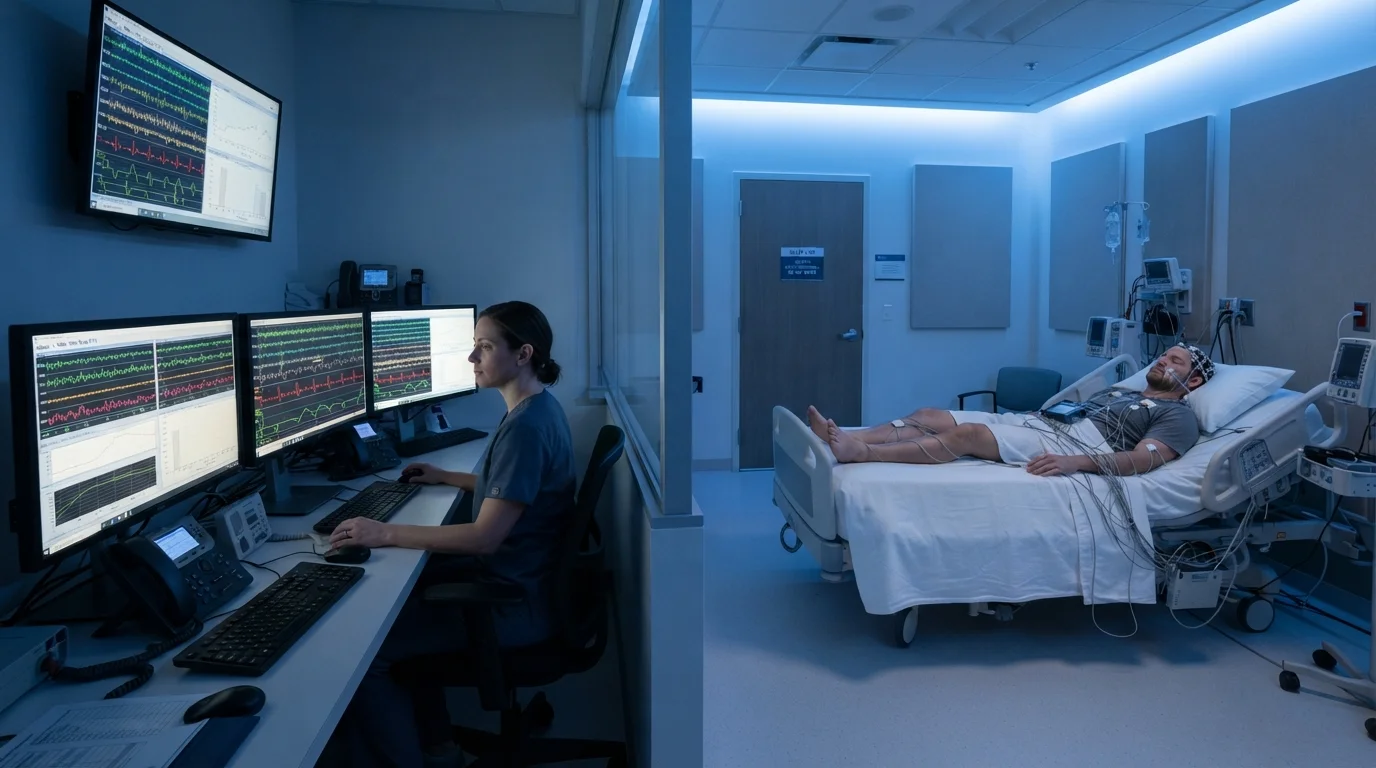
Polysomnography is a comprehensive sleep study conducted in a clinical sleep laboratory that records multiple body functions simultaneously while you sleep. Sensors placed on your scalp, face, chest, and legs capture brainwaves, eye movements, muscle activity, breathing patterns, heart rhythm, and blood oxygen levels throughout the night. The resulting data gives sleep specialists a detailed picture of your sleep architecture and any disruptions that occur.
PSG is considered the gold standard diagnostic tool for sleep disorders such as obstructive sleep apnea, narcolepsy, and REM sleep behavior disorder, as defined by the American Academy of Sleep Medicine (AASM).
Why Monitoring Multiple Signals at Once Matters
Sleep is not a single uniform state — it is a dynamic sequence of stages that cycle through the night, each with distinct physiological signatures. No single sensor can capture that complexity. Polysomnography solves this by recording simultaneously from many biological systems, allowing clinicians to see how breathing, brain activity, and body movement interact in real time.
Understanding what each channel measures helps you make sense of a report that can otherwise look like an intimidating wall of acronyms. For a broader foundation, see our sleep science vocabulary guide before diving into the specifics below.
The Core Channels: What Each Sensor Tracks
A full PSG typically includes the following measurement channels:
- EEG (Electroencephalogram): Electrodes placed on the scalp record the electrical activity of the brain. Different sleep stages produce characteristic wave patterns — slow, high-amplitude delta waves dominate deep sleep, while REM sleep produces low-amplitude, mixed-frequency waves that closely resemble wakefulness. The EEG is the primary tool for staging sleep. Learn how each stage contributes to recovery in our companion explainer.
- EOG (Electrooculogram): Electrodes near the eyes detect eye movements. Slow, rolling eye movements signal the transition into light sleep, while the rapid, jerky movements of REM — rapid eye movement — sleep are clearly visible on this channel. REM sleep produces a surprisingly active brain signature despite near-total muscle paralysis.
- EMG (Electromyogram): Surface electrodes on the chin and legs record muscle tone. Muscle activity drops sharply during REM sleep due to physiological atonia. Elevated chin EMG during REM can indicate REM sleep behavior disorder, while leg EMG detects periodic limb movements.
- Respiratory channels: Airflow sensors at the nose and mouth, combined with effort belts around the chest and abdomen, identify apneas (complete pauses in breathing) and hypopneas (partial reductions in airflow).
- Pulse oximetry: A sensor on the fingertip continuously measures blood oxygen saturation (SpO₂). Repeated dips below 90% during sleep are a hallmark of obstructive sleep apnea.
- ECG (Electrocardiogram): A single-lead heart rhythm recording can reveal arrhythmias that may be triggered by respiratory events during sleep.
30+
AHI events/hour indicating severe sleep apnea
Per American Academy of Sleep Medicine diagnostic criteria for obstructive sleep apnea severity classification.
30 sec
Length of one scored PSG epoch
Sleep technicians score each 30-second window of recording to assign a sleep stage, producing hundreds of scored epochs per night.
~90 min
Typical length of one sleep cycle
Healthy adults cycle through NREM and REM stages roughly every 90 minutes, completing four to six full cycles per night.
85%
Sleep efficiency threshold for healthy sleep
Sleep efficiency below 85% — time asleep divided by time in bed — may be associated with insomnia or significant nighttime arousals.
Reading the Hypnogram: Your Night at a Glance
All of those raw signals are summarized in a hypnogram — a chart plotting sleep stage against time across the full night. Technicians score each 30-second window of recording (called an epoch) and assign it to a stage: Wake, N1, N2, N3 (deep sleep), or REM. The hypnogram makes patterns immediately visible:
- Healthy adults typically cycle through all stages roughly every 90 minutes, completing four to six cycles per night.
- Deep sleep (N3) is concentrated in the first half of the night.
- REM periods grow longer toward morning.
- Frequent returns to the Wake stage appear as spikes in the chart and may indicate breathing events, pain, or environmental disruption.
A compressed hypnogram with little deep sleep or fragmented REM can suggest a diagnosable sleep disorder even before other metrics are examined.
Key Derived Metrics: What the Numbers Mean
Beyond raw waveforms, PSG reports include calculated indices that summarize important patterns:
- Apnea-Hypopnea Index (AHI)
- The total number of apnea and hypopnea events divided by hours of sleep. This is the central diagnostic metric for obstructive sleep apnea. The AASM defines severity thresholds at 5, 15, and 30 events per hour.
- Oxygen Desaturation Index (ODI)
- How many times per hour blood oxygen drops by 3–4% or more. ODI complements AHI and can flag cases where breathing disturbances are significant even when AHI alone is borderline.
- Sleep Efficiency
- The percentage of time in bed actually spent asleep. Values below 85% may suggest insomnia or frequent arousals.
- Arousal Index
- The number of brief brain-wave arousals per hour of sleep. Even arousals too short to remember can fragment sleep architecture and contribute to daytime fatigue.
Prepare Questions Before Reviewing Your Results
When you meet with your sleep physician to review PSG results, bring a written list of your symptoms and questions. Ask specifically what your AHI, sleep efficiency, and arousal index were, and what those numbers mean for your particular situation. Understanding the data empowers you to participate meaningfully in treatment decisions.
This article is for general informational purposes only and does not constitute medical advice. Consult a qualified healthcare provider or board-certified sleep physician to interpret your specific sleep study results or to discuss any concerns about your sleep health.