

| Standard sleep cycle length | Approximately 90 minutes (American Academy of Sleep Medicine) |
| AHI threshold for mild sleep apnea | 5–14 events per hour (AASM Scoring Manual) |
| Typical healthy sleep latency | 10–20 minutes (National Sleep Foundation) |
| Primary circadian timekeeper | Suprachiasmatic nucleus (SCN) (Established neuroscience consensus) |
| Adenosine's role | Drives homeostatic sleep pressure (Peer-reviewed sleep biology research) |
Why Sleep Vocabulary Matters
When you read about sleep research or speak with a healthcare provider about a sleep concern, terms like polysomnography, hypnogram, and sleep latency can appear without explanation. Knowing what these words mean helps you interpret findings accurately, ask better questions, and spot the difference between well-supported science and overstated claims.
This reference covers the core vocabulary of sleep science used by researchers and clinicians. For a broader introduction to how and why we sleep, see Sleep Science From the Ground Up, and for sleep habit terms specifically, visit the Sleep Habit Quick-Reference.
Polysomnography (PSG)
A comprehensive overnight sleep study that records multiple physiological signals simultaneously, including brain waves, eye movements, muscle activity, and breathing. It is considered the clinical gold standard for diagnosing most sleep disorders.
Hypnogram
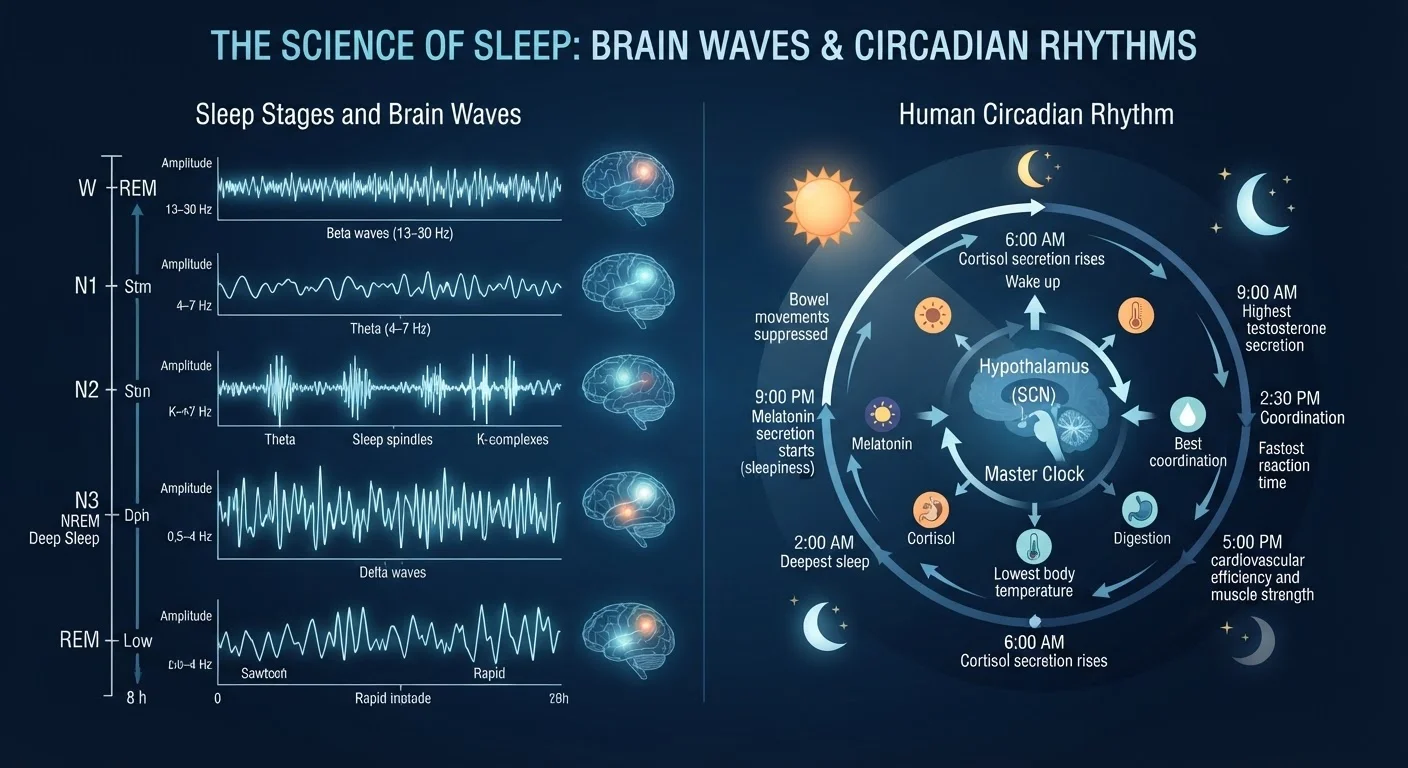
A graph that visually summarizes sleep stage progression across a night. Stages are plotted on the vertical axis and time on the horizontal axis, making cycles of light, deep, and REM sleep easy to identify.
Apnea-Hypopnea Index (AHI)
A clinical measure of breathing disruption severity during sleep, calculated as the number of apneas (complete pauses) and hypopneas (partial reductions) in airflow per hour. It is the primary metric for classifying obstructive sleep apnea.
Circadian Rhythm
An internal biological cycle of approximately 24 hours that regulates sleep timing, hormone release, body temperature, and other physiological processes. It is set and reset primarily by light exposure.
Homeostatic Sleep Pressure
The increasing biological need for sleep that accumulates during waking hours, largely driven by the buildup of adenosine in the brain. It is one of the two main forces (alongside circadian rhythm) that govern sleep timing.
Ultradian Rhythm
A biological cycle that repeats more than once per day, on a timescale shorter than 24 hours. In sleep science, the roughly 90-minute NREM-REM cycle is the most clinically relevant ultradian rhythm.
Sleep Latency
The elapsed time between lying down to sleep and the onset of the first sleep stage. Sleep latency is routinely measured in PSG studies and used as a diagnostic criterion for both insomnia and excessive daytime sleepiness.
Actigraphy
A non-invasive method of estimating sleep-wake cycles using a small accelerometer, typically worn on the wrist. It captures movement data over extended periods and is often used to assess circadian rhythm disorders.
Core Measurement and Research Terms
Sleep research depends on precise measurement tools. Understanding what these tools record helps readers evaluate study quality and clinical reports.
- Polysomnography (PSG): The gold-standard overnight sleep study that simultaneously records brain activity (EEG), eye movements (EOG), muscle tone (EMG), heart rhythm (ECG), and breathing effort. PSG is the primary tool used to diagnose conditions like sleep apnea and narcolepsy.
- Hypnogram: A chart generated from PSG data that maps sleep stages across a night on a single timeline. A healthy hypnogram shows predictable cycles of light, deep, and REM sleep, typically repeating four to six times.
- Actigraphy: A wrist-worn device that estimates sleep-wake patterns from movement over days or weeks. Less precise than PSG, but useful for tracking circadian rhythm disorders and sleep habits in real-world conditions.
- Apnea-Hypopnea Index (AHI): The number of breathing disruptions (apneas and hypopneas) per hour of sleep recorded during a PSG. Clinicians use AHI to classify sleep apnea severity — mild (5–14 events/hour), moderate (15–29), or severe (30+).
If a healthcare provider orders a sleep study, asking which measurement method is being used and what outcome will be evaluated is entirely appropriate. For context on sleep disorders diagnosed through these tools, see the Sleep Disorders hub.
Biological Rhythm and Pressure Terms
Several key terms describe the internal forces that drive when and how deeply we sleep.
- Circadian Rhythm: The roughly 24-hour internal clock regulated primarily by the suprachiasmatic nucleus (SCN) in the brain. Light exposure is the dominant external signal (zeitgeber) that keeps this clock synchronized with the external day.
- Homeostatic Sleep Pressure: The progressive biological drive to sleep that builds during waking hours, primarily driven by adenosine accumulation in the brain. Sleep discharges this pressure; caffeine temporarily masks it by blocking adenosine receptors.
- Ultradian Rhythm: Repeating biological cycles shorter than 24 hours. In sleep, the approximately 90-minute NREM-to-REM cycle is the most studied ultradian rhythm and underlies the stage architecture visible on a hypnogram.
- Sleep Latency: The time it takes to fall asleep after lights out. A sleep latency consistently under five minutes may indicate significant sleep deprivation; above 20–30 minutes is a common criterion for insomnia evaluation.
These mechanisms also inform sleep habits and routines — understanding sleep pressure, for instance, explains why keeping a consistent wake time helps consolidate sleep.
This article is for informational purposes only and is not a substitute for professional medical advice, diagnosis, or treatment. If you have concerns about your sleep, consult a qualified healthcare provider.