

Key Takeaways
Option A
Natural Immunity
The protection built from surviving an actual infection.
Best for: Understanding what the immune system learns after real-world pathogen exposure — and why it isn't a reliable public health strategy.
Option B
Vaccine-Induced Immunity
Controlled, evidence-backed protection without disease risk.
Best for: Individuals seeking predictable, safe, and schedule-guided protection endorsed by established clinical guidelines.
If you want protection without risking serious illness or complications
Vaccine-Induced Immunity
Vaccination provides immune protection without the life-threatening risks associated with natural infection, making it the only ethically viable deliberate strategy.
If you've already recovered from an infection and wonder about additional vaccination
Vaccine-Induced Immunity
Research on several diseases — including COVID-19 — suggests that vaccination after prior infection can strengthen and broaden immune responses. Consult your healthcare provider.
If you're weighing immunization for an older adult or immunocompromised individual
Vaccine-Induced Immunity
Vaccines are formulated to deliver optimized antigen doses safely; relying on natural infection in vulnerable populations poses unacceptable risk of severe outcomes.
If you're curious about overall immune system health beyond vaccines
Vaccine-Induced Immunity
Vaccines work alongside, not instead of, general immune health. Staying current on immunizations remains the most evidence-supported individual protective measure.
The Same Goal, Different Routes
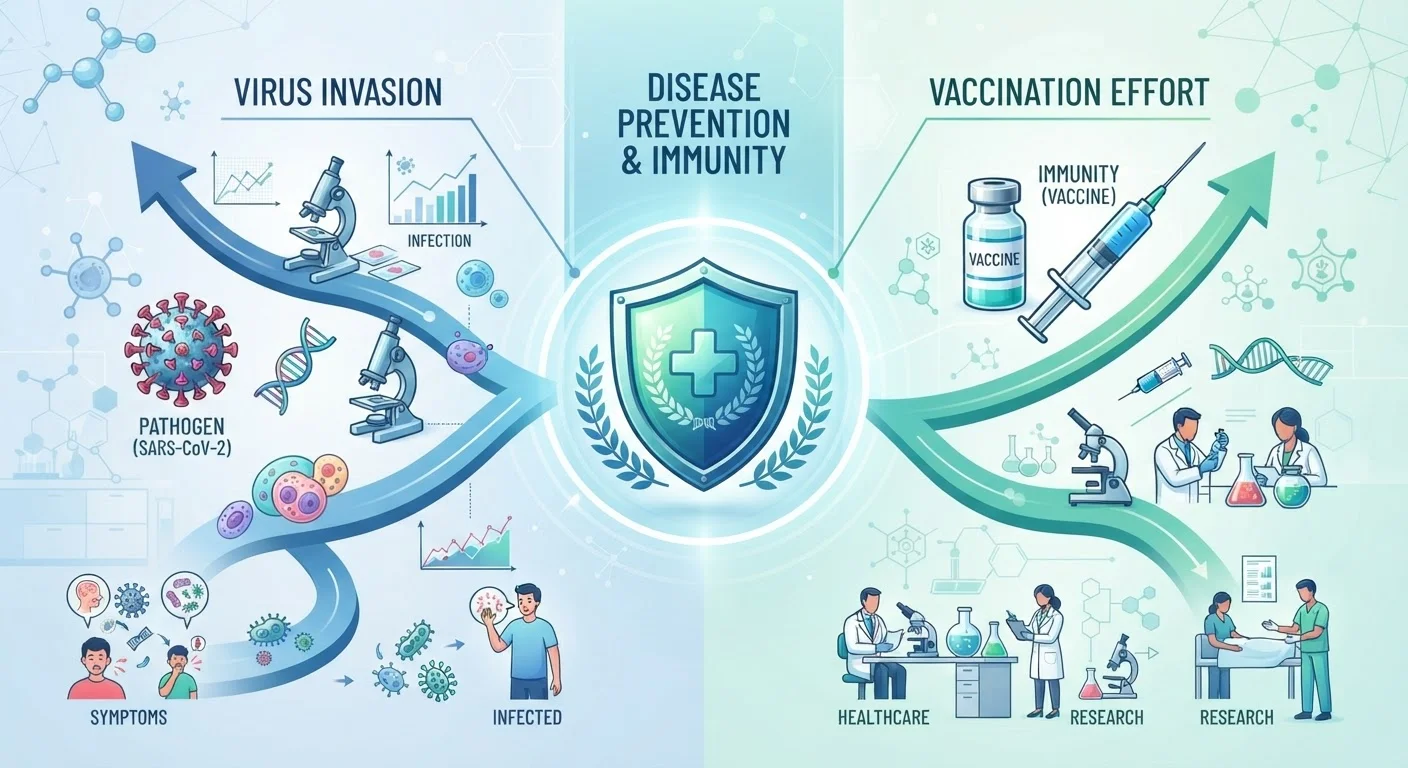
Natural immunity and vaccine-induced immunity share a common destination: teaching the immune system to recognize and respond rapidly to a specific pathogen. Both processes engage B cells (which produce antibodies) and T cells (which coordinate the immune attack and destroy infected cells). The critical difference is how that education happens — and at what cost.
When a pathogen infects the body naturally, it replicates freely before the immune response can contain it. This full-scale encounter often triggers a strong memory response, but only after the person endures days or weeks of illness — and faces the possibility of hospitalization, permanent organ damage, or death. Vaccination, by contrast, introduces a controlled antigen — a weakened pathogen, inactivated virus, protein subunit, or mRNA blueprint — that primes the immune system without causing the disease itself. To understand the cellular mechanics in detail, see how the immune system responds to a vaccine.
Head-to-Head: Key Differences That Matter
Comparing the two types of immunity requires looking at several dimensions: breadth of the antibody response, durability over time, variability between individuals, and population-level outcomes.
| Criterion | Natural Immunity | Vaccine-Induced Immunity |
|---|---|---|
| How protection is acquired | Through surviving active infection | Through controlled antigen exposure |
| Risk during acquisition | Illness, complications, or death possible | Mild, temporary side effects typical |
| Consistency across individuals | Highly variable by infection severity | Standardized dose optimizes consistency |
| Durability | Varies by pathogen; can be strong or brief | Engineered; boosters extend protection |
| Safety monitoring | None — infection is uncontrolled | Rigorous post-market surveillance systems |
| Recommended as deliberate strategy | Not recommended by clinical bodies | Endorsed by CDC, WHO, AAP, ACIP |
Natural immunity can vary enormously from person to person, because the severity of the infection — which influences how robustly the immune system is challenged — differs widely. Someone with a mild or asymptomatic infection may generate a weaker memory response than someone with severe illness. Vaccines are specifically engineered to deliver a consistent immune stimulus at an optimized dose, reducing that variability across a population.
Durability: How Long Does Each Type Last?
Neither natural nor vaccine-induced immunity is automatically lifelong, and the durability question depends heavily on the specific pathogen. For diseases such as measles, immunity acquired through natural infection is typically long-lasting — as is the protection conferred by the measles, mumps, and rubella (MMR) vaccine. For influenza and SARS-CoV-2, both types of immunity wane more quickly, partly because these viruses mutate rapidly.
Research on COVID-19 — one of the most studied examples in modern immunology — showed that protection from natural infection varied considerably by disease severity and declined over months. Vaccines, combined with booster doses, were shown to restore and sometimes broaden protection against emerging variants. For a deeper look at waning immunity mechanisms, why vaccine protection fades and when boosters make sense provides a thorough breakdown.
Public Health Implications: Why This Isn't Just Personal
A key reason public health bodies do not recommend intentional infection as an immunity strategy — beyond the obvious individual risk — is population-level unpredictability. Herd immunity thresholds require a sufficient proportion of the community to be protected; relying on natural infection to achieve those thresholds means accepting substantial preventable death and disability along the way. How herd immunity works and when it breaks down explains why community protection depends on coordinated vaccination, not mass exposure.
Vaccines are also subject to rigorous safety monitoring through systems like the CDC's Vaccine Adverse Event Reporting System (VAERS) and the Vaccine Safety Datalink. Natural infection carries no such safety guarantee. For context on understanding post-vaccination reactions, how to distinguish normal vaccine side effects from allergic reactions is a useful reference.
This article is for general health information only and does not constitute medical advice. Speak with a qualified healthcare provider about your personal immunization needs, history, or concerns.