

Key Takeaways
What the Micronutrient Section of a Label Actually Shows
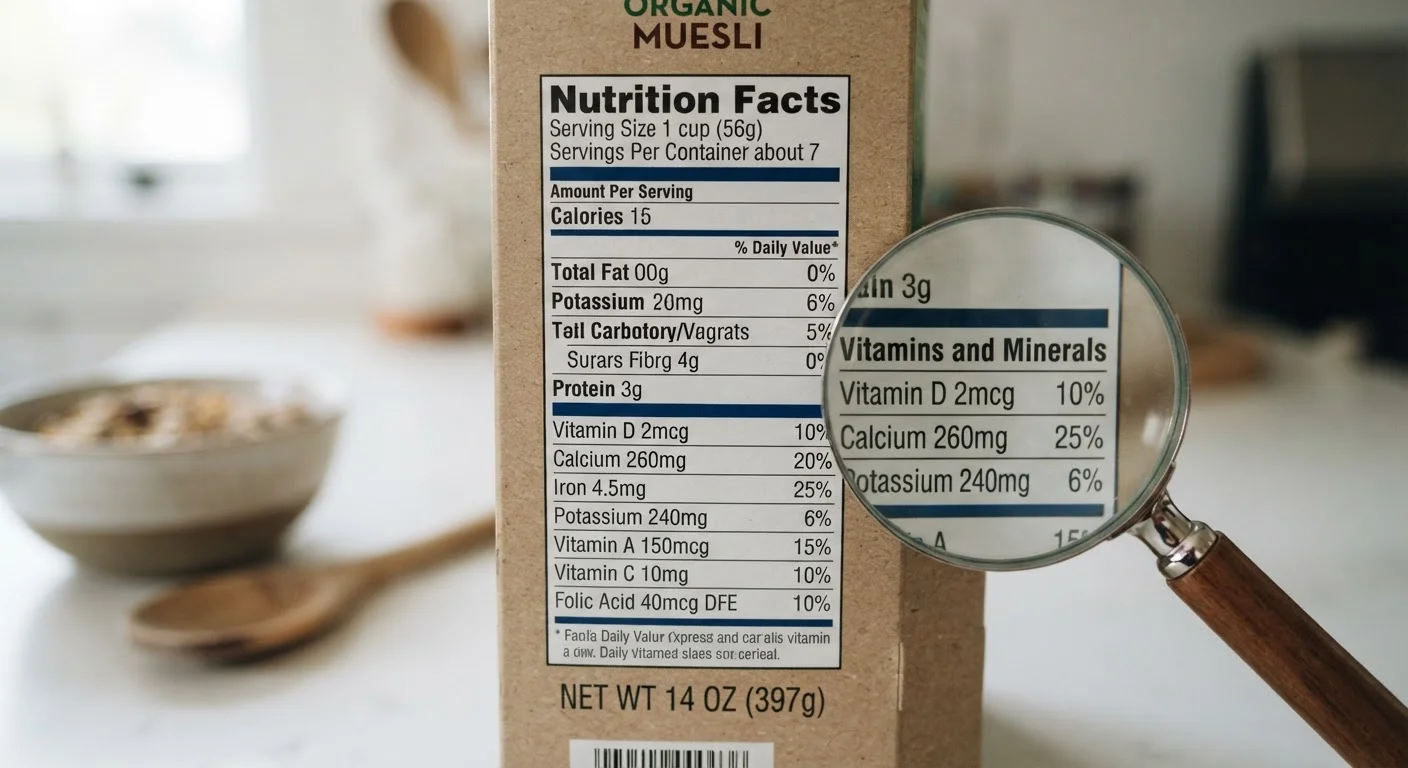
Near the bottom of every U.S. Nutrition Facts panel, below the macronutrients and dietary fiber, you will find a list of vitamins and minerals. This section exists because federal regulations require manufacturers to disclose nutrients that matter most for public health. Unlike the calorie count or fat grams near the top of the label, the micronutrient section uses Percent Daily Value (%DV) as its primary unit — not milligrams or micrograms.
%DV is a reference figure set by the U.S. Food and Drug Administration. It shows what fraction of a standard daily reference intake a single serving of that food provides, assuming a 2,000-calorie diet. It is a shorthand tool for comparison, not a personalized prescription. Your actual needs may be higher or lower based on age, sex, pregnancy status, or health conditions. For personal guidance, consult a registered dietitian or your healthcare provider.
As of the updated Nutrition Facts label rules, four nutrients must appear on every packaged food label: vitamin D, calcium, iron, and potassium. These were chosen because research consistently shows Americans tend to fall short on them. To understand why these gaps are so common, see The Micronutrient Gap in American Diets. Manufacturers may also voluntarily list other vitamins and minerals, such as vitamin C, magnesium, or B vitamins.
Use %DV to Compare, Not to Calculate
%DV is most powerful as a comparison tool between two products on a store shelf. Rather than trying to tally your exact daily micronutrient totals from labels, use %DV to identify which option delivers more of the nutrients you care about per serving. This approach is faster, practical, and fits naturally into everyday shopping decisions.
How to Read the Numbers: A Step-by-Step Walkthrough
The steps below walk you through interpreting the micronutrient section of any standard Nutrition Facts label with confidence.
Confirm the serving size before reading anything else
All %DV figures on the label apply to one serving, as defined by the manufacturer. Find the serving size declaration at the very top of the panel (e.g., "1 cup" or "28 g"). If you eat two servings, every percentage doubles. This is the single most common source of label misreading.
Locate the micronutrient section
Scroll past the calories, total fat, sodium, and carbohydrate rows. After dietary fiber and total sugars, you will reach a dividing line followed by vitamin and mineral listings. Each line shows the nutrient name and its %DV for one serving.
Apply the 5% and 20% benchmarks
The FDA provides a simple guide: 5% DV or less means a food is low in that nutrient per serving; 20% DV or more means it is high. Use these anchors to quickly categorize whether a food is a meaningful source of a given vitamin or mineral, or only a minor one.
Pay attention to the four required nutrients
Check the %DV for vitamin D, calcium, iron, and potassium specifically. These four are mandated by federal regulation because population data shows widespread shortfalls. Foods with higher %DV for these nutrients can help close common gaps in typical American eating patterns.
Note any voluntarily listed nutrients
Manufacturers may also list vitamin C, magnesium, B vitamins, zinc, or other micronutrients. These appear below the required four. Their presence is informative but optional, so absence does not mean the food lacks those nutrients — it may simply mean the manufacturer chose not to measure and declare them.
Once you work through the label systematically, it becomes a quick scan rather than a confusing puzzle. For a deeper look at how these nutrients function in your body, the Essential Vitamins and Minerals: A Quick-Reference Guide is a useful companion reference.
Keep in mind that eating a nutrient and absorbing it are not the same thing. Factors like cooking method and what else you eat at the same meal influence how much your body actually uses. Learn more in Why Nutrient Absorption Matters as Much as Intake.
Putting Label Reading into Everyday Practice
Reading micronutrient labels is most useful as a comparative habit — choosing between two similar products, checking whether a food meaningfully contributes to nutrients you know you eat too little of, or spotting a fortified food that could help fill a gap. It is less useful as a precise accounting tool, because labels represent averages and reference values, not exact biochemical measurements.
A practical rule of thumb: look for foods that supply at least 10–15% DV of the four mandatory nutrients (vitamin D, calcium, iron, and potassium) per serving if you want that food to contribute meaningfully to your daily total. Below 5% DV, the contribution is minimal. Some nutrients also work synergistically — for example, vitamin D enhances calcium absorption, and vitamin C can improve iron absorption from plant foods. Understanding those relationships can help you get more from the foods you already eat. See Nutrients That Work Better Together for a practical overview.
Finally, no label-reading strategy replaces variety. Whole fruits, vegetables, legumes, and lean proteins deliver micronutrients in combinations and food matrices that packaged products often cannot replicate. For actionable steps toward a more micronutrient-dense everyday diet, visit Building a Micronutrient-Rich Plate: Practical Everyday Strategies.
This article is for general informational and educational purposes only and does not constitute medical or dietary advice. Consult a qualified healthcare professional before making changes to your diet, especially if you have a health condition or specific nutritional needs.