

Key Takeaways
Start here
Why Home Yoga Works for Beginners
Next
Setting Up Your Space
Build your routine
Sequencing Basics: Building Your First Routine
Go deeper
Breathing as the Foundation
Keep growing
Progressing Safely Over Time
Why Home Yoga Works for Beginners
The idea that yoga requires a studio membership, expensive props, or an already-flexible body is one of the most persistent myths in wellness. In reality, yoga's core benefits - improved body awareness, reduced stress, better breathing - are fully accessible on your living room floor.
Practicing at home removes several real barriers: there's no commute, no intimidating class dynamic, and no cost beyond your time. For beginners especially, the privacy of home practice lets you move at your own pace and sit with poses long enough to actually feel them, rather than rushing to keep up.
If you're also exploring other ways to add movement to your daily life, our guide to building an active daily life without a gym covers complementary strategies that pair well with yoga. And if you've wondered what a studio class looks like before committing, what to know before your first yoga class offers a useful comparison point.
Setting Up Your Space
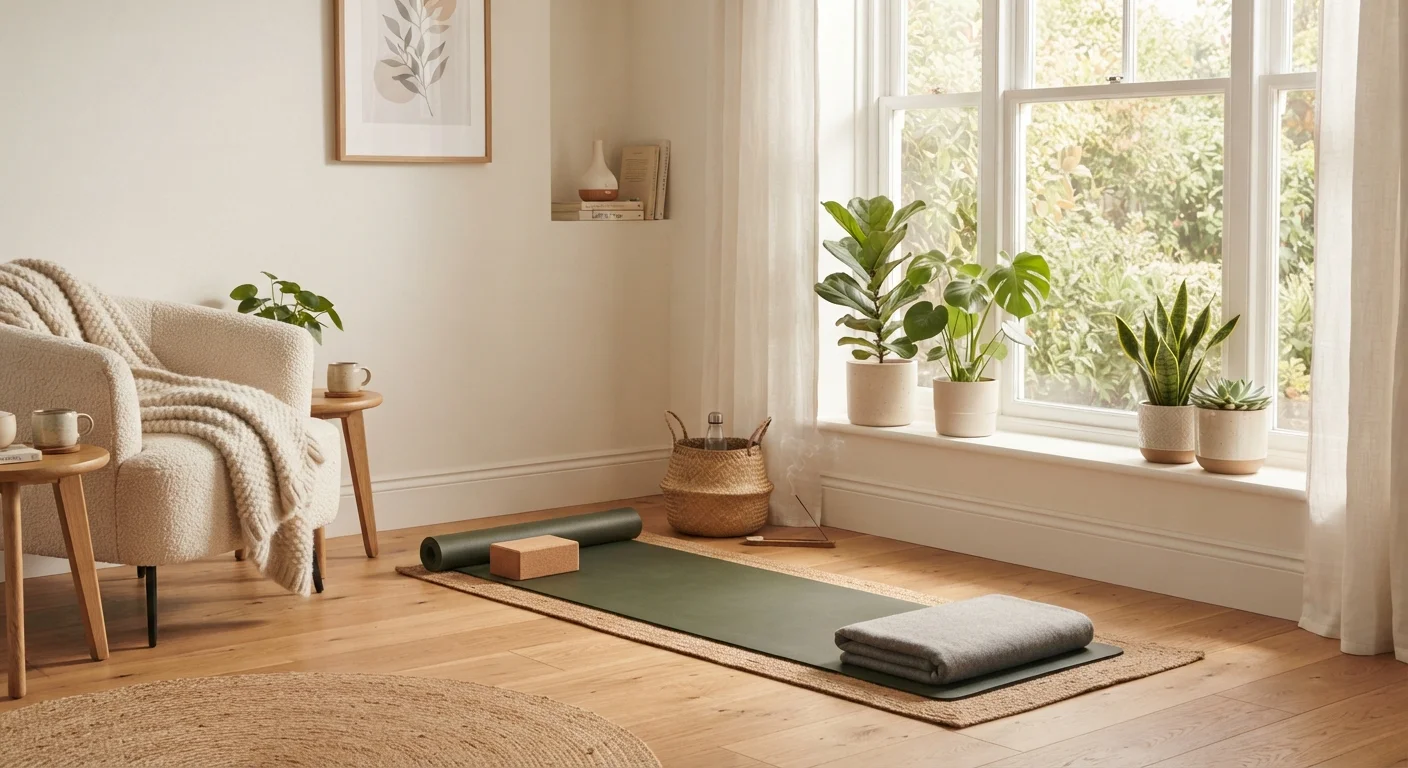
Your space doesn't need to be a dedicated room - it needs to be safe, clear, and consistently available. A roughly 6-by-4-foot area of flat floor is enough for virtually every beginner pose.
- Surface: A non-slip mat is helpful; a folded blanket on carpet works in a pinch. Avoid slick hardwood without grip.
- Lighting: Natural or soft light supports a calm mood. Harsh overhead fluorescents make it harder to settle.
- Temperature: A comfortably warm room (not hot) helps muscles ease into movement more safely.
- Distractions: Silence your phone. Even a 15-minute practice benefits from uninterrupted attention.
As for props - blocks, straps, and bolsters can deepen a practice over time, but they're optional at the start. Thick books substitute for blocks; a belt or bathrobe tie works as a strap. The goal is accessibility, not perfection.
Consistency Beats the Perfect Setup
It's tempting to wait until you have the 'right' mat or a dedicated room. Don't. Rolling out whatever you have in whatever space is available - and doing it regularly - is what builds an actual practice. The best setup is the one you'll use today.
Sequencing Basics: Building Your First Routine
A beginner yoga sequence doesn't need to be complex. A simple structure - warm-up, standing or seated poses, cool-down - gives your body a logical arc to follow.
Asana
A Sanskrit word meaning 'posture' or 'pose' - the physical positions practiced in yoga. Asanas range from simple seated stretches to complex balance poses.
Savasana
A resting pose performed lying flat on the back, typically done at the end of a yoga session to allow the body and nervous system to integrate the practice.
Diaphragmatic breathing
Breathing that engages the diaphragm so the belly rises on inhale rather than just the chest. It activates the body's relaxation response and is considered the foundation of most breathwork.
Parasympathetic nervous system
The part of the nervous system responsible for rest, digestion, and recovery - sometimes called 'rest and digest.' Yoga and controlled breathing help activate this system.
Ujjayi breath
A breathing technique used in yoga involving a gentle narrowing at the back of the throat, creating a soft audible sound on both inhale and exhale. It helps maintain focus and control during movement.
A practical starting framework:
- Warm-up (3-5 min): Gentle neck rolls, cat-cow spinal movements, and seated hip circles wake up the joints without strain.
- Core poses (10-15 min): A handful of foundational postures - mountain pose, downward-facing dog, child's pose, warrior I, and seated forward fold - cover the major muscle groups and movement patterns.
- Cool-down (3-5 min): Supine twists and a final rest in savasana (lying still on your back) allow your nervous system to shift toward recovery.
Aim for 15 to 25 minutes total when starting out. Repetition across a week builds familiarity far faster than variety. Once the sequence feels natural, you can layer in new poses one at a time.
Breathing as the Foundation
In yoga, breath isn't background noise - it's the practice itself. Breath links movement to awareness and is the primary mechanism through which yoga supports stress resilience. When you coordinate breath with motion, you engage the parasympathetic nervous system, the body's rest-and-digest counterweight to the stress response.
The foundational breath technique for beginners is diaphragmatic breathing (breathing into the belly rather than the chest). Simply placing one hand on your abdomen and noticing whether it rises on inhale is a meaningful first step.
From there, ujjayi breath - a gentle constriction at the back of the throat that creates a soft ocean-wave sound - is widely taught in yoga to help maintain focus and regulate pace. It takes a few sessions to feel natural, so be patient with yourself.
For a broader look at how breath practices support mental wellness, our article on getting started with mindfulness explores overlapping territory in accessible terms.
Progressing Safely Over Time
Sustainable progress in yoga looks less like dramatic flexibility gains and more like showing up consistently and noticing subtle shifts - a deeper breath, less tension in a familiar pose, improved balance.
A few principles to guide safe progression:
- Distinguish sensation from pain. Mild muscular stretch or effort is expected; sharp, shooting, or joint-based pain is a signal to back off immediately.
- Add variety slowly. Introduce one or two new poses per week rather than overhauling your sequence entirely.
- Rest days matter. Connective tissue - tendons and ligaments - adapts more slowly than muscle. Regular rest prevents overuse.
- Use quality free resources. Many reputable yoga teachers offer free beginner video series online; these provide visual alignment cues that text alone can't replicate.
If you're managing a chronic pain condition, the principles that guide safe adaptation are meaningfully different - and a healthcare provider's input is essential before beginning. Our companion piece on practicing yoga with chronic pain covers this in depth. Similarly, pairing a yoga habit with good sleep supports recovery and consistency - building a consistent sleep routine is a natural complement.
This article is for general informational and educational purposes only and is not a substitute for professional medical advice. If you have any health concerns or conditions, please consult a qualified healthcare provider before beginning a new exercise practice.