

Key Takeaways
Option A
Stress
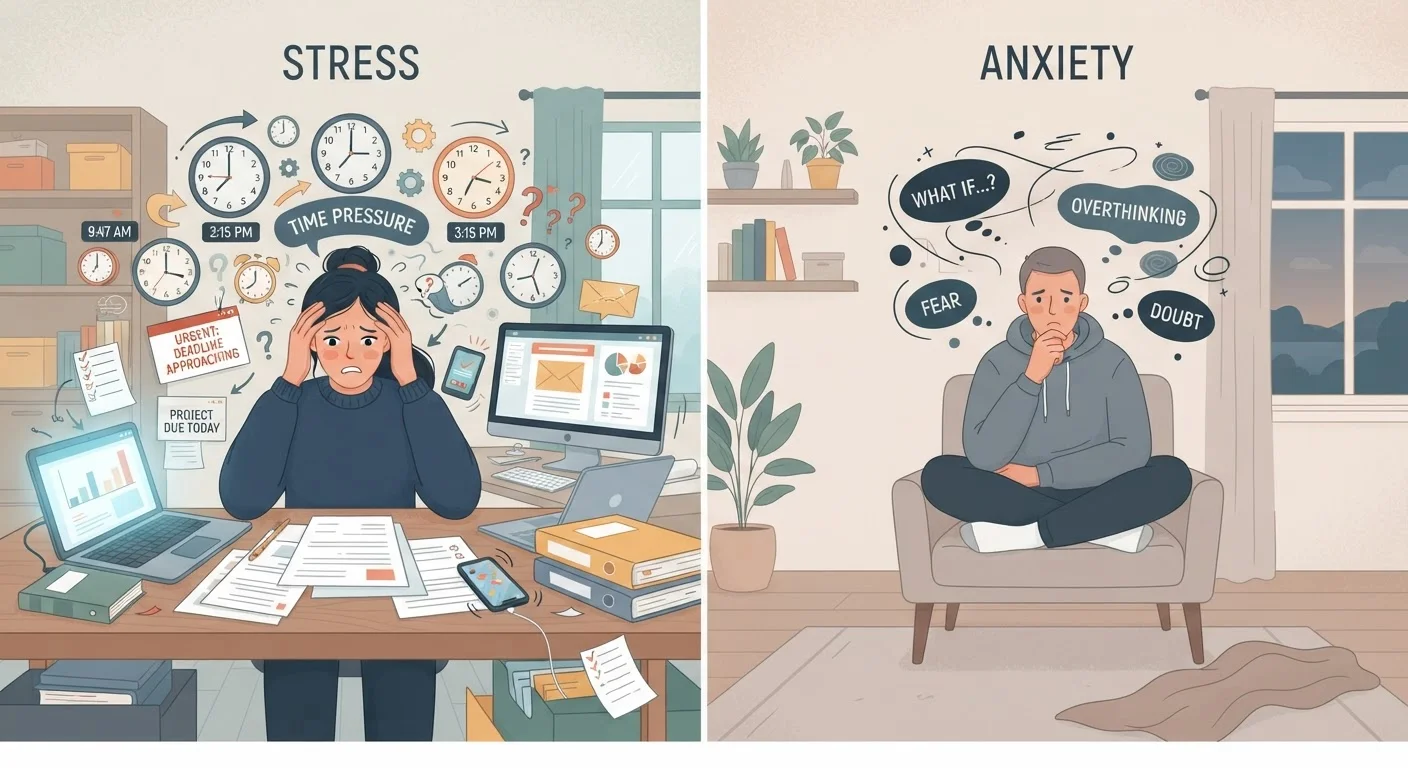
The external pressure response.
Best for: Understanding reactions tied to identifiable demands, deadlines, or life pressures.
Option B
Anxiety
The internal, persistent worry state.
Best for: Recognizing worry or dread that persists even without a clear, present cause.
If you feel overwhelmed by a specific deadline, workload, or life event
Address as Stress
Stress tied to a concrete cause typically eases once that situation is resolved or managed. Problem-solving, prioritization, and rest are highly effective starting points.
If worry lingers or intensifies with no clear trigger
Treat as Anxiety
Anxiety that doesn't track a specific cause may require different strategies - including grounding techniques, professional therapy, or evaluation for an anxiety disorder.
If physical symptoms like racing heart or muscle tension appear regularly
Consult a healthcare professional
Overlapping physical symptoms can stem from either stress or anxiety - and sometimes other health conditions. A professional evaluation provides the clearest path forward.
What Stress Actually Is
Stress is the body's response to a demand it perceives as challenging or threatening. It has an identifiable source - a looming work deadline, a difficult conversation, a financial crunch - and it typically fades once that source is addressed or removed.
From a physiological standpoint, stress activates the hypothalamic-pituitary-adrenal (HPA) axis, flooding the body with hormones like cortisol and adrenaline. Heart rate rises, muscles tighten, and focus narrows. This is the classic "fight-or-flight" response, and in short bursts it can actually sharpen performance.
The trouble arises when stressors stack up without relief. Chronic stress affects the body very differently than acute stress, gradually wearing down immune function, sleep quality, and mood. But the key feature of stress remains: there's a recognizable cause you can, at least in theory, point to.
| Criterion | Stress | Anxiety |
|---|---|---|
| Primary trigger | External stressor (identifiable cause) | Internal or anticipated threat (often unclear) |
| Duration | Eases when stressor resolves | Persists even after threat passes |
| Focus of worry | Present demands or challenges | Future "what if" scenarios |
| Physical symptoms | Tension, fatigue, irritability | Tension, racing heart, restlessness |
| Typical coping approach | Problem-solving, rest, boundary-setting | Cognitive techniques, therapy, grounding |
| When to seek help | If stress becomes chronic or unmanageable | If persistent, intense, or disrupting daily life |
What Anxiety Actually Is
Anxiety shares many of stress's physical hallmarks - muscle tension, rapid heartbeat, shallow breathing - but its defining quality is that it persists or intensifies even when there's no clear, present threat. The worry often points toward future scenarios: What if something goes wrong? What if I'm not enough?
Psychologists describe anxiety as apprehension about anticipated danger, whether realistic or not. When anxiety becomes frequent, intense, or difficult to control, it may meet criteria for a clinical anxiety disorder - including Generalized Anxiety Disorder (GAD), panic disorder, or social anxiety disorder. These are recognized medical conditions, not character flaws.
It's worth noting that some anxiety is normal and even protective. Mild anxiety before a job interview can keep you prepared. The concern arises when anxiety is disproportionate, persistent, or significantly disrupts daily life. Many widely held beliefs about anxiety don't hold up to scrutiny, and clearing up those misconceptions is an important step toward getting appropriate support.
Why the Distinction Matters for How You Respond
When stress and anxiety are lumped together, people often apply the same strategies to both - and wonder why they're not working. For stress, practical problem-solving often helps: breaking a task into steps, delegating, or simply resting after the stressor passes. These strategies target the external cause.
Anxiety, because it's internally driven, often requires different tools. Cognitive techniques - like examining whether a feared outcome is truly likely - can interrupt anxious thought loops. Breathing exercises and grounding practices help regulate the nervous system in the moment. For persistent or severe anxiety, evidence-based therapies such as Cognitive Behavioral Therapy (CBT) have a strong research track record.
Understanding the key terms researchers use around stress and anxiety can also help you communicate more clearly with healthcare providers and better understand what you're experiencing.
If you're unsure which you're dealing with - or if symptoms have persisted for several weeks, feel unmanageable, or are interfering with work or relationships - speaking with a qualified mental health professional is the most reliable next step. This article offers general health information only and is not a substitute for personalized clinical guidance.
A Note on Overlap - and When to Get Help
Stress and anxiety frequently co-occur, and one can fuel the other. Prolonged stress can lower the threshold for anxiety, while anxiety can make everyday stressors feel far more overwhelming. If you notice that worry feels constant, disproportionate, or difficult to switch off - even during calm periods - that's a signal worth discussing with a mental health professional. Seeking support early tends to lead to better outcomes and is a sign of self-awareness, not weakness.
This article is for informational and educational purposes only and does not constitute medical or mental health advice. If you are experiencing distressing or persistent symptoms, please consult a qualified healthcare or mental health professional.