

Key Takeaways
Option A
Compound Exercises
The multi-muscle, movement-efficient foundation of most training programs.
Best for: Anyone looking to build overall strength, burn more calories, and train efficiently in limited time.
Option B
Isolation Exercises
The targeted, single-muscle tool for precision and balance.
Best for: Addressing muscle imbalances, supporting rehabilitation, or adding focused volume to a specific muscle group.
If you have limited time and want broad strength gains
Compound Exercises
Compound movements engage more muscle mass per set, giving you the most training value in the fewest exercises.
If you're recovering from an injury or addressing a muscle imbalance
Isolation Exercises
Isolation work lets you load a specific muscle without stressing surrounding joints or compensating with stronger muscle groups.
If you're building a complete strength program
Compound Exercises
Starting sessions with compound lifts builds a strong movement foundation before adding supplementary isolation work.
If you want to develop a lagging muscle group
Isolation Exercises
Targeted isolation exercises allow you to add extra volume to underdeveloped muscles that compound lifts may underload.
If you're a beginner establishing a fitness habit
Compound Exercises
A handful of compound movements covers the whole body, making programming simpler and easier to stay consistent with.
Defining the Two Categories
Every resistance exercise you perform falls into one of two broad categories, and the distinction shapes how your body responds to training.
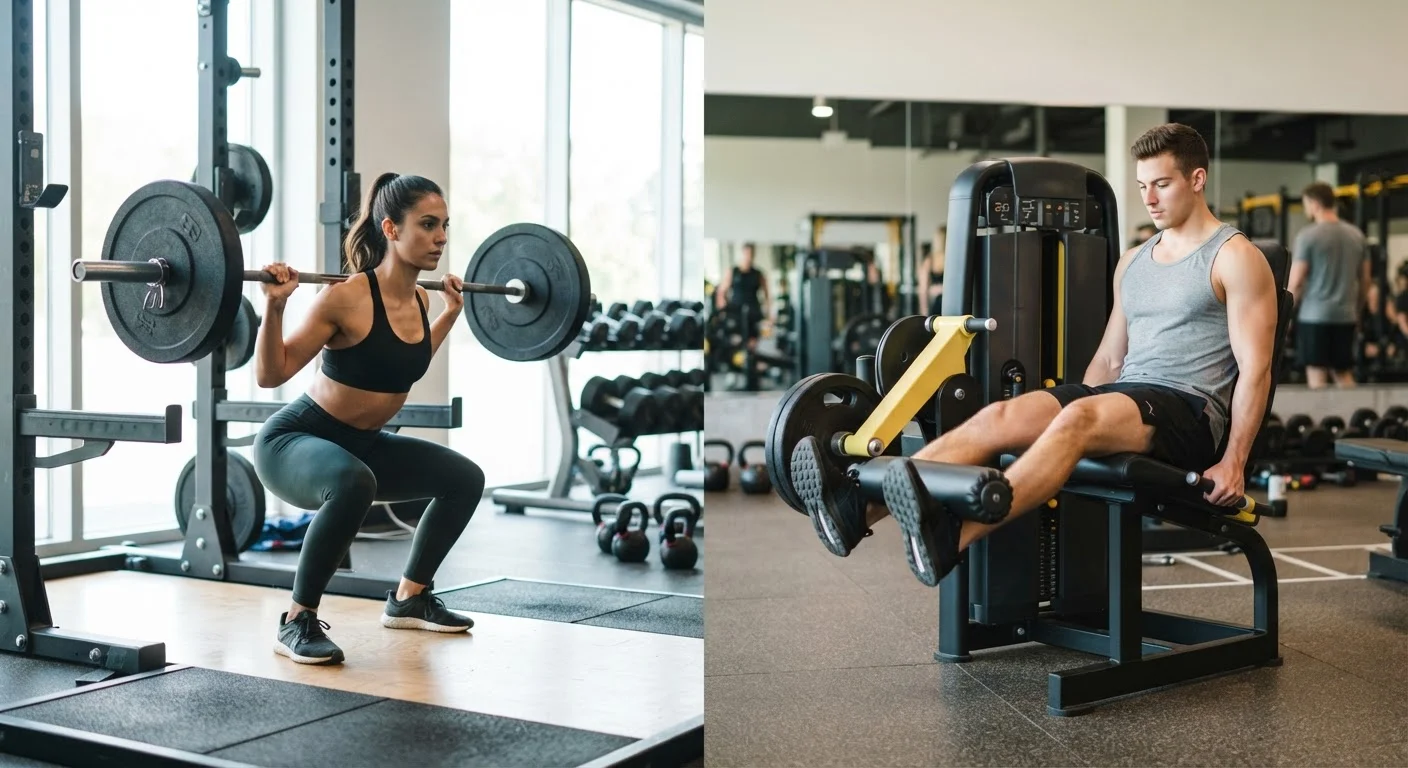
Compound exercises involve movement at two or more joints and engage multiple muscle groups at the same time. A squat, for example, simultaneously works your quadriceps, hamstrings, glutes, and core - all while your ankles, knees, and hips move together. Other classic compound movements include the deadlift, bench press, overhead press, and pull-up.
Isolation exercises, by contrast, move a single joint and are designed to stress one primary muscle. The bicep curl is the textbook example: only the elbow flexes, and the biceps does most of the work. Other isolation exercises include the leg extension, lateral raise, and tricep pushdown.
Understanding this distinction is not just technical trivia - it directly informs how you structure sessions, sequence exercises, and match training to your goals. For a deeper look at how movement principles connect, see our breakdown of core stability versus core strength.
| Criterion | Compound Exercises | Isolation Exercises |
|---|---|---|
| Joints involved | Two or more | One |
| Muscles recruited | Multiple groups simultaneously | One primary muscle |
| Time efficiency | High - broad stimulus per set | Lower - narrow focus per set |
| Functional carryover | Strong - mirrors real-world movement | Limited - highly specific |
| Best session placement | Start of session | End of session |
| Rehabilitation suitability | Moderate - involves multiple joints | High - controlled, targeted load |
| Examples | Squat, deadlift, bench press | Bicep curl, leg extension, lateral raise |
The Practical Tradeoffs
Each approach carries genuine advantages - and real limitations worth knowing before you program your next session.
What compound exercises do well
- Efficiency: Because they recruit more muscle mass per set, compound lifts deliver broader training stimulus in less time.
- Functional carryover: Multi-joint movements mirror real-world actions like lifting, pushing, and climbing, which can translate to everyday physical capability.
- Hormonal response: Research suggests heavy compound lifts may produce a greater acute hormonal response compared to isolation work, though the long-term significance of this difference is still debated among exercise scientists.
What isolation exercises do well
- Targeted loading: If a specific muscle is lagging or underdeveloped relative to others, isolation work lets you address it without relying on stronger muscles to compensate.
- Rehabilitation and injury management: Controlled single-joint movements allow clinicians and trainers to load a healing muscle with minimal stress on surrounding structures. Always work with a qualified professional if you are recovering from injury.
- Reduced systemic fatigue: Isolation exercises are less taxing on the nervous system and connective tissue, making them useful as supplementary volume at the end of a session when your body has already worked hard.
This tradeoff mirrors a broader theme in fitness: structured exercise versus lifestyle activity - neither is the complete picture on its own.
How to Use Both in a Sensible Program
For most people - beginners especially - the smartest approach is a compound-first structure. Open each session with one or two compound movements while your energy and focus are highest. Follow them with two or three isolation exercises to address specific muscles or weaknesses.
A simple lower-body session might look like this:
- Squats (compound) - primary stimulus for legs and hips
- Romanian deadlift (compound) - posterior chain emphasis
- Leg curl (isolation) - additional hamstring work
- Calf raise (isolation) - targeted lower-leg volume
This structure means you're never skipping the movements that give you the most return, but you're also not ignoring smaller muscles that compound lifts may underload.
It's also worth noting that some exercises sit in a gray zone. A lunge is technically compound, but it emphasizes the quadriceps more narrowly than a squat. Context and intent matter as much as the label. Pairing this approach with complementary training habits - as discussed in our article on strength training and flexibility - rounds out a well-balanced program.
8+
Muscle groups engaged in a single deadlift
Exercise science literature consistently identifies the deadlift as one of the most comprehensive compound movements, activating muscles from the feet to the upper back.
~2x
More muscles active in compound vs. isolation sets
Studies in the Journal of Strength and Conditioning Research have found compound movements recruit significantly more total muscle mass per set than equivalent isolation exercises.
This article is for general informational purposes only and does not constitute medical or professional fitness advice. Consult a qualified healthcare or exercise professional before beginning or significantly changing any exercise program, particularly if you have existing health conditions or injuries.