

Key Takeaways
Where the Myth Comes From
The idea that lifting weights makes you stiff - and that stretching is the antidote - has circulated in gyms and fitness circles for decades. It persists partly because of real but misunderstood observations: some athletes who overtrain with heavy loads and never work through full range of motion do become less mobile over time. But that outcome reflects a programming problem, not an inherent conflict between strength and flexibility.
Understanding the real relationship between the two qualities starts with recognizing what each one actually is. For a deeper look at related terminology, our strength and flexibility training glossary covers key concepts in plain language.
Myth
Lifting weights shortens muscles and makes you less flexible over time.
Fact
Resistance training through a full range of motion can improve flexibility, not diminish it.
The "muscles get shorter from lifting" idea is anatomically inaccurate. Muscles don't permanently shorten from resistance training. What can happen is that tight, restricted movement patterns - often from training only partial ranges - limit mobility over time. When strength work is performed through complete, controlled range of motion, it trains both force production and tissue length simultaneously. The result is a more pliable, adaptable muscle, not a rigid one.
Myth
You need to choose between building strength and improving flexibility - prioritizing one comes at the cost of the other.
Fact
Strength and flexibility are complementary physical qualities that reinforce each other when trained appropriately.
This either/or framing is one of the most persistent misconceptions in fitness. In reality, the two qualities operate along a continuum. A muscle that is both strong and flexible is more resilient under load, better at absorbing impact, and more capable of controlling movement at the edges of its range. Athletes in gymnastics, martial arts, and Olympic weightlifting regularly demonstrate extreme strength and flexibility - not one or the other.
Myth
Stretching before lifting prevents injury and improves performance.
Fact
Static stretching immediately before strength training may temporarily reduce force output; dynamic warm-up is generally more effective for pre-exercise preparation.
Research suggests that prolonged static stretching performed immediately before resistance training can transiently decrease muscle force production. A dynamic warm-up - movement-based preparation that takes joints through their working range - is generally better suited as a pre-training routine. Static stretching remains useful, but its most effective placement is typically after training or in dedicated flexibility sessions, not as an immediate precursor to heavy lifting.
Myth
If you're already flexible, you don't need to worry about strength training for mobility.
Fact
High passive flexibility without corresponding strength can increase injury risk rather than reduce it.
Passive flexibility - the ability to be moved into a range by an external force or gravity - is not the same as having the muscular control to stabilize that range under load. Individuals with naturally high flexibility, sometimes called hypermobility, can be particularly vulnerable to joint instability if their supporting muscles aren't strong enough to control end-range positions. Our article on training with hypermobility explores this in more detail.
Myth
Bodybuilders and powerlifters are inflexible because they do too much strength training.
Fact
Reduced flexibility in some strength athletes typically reflects programming choices, not an inevitable outcome of lifting heavy.
When athletes in strength sports exhibit limited range of motion, it's usually due to consistently training through partial ranges, neglecting mobility work, or prioritizing load over movement quality. Strength training itself is not the cause. Many competitive powerlifters and weightlifters maintain excellent mobility precisely because their sport demands it - a full squat or clean requires substantial hip, ankle, and thoracic range of motion alongside significant muscular strength.
What the Evidence Actually Shows
Research in exercise science has consistently found that resistance training - particularly when performed through a full range of motion - can produce meaningful flexibility gains. A review published in the Journal of Strength and Conditioning Research found that full-range resistance training improved flexibility to a degree comparable to static stretching programs. The mechanism is straightforward: muscles working at or near their length limit under load are being conditioned to tolerate and control that extended position.
This is also why loaded stretching has gained attention as an approach that builds both qualities simultaneously. When a muscle is strengthened at its longest functional length, it adapts not just in force output but in the nervous system's willingness to allow that range.
≈Equal
Flexibility gains: full-range lifting vs. static stretching
A review in the Journal of Strength and Conditioning Research found full-range resistance training produced flexibility improvements comparable to dedicated static stretching programs.
2-in-1
Qualities trained simultaneously with loaded end-range movements
Exercises performed at or near a muscle's full length under load condition both force output and tissue extensibility in the same session.
It's also worth distinguishing between flexibility and mobility - two terms often used interchangeably but describing different things. Our article on the difference between flexibility and mobility explains why that distinction matters for how you train.
How to Train for Both at Once
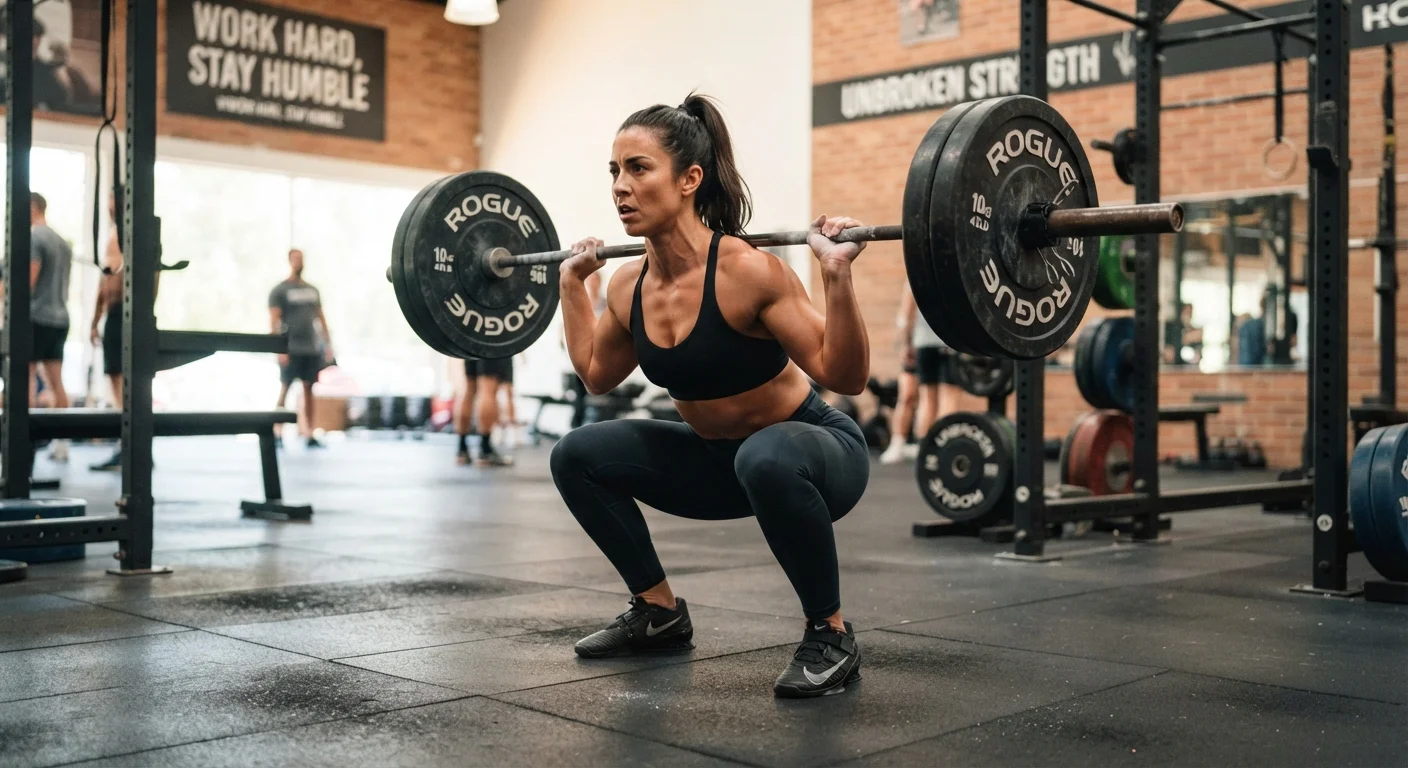
The most practical way to develop strength and flexibility together is to prioritize full range of motion in compound movements. A squat that reaches full depth, a Romanian deadlift that allows a genuine hip hinge with a long hamstring stretch, or an overhead press that moves through complete shoulder range - these are all examples of movements that challenge strength while simultaneously conditioning end-range tissue.
Organizing your training around fundamental movement patterns - hinge, squat, push, pull, carry - ensures that the major joints are consistently loaded through their natural ranges. This approach reduces the likelihood of developing strength imbalances that restrict mobility.
Supplemental stretching still has a place, particularly for areas where range is genuinely limited. But passive stretching alone develops flexibility without the neuromuscular control needed to use it functionally. A combined approach - strength training with attention to range, plus targeted mobility work - tends to produce more durable results than either in isolation.
This article is for general informational and educational purposes only and does not constitute medical or exercise prescription advice. Consult a qualified fitness or healthcare professional before beginning or significantly changing your training program, especially if you have existing injuries or health conditions.