

Key Takeaways
Obstructive Sleep Apnea (OSA)
Obstructive sleep apnea is a common sleep disorder in which the muscles in your throat repeatedly relax during sleep, causing the airway to narrow or close completely. This blocks normal breathing, leading to brief pauses in airflow that can occur dozens or even hundreds of times a night. Your body responds by briefly rousing you just enough to reopen the airway, often without you ever becoming fully conscious.
OSA is classified by severity using the Apnea-Hypopnea Index (AHI), which measures the average number of breathing disruptions per hour of sleep: mild (5–14 events/hr), moderate (15–29 events/hr), or severe (30+ events/hr).
The Mechanics of an Apnea Event
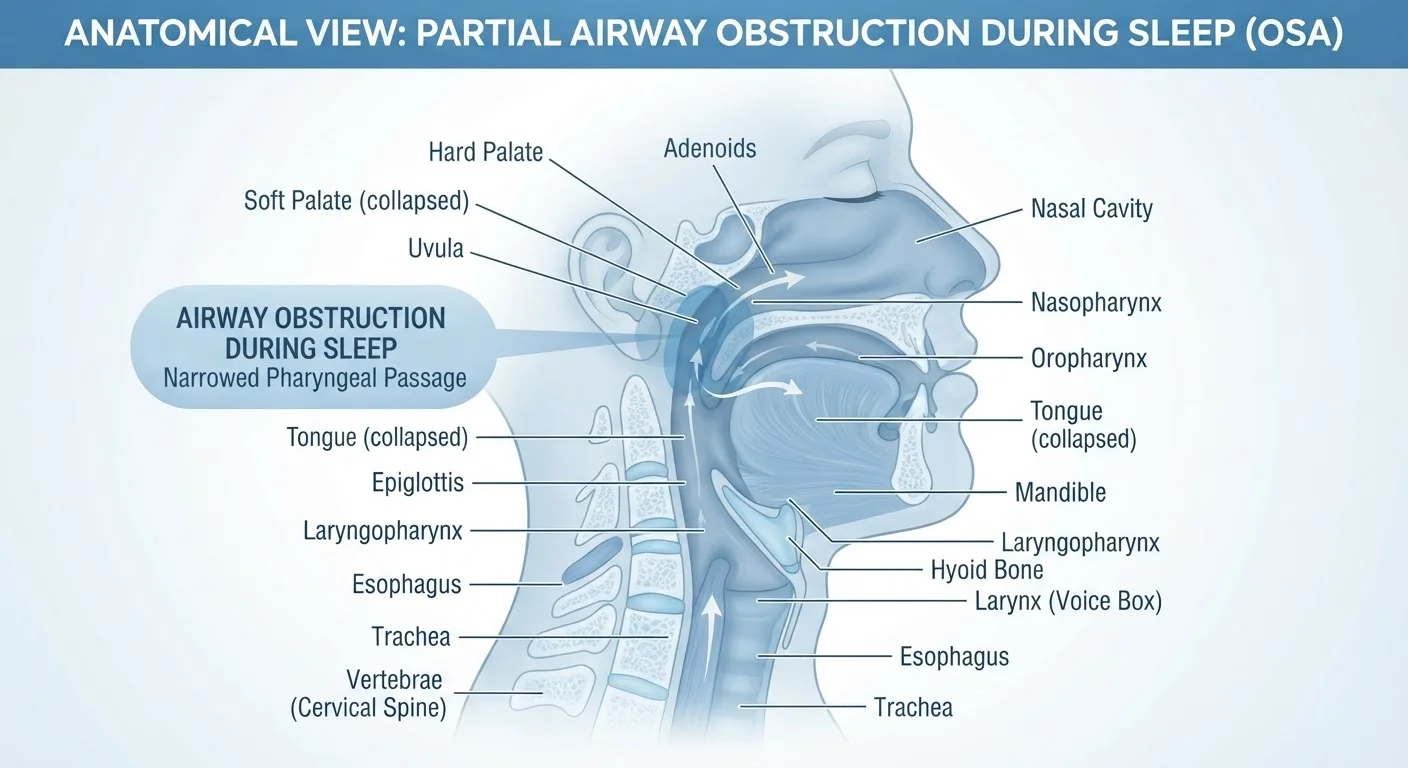
To understand obstructive sleep apnea, it helps to picture what the airway looks like during normal sleep. As you drift off, the muscles throughout your body — including those in your throat — naturally relax. For most people, this relaxation doesn't interfere with breathing. For those with OSA, however, the soft tissues at the back of the throat collapse inward, narrowing or completely blocking the passage that air travels through.
When airflow stops, oxygen levels in the blood begin to fall. Within seconds, your brain detects the problem and sends a distress signal. Your body briefly arouses — usually just enough to tighten the throat muscles and restore airflow — before you slip back into sleep. This cycle can repeat five times per hour in mild cases, or more than thirty times per hour in severe OSA.
Because these arousals are so brief, most people have no memory of them. They wake up feeling unrefreshed, unaware that their sleep was fragmented dozens of times throughout the night. For a broader context on how OSA fits among other conditions, see our overview of common sleep disorders.
Warning Signs You Shouldn't Dismiss
OSA is significantly underdiagnosed, partly because its most obvious symptoms occur while you're asleep. A bed partner is often the first to notice the telltale pattern: loud snoring interrupted by silence, then a gasp or snort as breathing resumes.
Daytime symptoms are equally important to recognize:
- Excessive daytime sleepiness — falling asleep during routine activities, not just when tired
- Waking with a headache — a sign of overnight oxygen drops
- Difficulty concentrating or memory problems — linked to fragmented, non-restorative sleep
- Irritability or mood changes — a byproduct of chronic sleep deprivation
- Waking with a dry mouth or sore throat — common after episodes of mouth breathing
If these symptoms sound familiar, they warrant a conversation with a healthcare provider — not a wait-and-see approach.
Track Your Symptoms Before Your Appointment
Before seeing a doctor, keep a brief sleep log for one to two weeks. Note how rested you feel each morning, whether you have headaches upon waking, and ask a bed partner (if applicable) to observe and record any snoring or breathing pauses. This information can meaningfully speed up your clinical evaluation.
Why Untreated OSA Is a Serious Health Concern
Each apnea event triggers a cascade of physiological stress responses. The repeated drops in blood oxygen — known as intermittent hypoxia — activate the sympathetic nervous system, spike blood pressure, and promote inflammation throughout the body. Over months and years, this sustained stress takes a measurable toll.
Research published by the American Academy of Sleep Medicine and others has consistently linked untreated OSA to significantly elevated risk for:
- Hypertension (high blood pressure)
- Coronary artery disease and heart failure
- Stroke
- Type 2 diabetes and metabolic dysfunction
- Cognitive decline and increased dementia risk
~30M
Americans estimated to have OSA
According to estimates from the American Academy of Sleep Medicine, approximately 30 million U.S. adults have obstructive sleep apnea, with many cases remaining undiagnosed.
2–3x
Higher hypertension risk with untreated OSA
Research consistently shows that individuals with moderate-to-severe untreated OSA face two to three times the risk of developing high blood pressure compared to those without the disorder.
Up to 80%
OSA cases that go undiagnosed
Sleep medicine researchers estimate that as many as 80% of moderate-to-severe OSA cases in the general population remain undiagnosed and untreated.
OSA also impairs driving ability — sleep-deprived individuals with untreated apnea have substantially higher rates of motor vehicle accidents. This makes OSA not only a personal health issue but a public safety concern.
Getting Evaluated and What Comes Next
If you suspect you have OSA, the path forward starts with a clinical evaluation. A healthcare provider will review your symptoms, medical history, and risk factors. From there, they may refer you for a sleep study — either conducted in a specialized lab or using a home monitoring device.
To understand exactly what this process involves, our guide on what a sleep study actually involves walks through preparation, the overnight testing experience, and how results are interpreted.
Treatment is highly effective for most people. CPAP (continuous positive airway pressure) therapy remains the gold-standard intervention, delivering a steady stream of pressurized air through a mask to keep the airway open during sleep. For those who cannot tolerate CPAP, alternatives such as oral appliance therapy or surgical options may be appropriate — decisions best made in partnership with a qualified sleep specialist.
This article is for general informational and educational purposes only and does not constitute medical advice. If you have concerns about your sleep or breathing during sleep, please consult a qualified healthcare professional.