

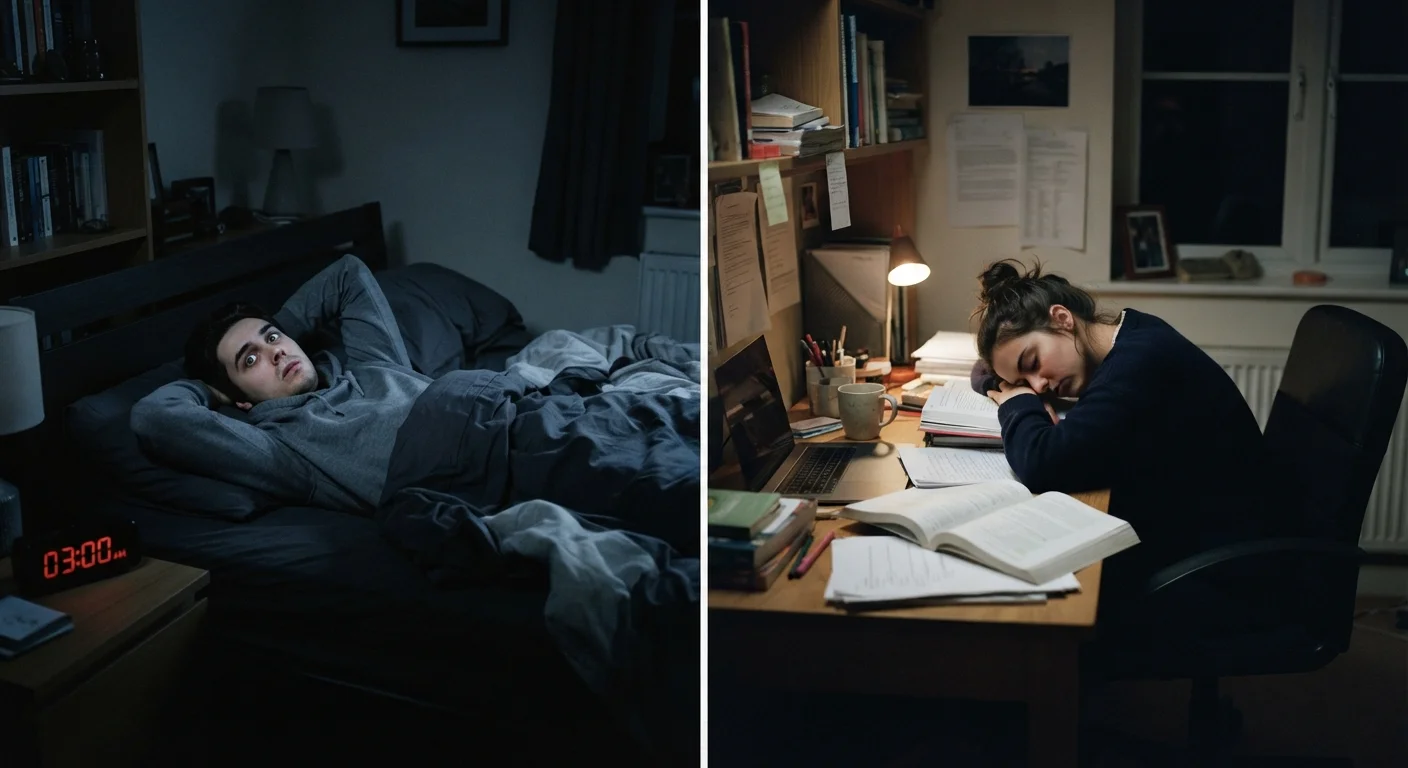
Key Takeaways
Option A
Insomnia
The inability to sleep despite adequate opportunity.
Best for: Understanding a clinical sleep disorder rooted in hyperarousal, anxiety, or disrupted sleep regulation.
Option B
Sleep Deprivation
Insufficient sleep due to circumstance or behavior.
Best for: Recognizing when lifestyle, schedule, or environment is simply not allowing enough time for sleep.
If you can't fall or stay asleep despite having enough time in bed
Evaluate for Insomnia
Difficulty initiating or maintaining sleep when opportunity exists points toward insomnia, which may benefit from cognitive behavioral therapy for insomnia (CBT-I) or professional assessment.
If you're sleeping too few hours because of work, caregiving, or schedule demands
Address Sleep Deprivation
Extending total sleep time by adjusting habits and schedule is typically the most direct solution when the problem is insufficient opportunity rather than inability to sleep.
If you've had sleep problems for more than three weeks
Consult a Healthcare Provider
Chronic sleep difficulties—regardless of the cause—warrant professional evaluation to rule out underlying conditions and guide appropriate treatment.
If you feel sleepy instantly when given the chance to rest but struggle at night
Evaluate for Insomnia
Paradoxical sleepiness during the day combined with nighttime hyperarousal is a hallmark pattern of insomnia disorder, distinct from simple sleep debt.
Why the Distinction Matters
The terms insomnia and sleep deprivation are often used interchangeably, but clinically and practically, they describe two distinct problems. Confusing them leads people toward solutions that don't fit their situation—sometimes making things worse.
Insomnia is a disorder of sleep regulation. A person with insomnia has adequate time and opportunity for sleep but cannot initiate or maintain it. Sleep deprivation, by contrast, is a circumstantial deficit: the person could sleep, but their schedule, environment, or behavior does not allow enough time for it.
According to the American Academy of Sleep Medicine (AASM), insomnia disorder is defined by difficulty sleeping at least three nights per week for at least three months, accompanied by daytime impairment. Sleep deprivation has no such threshold—it simply means sleeping less than your body requires, often due to external factors.
Understanding which problem you face shapes every decision that follows—from whether lifestyle changes are enough to whether professional care is warranted. For a broader look at how sleep issues are classified, see Sleep Disorders Explained.
Head-to-Head: Insomnia vs. Sleep Deprivation
The table below captures the core differences across the dimensions that matter most for recognition and response.
| Criterion | Insomnia | Sleep Deprivation |
|---|---|---|
| Core definition | Inability to sleep despite opportunity | Insufficient sleep time due to circumstance |
| Sleep opportunity | Adequate time in bed available | Not enough time allocated to sleep |
| Primary cause | Hyperarousal, anxiety, conditioned wakefulness | Schedule, behavior, or environment |
| Ability to nap | Often difficult even when fatigued | Falls asleep quickly when given chance |
| Duration pattern | Chronic; often months or years | Resolves when more sleep is obtained |
| First-line approach | CBT-I; clinical evaluation | Behavioral change; protect sleep time |
| Clinical classification | Recognized sleep disorder (DSM-5, ICSD-3) | Not a disorder; a deficit state |
One key distinction worth emphasizing: a sleep-deprived person typically falls asleep quickly when given the chance—on a couch, during a lunch break, or at the weekend. A person with insomnia often cannot, even when exhausted. Their nervous system remains in a state of hyperarousal that resists sleep regardless of fatigue level.
Causes and Contributing Factors
Insomnia is frequently linked to psychological and physiological hyperarousal. Common contributors include anxiety, depression, chronic stress, certain medications, and poor sleep-related habits (such as clock-watching or spending excessive time in bed awake). It can also arise secondary to other medical conditions, including chronic pain or sleep apnea. Importantly, the brain of someone with chronic insomnia shows measurable differences in arousal patterns compared to normal sleepers.
Sleep deprivation, on the other hand, is usually situational. Long work hours, caregiving responsibilities, shift work, social obligations, and excessive screen use before bed are common culprits. The body wants and is capable of sleep—there simply isn't enough of it. Research on how sleep deprivation affects the body shows consequences spanning immunity, metabolism, cardiovascular health, and cognition.
Both conditions can coexist. A person chronically short on sleep may develop conditioned arousal around bedtime, eventually developing insomnia on top of their deprivation.
Different Solutions for Different Problems
Because the root causes differ, so do the approaches.
For sleep deprivation, the primary intervention is behavioral: protect more time for sleep, improve sleep hygiene, and reduce or adjust obligations that cut into sleep hours. Consistent sleep and wake times, limiting caffeine, and reducing evening light exposure are well-supported starting points.
For insomnia, simply going to bed earlier often backfires—more time in bed without sleep can deepen the association between bed and wakefulness. The first-line evidence-based treatment recommended by the AASM is Cognitive Behavioral Therapy for Insomnia (CBT-I), a structured program that addresses the thoughts and behaviors perpetuating sleeplessness. CBT-I includes techniques such as sleep restriction therapy and stimulus control, which work by rebuilding the brain's association between bed and sleep.
Medications may be considered in some cases but are generally viewed as short-term tools rather than long-term solutions for chronic insomnia. Decisions about medication always require guidance from a qualified healthcare provider.
If you're uncertain whether your sleep difficulties cross into clinical territory, learn when poor sleep becomes a medical concern for guidance on warning signs.
This article is for general informational purposes only and is not a substitute for professional medical advice, diagnosis, or treatment. If you are experiencing persistent sleep difficulties, please consult a qualified healthcare provider.