

Key Takeaways
Laboratory Reference Range
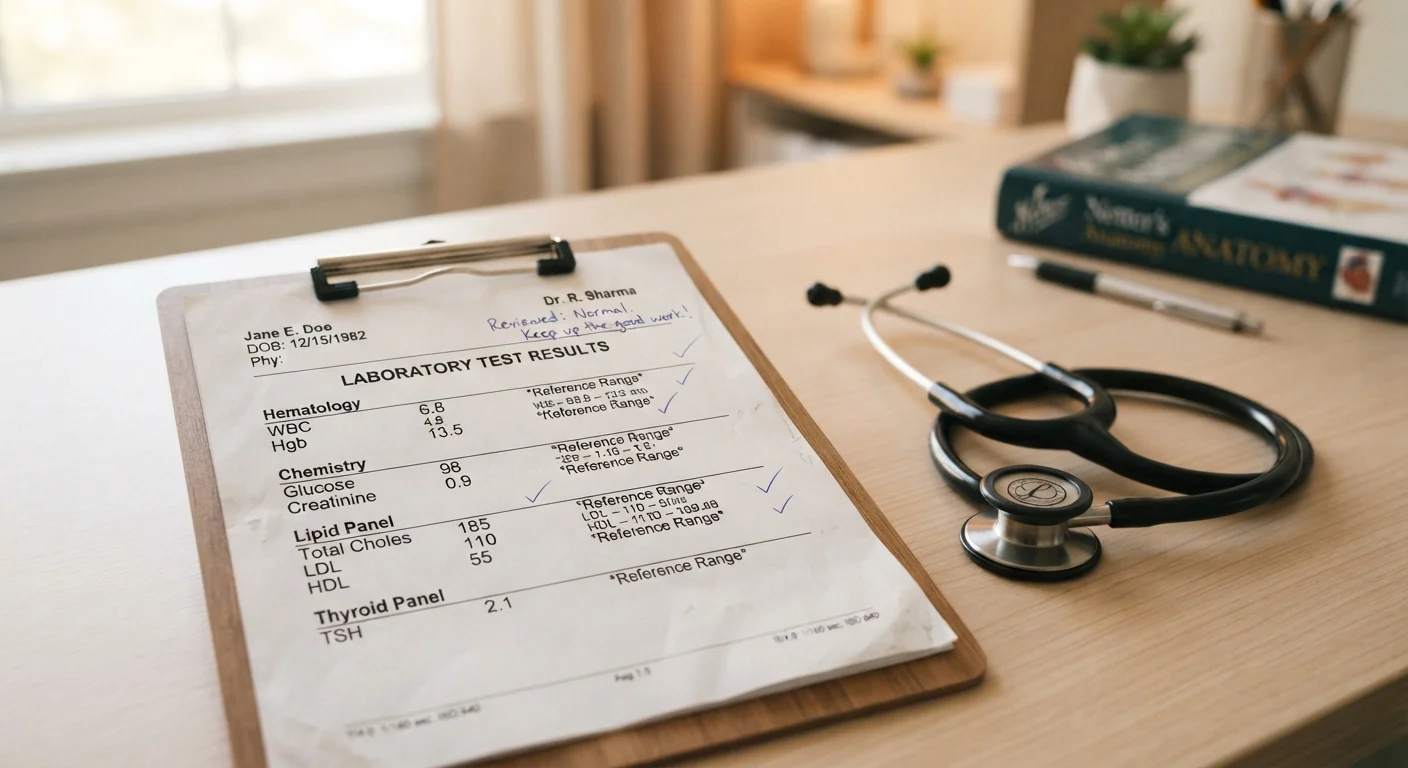
A reference range on a lab report is the set of values considered typical for a large sample of healthy people. When your result falls within this range, it's marked "normal" or "in range." When it falls outside, it may be flagged — though that doesn't automatically mean something is wrong.
Reference ranges are typically defined as the interval containing 95% of values from a healthy reference population, meaning roughly 1 in 20 healthy people will fall outside the range for any given test purely by statistical chance.
How Reference Ranges Are Built — and What They Can't Tell You
When a lab report comes back, most results sit alongside two numbers: a low and a high. That window is the reference range, and it's derived by testing a large group of apparently healthy individuals and capturing the middle 95% of their values. The math is straightforward. The interpretation is not.
Because reference ranges are population-level tools, they carry an inherent limitation: they don't account for you specifically. Your age, sex, ethnicity, medications, diet before the test, and even the time of day blood was drawn can all shift where your number lands. A result just below or above the boundary may reflect your individual baseline rather than a pathological change.
Reference ranges also vary between laboratories. Two facilities running the same test with different analyzers or reagents may use slightly different thresholds. This is worth knowing when you're comparing a new report to an older one from a different lab. Routine tests like blood pressure and cholesterol checks carry similar interpretation nuances that are worth understanding alongside your bloodwork.
When "In Range" Doesn't Mean "All Clear"
One of the most important things to understand about lab results is that the normal range is not a bright line between healthy and unwell. Conditions like prediabetes, early kidney dysfunction, or mild thyroid changes can develop for years while values stay technically within reference limits — inching toward the boundary rather than crossing it.
This is precisely why trends matter. A fasting glucose that moved from 82 mg/dL three years ago to 98 mg/dL today is still "normal" by most reference ranges — but the direction of change is worth a conversation with your provider. Sequential results over time often tell a richer story than any single data point.
1 in 20
Healthy people who fall outside a reference range
Because reference ranges capture 95% of a healthy population, statistically one in twenty healthy individuals will have a result outside the range on any given test.
~96 million
U.S. adults with prediabetes
According to the CDC, the vast majority of U.S. adults with prediabetes are unaware of their condition — many because their glucose values haven't yet crossed a clinical threshold.
Similarly, the concept of "optimal" versus "normal" applies to several common markers. Total cholesterol within the reference range, for example, still warrants individual assessment of cardiovascular risk factors. Understanding what these numbers mean in context is explored further in our overview of blood pressure and cholesterol screenings.
Flagged Results: What to Do Before You Worry
Seeing a result printed in bold or marked with an "H" or "L" can be unsettling. Before drawing conclusions, consider these steps.
- Don't interpret in isolation. A single abnormal marker rarely tells the full story. Labs often order panels — groups of related tests — precisely because individual values gain meaning in combination.
- Check for common confounders. Were you fasted as required? Did you take your usual medications? Had you exercised intensely the day before? These variables affect dozens of markers, from blood glucose to creatinine to white cell counts.
- Ask about repeat testing. For mildly out-of-range values, providers often recommend repeating the test under more controlled conditions before acting on the result.
- Request plain-language context. You're entitled to understand what the result means, why it matters, and what — if anything — comes next. Bring a list of questions to your follow-up appointment.
Body weight context can also intersect with lab interpretation. Certain metabolic markers are evaluated alongside weight history, as explored in what healthy weight ranges actually mean and how they're defined.
Making the Most of Routine Screenings
Preventive lab work is most valuable when it's consistent and contextualized. A few practical habits can help you get more from every result.
- Keep a personal record. Ask for copies of your lab reports and store them somewhere accessible. Tracking your own trends across years is one of the most underused tools in preventive health.
- Understand which tests are ordered and why. Knowing whether a comprehensive metabolic panel, a lipid panel, or a complete blood count is being run helps you ask informed follow-up questions.
- Don't skip follow-up appointments. Providers use repeat testing strategically. Missing a scheduled follow-up after a flagged result delays the information needed to act appropriately.
The goal of routine screening is not to find a problem at every visit — it's to establish your baseline, monitor change over time, and catch meaningful shifts early enough to act on them. That requires a partnership between you and your care team, grounded in shared understanding of what the numbers actually mean.
This article is for general informational purposes only and does not constitute medical advice. Always consult a qualified healthcare professional for guidance about your individual lab results, health conditions, or medical decisions.