

Key Takeaways
Autonomic Nervous System
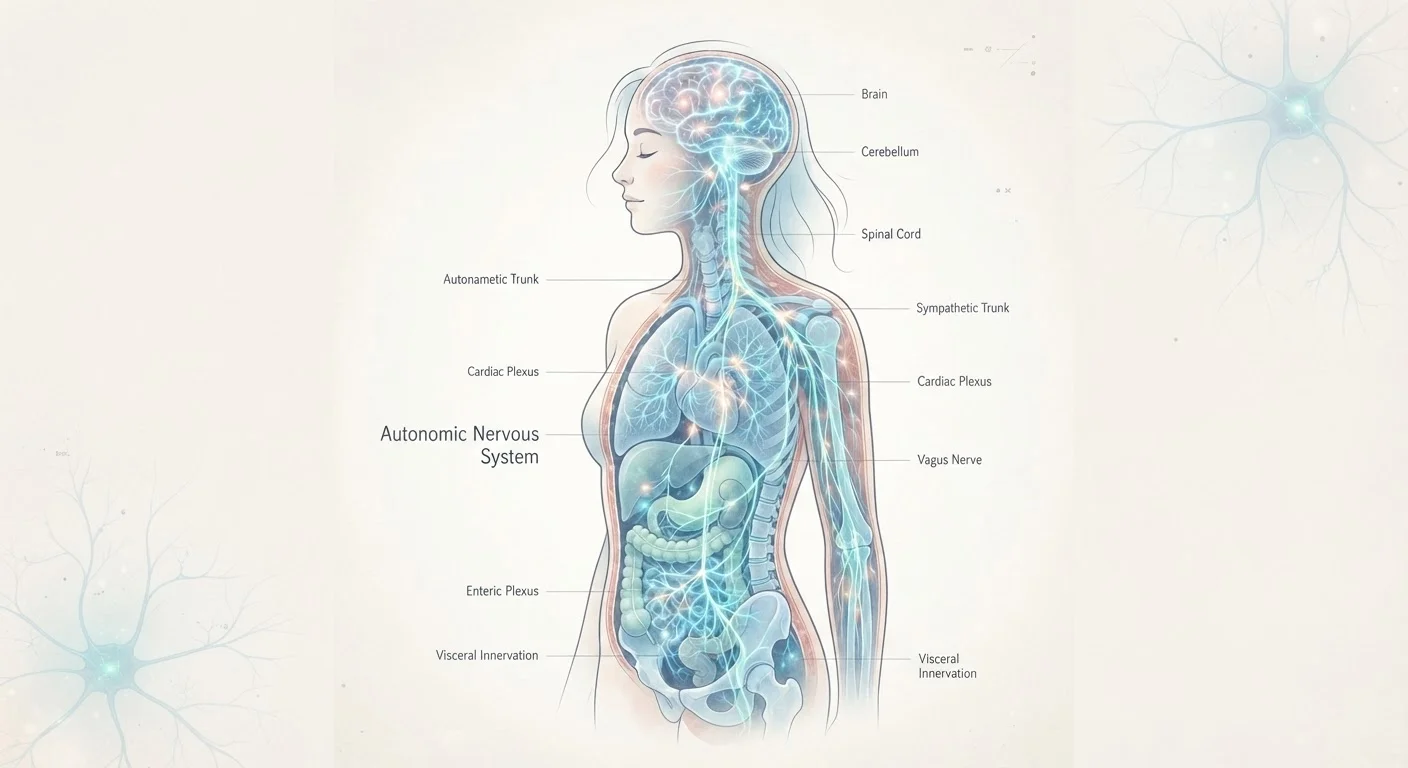
The autonomic nervous system (ANS) is the part of your nervous system that controls involuntary body functions — things like heart rate, breathing, digestion, and blood pressure — without any conscious effort from you. It has two main branches: the sympathetic system, which activates your stress response, and the parasympathetic system, which drives rest, digestion, and recovery. These two branches work in a push-pull relationship to keep your body balanced.
The ANS operates largely through the hypothalamus and brainstem, with the vagus nerve serving as the primary parasympathetic pathway to major organs, including the heart and gut.
Two Branches, One Ongoing Negotiation
Your autonomic nervous system is always running in the background, making thousands of micro-adjustments to keep you alive and functional. Think of it as an internal thermostat — constantly reading the environment and deciding how much energy to allocate and where.
The sympathetic branch is your gas pedal. It mobilizes energy, elevates heart rate, shunts blood to muscles, and suppresses non-urgent functions like digestion. This is the system behind your fight-or-flight response — useful in genuine danger, but costly when it runs chronically. For a deeper look at how this branch operates under pressure, see The Science Behind Your Stress Response.
The parasympathetic branch is your brake pedal. It slows the heart, stimulates digestion, promotes cellular repair, and signals the immune system to do housekeeping. Recovery — in every meaningful sense — happens almost exclusively in this state. You cannot meaningfully repair tissue, consolidate memory, or regulate mood while your sympathetic system is dominant.
These two branches don't alternate like a light switch. They're more like two musicians playing simultaneously, with one gradually turning up while the other turns down. Health and resilience depend on how smoothly that transition happens.
The Vagus Nerve: Your Recovery Highway
The vagus nerve is the longest and most complex nerve in the autonomic system, running from the brainstem down through the neck, heart, lungs, and gut. It carries the bulk of parasympathetic signaling — which is why researchers and clinicians pay such close attention to it.
One useful window into vagal function is heart rate variability (HRV) — the subtle variation in time between heartbeats. A healthy autonomic system shows higher HRV, reflecting the ability to flex between activation and rest. Lower HRV is often associated with chronic stress, poor sleep, or reduced recovery capacity.
~75%
Vagal fibers that carry signals to the brain
Research estimates that roughly 75–80% of vagus nerve fibers are afferent (sensory), sending information from the body to the brain — not the other way around.
Higher HRV
Associated with greater stress resilience
Multiple studies have linked higher resting heart rate variability to better emotional regulation, faster recovery from exercise, and improved cardiovascular health outcomes.
20–30 min
Time for parasympathetic activation after acute stress
Research on stress physiology suggests cortisol and sympathetic activation can take 20–30 minutes or more to return to baseline after a stressor ends, even without further triggers.
What matters practically: the vagus nerve responds to signals you can deliberately generate. Slow, extended exhales, humming, cold water on the face, and even social connection are all documented to increase vagal tone — the responsiveness of this parasympathetic pathway. Understanding this is the foundation of why so many evidence-based recovery tools actually work.
Why Your Body Struggles to Switch Off
Modern life creates a mismatch. The sympathetic system evolved for acute, physical threats — a predator, a fight, a sprint. Today's stressors are largely psychological and relentless: deadlines, financial worry, relationship tension, screen overstimulation. These triggers activate the same stress physiology without the physical resolution (running, fighting) that would naturally exhaust and reset the system.
The result, for many people, is a baseline tilt toward sympathetic dominance — not full fight-or-flight, but a low-level background activation that prevents the parasympathetic system from fully engaging. Sleep becomes lighter, digestion is sluggish, and the feeling of never quite recovering despite a night's rest becomes familiar.
This is why recovery isn't just about how much downtime you get — it's about the quality of the physiological state you're in during that downtime. For a broader look at how rest intersects with recovery, The Science of Rest is a useful companion read.
Practical Tools That Support Parasympathetic Activation
The good news is that the parasympathetic system is accessible — you just need the right inputs. Research supports several approaches for encouraging this shift:
- Controlled breathing: Extended exhales activate the vagus nerve and slow heart rate. A 4-count inhale followed by a 6–8 count exhale is a well-studied pattern. Learn more about the mechanisms in The Science Behind How Controlled Breathing Calms the Nervous System.
- Quality sleep: Deep slow-wave sleep is the most powerful parasympathetic state the body enters. Protecting sleep consistency matters more than most people realize.
- Moderate, regular movement: Exercise temporarily activates the sympathetic system, but regular moderate activity is associated with improved parasympathetic tone and HRV over time.
- Social connection and safety: The polyvagal theory, developed by researcher Stephen Porges, proposes that cues of social safety actively down-regulate stress physiology — a concept with growing research support.
For a broader collection of daily habits that support these systems, see Daily Habits That Support Nervous System Recovery.
This article is for informational purposes only and is not a substitute for professional medical advice. If you're experiencing persistent symptoms related to stress, fatigue, or autonomic dysfunction, please consult a qualified healthcare provider.