

Key Takeaways
Why Yoga Myths Stick - and Why They Matter
Yoga is one of the most widely practiced wellness disciplines in the United States, yet a significant number of people who are curious about it never try it. The barrier is rarely cost or access - it's belief. Persistent myths about who yoga is for and what it requires send beginners toward the exit before they've taken a single class.
These misconceptions aren't arbitrary. Many stem from the way yoga is represented visually in mainstream media: advanced postures performed by a narrow range of body types. That image is real, but it is not representative of what yoga actually is or who it serves. Unpacking these myths one by one is a practical step toward a more accurate - and more welcoming - picture.
Myth
You have to be flexible before you can start yoga.
Fact
Flexibility is an outcome of yoga practice, not a prerequisite for it.
This is the single most common reason beginners never unroll a mat. The logic feels circular once you name it: flexibility comes from practicing yoga - you don't need it beforehand. Research on stretching and range of motion consistently shows that regular, repeated movement through a joint's range is what produces lasting flexibility gains. Starting stiff is, in many ways, exactly the right time to begin. Common stretching myths can compound this barrier, but the underlying science is straightforward: the body adapts to what you repeatedly ask it to do.
Myth
Yoga is only for young, thin, or already-fit people.
Fact
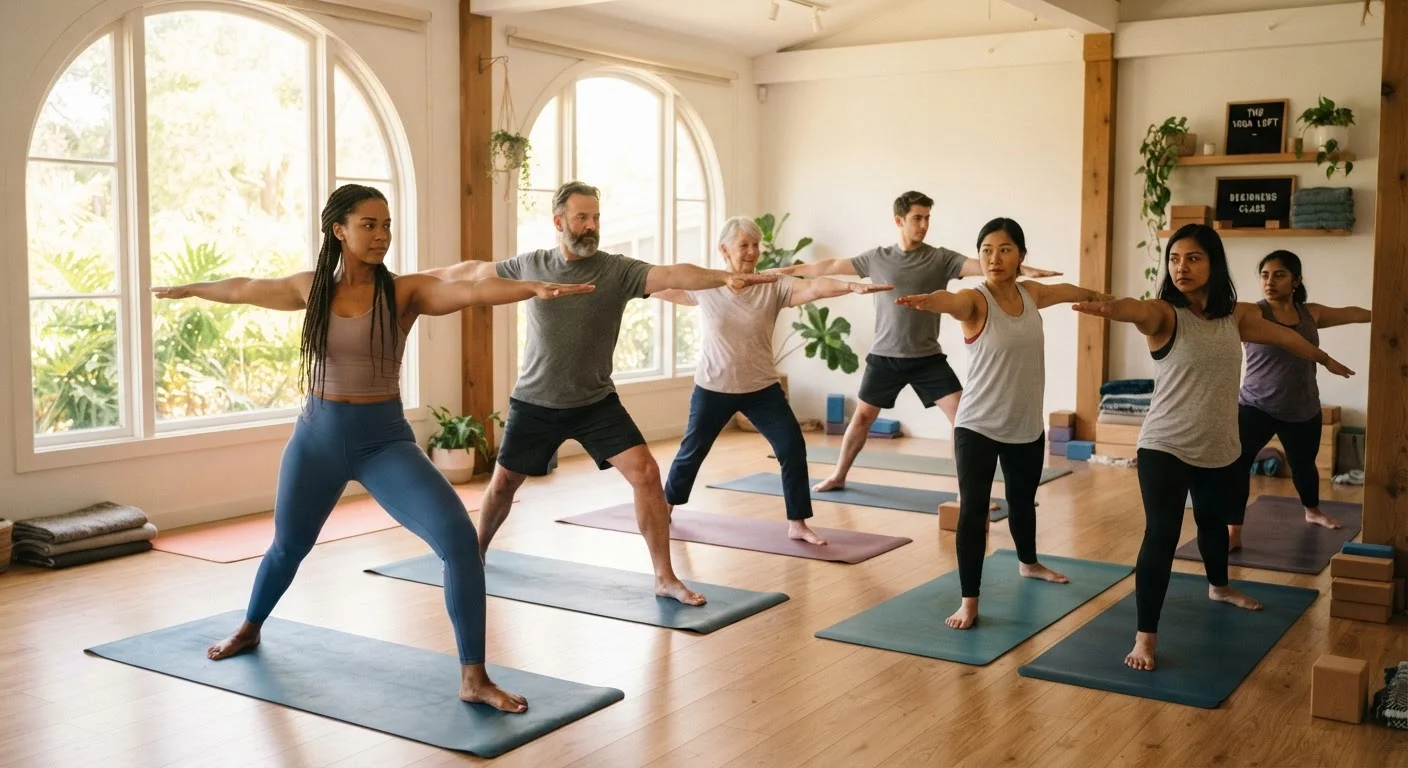
Yoga practice is scalable to virtually every body type, age, and fitness level through modifications and props.
Chair yoga, restorative yoga, and adaptive yoga traditions exist specifically to meet people where they are physically. Blocks, straps, and bolsters aren't training wheels - they're tools that allow the same foundational postures to work safely across a huge range of bodies. Many longtime practitioners are in their 60s, 70s, and beyond. If you ever feel a class is not designed for your body, that's a reflection of the class format, not of yoga itself.
Myth
Yoga is basically just stretching - it won't build real strength.
Fact
Yoga builds functional muscular strength, stability, and endurance alongside mobility.
Holding a plank, a warrior sequence, or a balance pose requires active muscular engagement - it is not passive elongation. Studies measuring muscle activation during yoga postures have found significant recruitment of core, hip, and shoulder stabilizers. As strength and flexibility are not competing goals, the two qualities reinforce each other. Many people who combine yoga with resistance training report improvements in both domains.
Myth
If it doesn't hurt, you're not doing it right.
Fact
Effective yoga involves sensation, not pain - pushing through sharp discomfort risks real injury.
There is a meaningful difference between the mild, diffuse sensation of a muscle being lengthened under load and the sharp, localized signal of tissue being stressed beyond its tolerance. Yoga tradition and modern sports medicine agree: pain is a stop signal, not a productivity indicator. Breath is a useful guide - if you lose smooth, controlled breathing in a pose, the demand has likely exceeded your current capacity. Back off, use a modification, and return another day. This is how sustainable progress actually works.
Myth
Yoga is a purely physical practice with no mental health benefit.
Fact
Yoga's breathwork and mindful movement have documented effects on stress physiology and emotional regulation.
The physiological mechanism is well established: slow, controlled breathing activates the parasympathetic nervous system, reducing cortisol and heart rate. This is why breathwork sits at the center of yoga - not as decoration, but as mechanism. Research has associated regular yoga practice with reductions in self-reported anxiety and improvements in sleep quality, though individual results vary. These effects mirror what mindfulness practice produces through attention training - calm, not emptiness.
What Yoga Actually Builds Over Time
Looked at honestly, a consistent yoga practice develops several qualities at once: joint mobility, muscular endurance, body awareness, and the capacity to manage stress through breath. These qualities are genuinely useful in daily life - getting up from the floor, carrying groceries, sitting at a desk for hours, or managing a hard conversation without the nervous system spiraling.
For people curious about how yoga compares with other movement approaches, yoga, Pilates, and stretching routines each serve different goals - understanding those differences helps you choose a practice that fits what you actually need.
It's also worth noting that being naturally very flexible is not an automatic advantage in yoga. Hypermobile individuals often benefit more from stability work than from additional stretching - a reminder that yoga is about balance, not extremes.
36M+
Americans who practice yoga
According to the Yoga Alliance and Yoga Journal's 2023 Yoga in America study, over 36 million Americans reported practicing yoga.
~55%
Beginners who cite flexibility concerns
Industry surveys consistently find that fear of not being flexible enough is among the top reasons cited by non-practitioners for avoiding yoga.
8-12 weeks
Typical timeframe for measurable flexibility gains
Research on stretching interventions generally finds meaningful range-of-motion improvements within 8 to 12 weeks of regular practice.
This article is for general informational and educational purposes only. It is not medical advice. If you have existing injuries, chronic conditions, or are new to exercise, consult a qualified healthcare professional before beginning any yoga or movement program.