

Key Takeaways
Option A
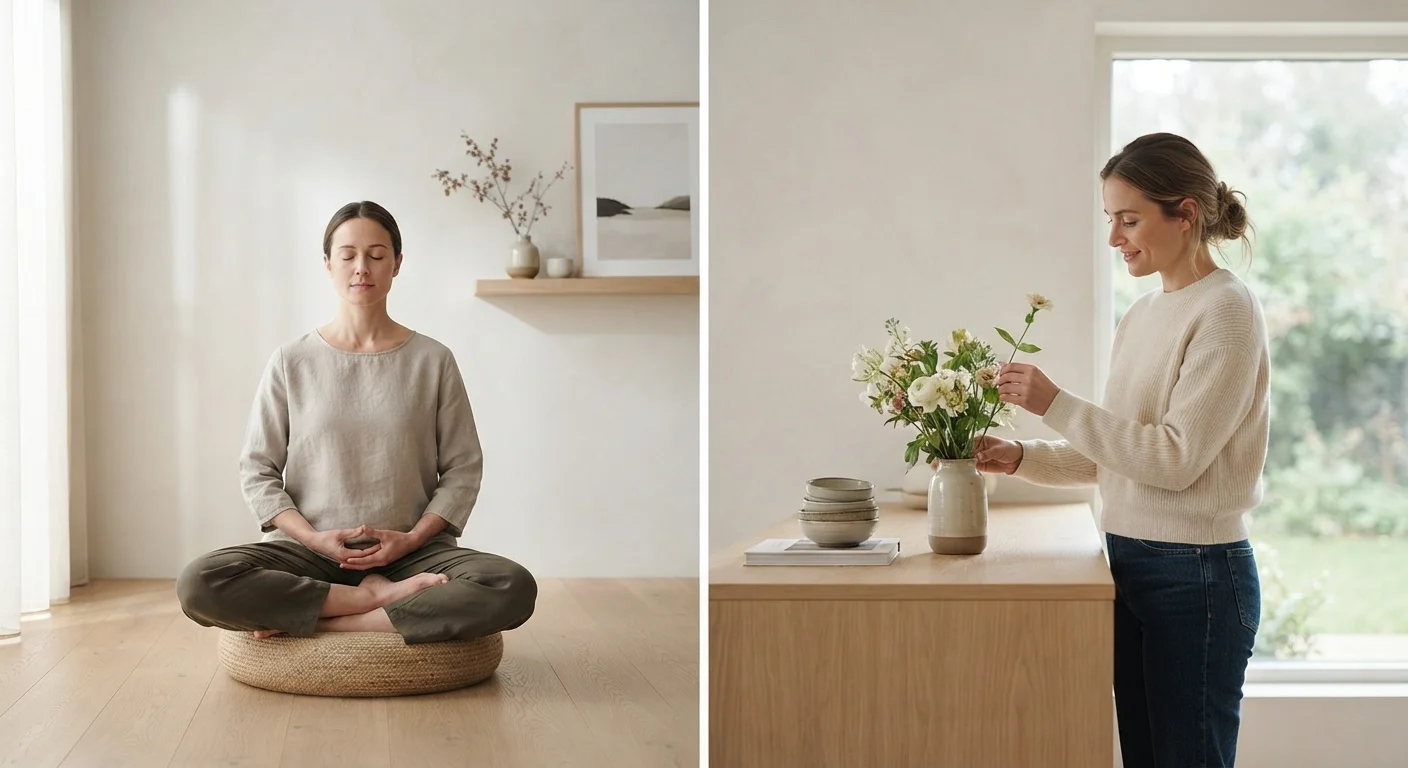
Meditation
The dedicated, structured practice.
Best for: People who benefit from set-aside time and a defined technique to train attention and cultivate mental calm.
Option B
Mindfulness
The portable, moment-to-moment awareness.
Best for: People who want to bring present-moment awareness into everyday activities without carving out extra time.
If you want a structured, repeatable daily mental wellness routine
Meditation
Formal meditation sessions provide a reliable framework for training attention and building consistency over time.
If your schedule makes dedicated sessions feel unrealistic
Mindfulness
Informal mindfulness practice slots into existing moments - eating, commuting, or washing dishes - with no extra time required.
If you want to manage daily anxiety and racing thoughts
Mindfulness
Moment-to-moment awareness helps interrupt anxious thought loops as they arise throughout the day.
If you want to explore deeper contemplative or focus-building techniques
Meditation
Practices like breath-focused or loving-kindness meditation build sustained attentional capacity through deliberate, extended training.
If you are brand new and unsure where to start
Mindfulness
Informal mindfulness has virtually no barrier to entry and can be practiced right now, making it an accessible first step.
The Core Distinction: Skill vs. Practice
These two words are used so interchangeably in wellness conversations that the difference can feel invisible. But the distinction is worth understanding - not because one is better, but because knowing what each term actually means helps you use both more effectively.
Mindfulness refers to a mental quality: the ability to pay deliberate, non-judgmental attention to the present moment. It is a capacity every person already possesses to some degree. You are practicing mindfulness when you notice the warmth of your coffee cup before you reach for your phone, or when you catch yourself mid-worry and gently return your focus to what's in front of you.
Meditation, by contrast, is a practice - a set of deliberate mental exercises performed during dedicated time. Many forms of meditation exist, including breath-focused concentration, body scans, visualization, and loving-kindness (metta) practice. Mindfulness meditation is one of the most widely studied types, but the category is broad.
The simplest way to hold both ideas at once: mindfulness is a skill, and meditation is one of the most effective tools for developing it. You can also strengthen mindfulness informally - through intentional attention during daily tasks - without ever sitting down to meditate. For a deeper look at what mindfulness really means, see what mindfulness actually means.
How Each One Works in Practice
Understanding the mechanics of each helps remove the mystery.
Meditation in practice
Meditation is typically done in a defined session - sitting quietly, following a guided audio, or using a structured technique for a set period. Common anchor points include the breath, a repeated word or phrase (mantra), bodily sensations, or imagery. The session has a start and an end. The goal is not to empty your mind but to notice when attention drifts and repeatedly bring it back - a process that itself builds mental flexibility over time.
Mindfulness in practice
Informal mindfulness requires no timer and no cushion. It means intentionally bringing full attention to whatever you are already doing. Research on what's called informal mindfulness practice suggests it can meaningfully reduce perceived stress when sustained over time, even without formal sessions. Everyday entry points include mindful eating, mindful walking, or simply pausing for three conscious breaths before responding to a stressful message.
| Criterion | Meditation | Mindfulness |
|---|---|---|
| What it is | A structured practice or exercise | A quality of present-moment attention |
| When it happens | During dedicated sessions | Anytime, woven into daily life |
| Time required | Set aside time (varies by practice) | No extra time needed for informal use |
| Learning curve | Technique-dependent; guided help useful | Accessible immediately with simple cues |
| Research base | Extensive for structured programs (e.g., MBSR) | Growing, especially for stress reduction |
| Best entry point | Guided breath-focused session | Mindful attention during a routine task |
If you are curious whether informal practice might actually suit your life better than scheduled sessions, the comparison in formal vs. informal mindfulness practice is worth a read.
What the Research Actually Shows
Both practices have meaningful bodies of research behind them, though the science is still maturing and results vary by individual and context.
Mindfulness-Based Stress Reduction (MBSR), an 8-week structured program developed by Jon Kabat-Zinn at the University of Massachusetts in the late 1970s, has been one of the most studied interventions in behavioral medicine. Studies published in peer-reviewed journals have associated MBSR - which combines formal meditation with mindfulness concepts - with reductions in self-reported stress, improvements in sleep quality, and modest benefits for anxiety and depression symptoms. It is important to note that most studies rely on self-report measures and vary in design quality.
Research on informal mindfulness practices suggests benefits too, particularly for emotional regulation and stress reactivity, though the evidence base is less extensive than for structured programs.
Neither meditation nor mindfulness is a substitute for professional mental health care. If you are managing a clinical condition, please speak with a qualified healthcare provider about what role, if any, these practices might play alongside appropriate treatment.
~14%
U.S. adults who meditate regularly
A National Health Interview Survey found roughly 14% of American adults reported meditating in the prior 12 months, up from about 4% in 2012.
8 weeks
Duration of standard MBSR program
Mindfulness-Based Stress Reduction, the most studied structured mindfulness intervention, is delivered over an 8-week course of guided practice.
3x increase
Rise in meditation participation (2012-2017)
CDC data showed U.S. adult meditation use roughly tripled between 2012 and 2017, reflecting growing mainstream interest in mind-body practices.
Common Misconceptions That Get in the Way
One reason people abandon both practices is that they start with unrealistic expectations. A few worth clearing up:
- "I need to clear my mind." Neither meditation nor mindfulness requires an empty mind. Both involve noticing thoughts and gently redirecting attention - mind-wandering is part of the process, not evidence of failure. Why a wandering mind doesn't mean you're doing it wrong explains this well.
- "I need to meditate for a long time to get benefits." Research suggests even brief, consistent sessions - some studies have examined sessions as short as 10 minutes - can contribute to measurable effects over time, though individual results vary.
- "Mindfulness is just relaxation." Mindfulness can feel calming, but its purpose is awareness, not necessarily relaxation. Sometimes being more present means noticing discomfort you had been avoiding.
For a fuller look at myths that discourage beginners, see mindfulness misconceptions that keep people from trying it.
This article is for informational purposes only and is not a substitute for professional medical or mental health advice. If you are experiencing significant distress, please consult a qualified healthcare professional.