

Key Takeaways
No equipment or gym membership required
Bodyweight training can be done in almost any space, eliminating cost and logistical barriers that cause many people to skip workouts.
Builds functional, real-world strength
Movements like squats, push-ups, and lunges closely mirror everyday physical tasks, making the strength gains directly applicable to daily life.
Highly accessible for beginners
The learning curve is gradual, and most foundational bodyweight exercises can be modified to suit nearly any fitness level or physical limitation.
Improves body awareness and joint stability
Controlling your body through space develops proprioception and balance - qualities that reduce injury risk and support long-term movement health.
Progression is possible without added weight
Changing leverage, tempo, range of motion, and exercise complexity allows continued challenge well beyond the beginner stage.
Load ceiling limits muscle growth potential
Once adapted to supporting their own body weight, advanced trainees cannot easily replicate the progressive overload that external resistance provides for hypertrophy.
Lower-body training is particularly constrained
Single-leg variations can increase difficulty, but they still cannot match the absolute load of barbell or machine-based lower-body exercises for strength development.
Difficult to measure and track progress precisely
Unlike adding a plate to a barbell, progressing to a harder exercise variation involves a significant and sometimes unpredictable jump in difficulty.
Not optimal for maximum strength or size goals
People whose primary goal is significant muscle hypertrophy or maximal strength will find bodyweight training insufficient as a sole training method beyond intermediate levels.
Our Verdict
Bodyweight training is a genuinely effective, accessible approach to fitness that delivers measurable improvements in strength, endurance, and mobility - especially for beginners and intermediate exercisers. Its main limitation surfaces when advanced lifters pursue maximum muscle hypertrophy or high-load strength gains, areas where external resistance has a clear advantage. Used thoughtfully, bodyweight training is far more than a stopgap - it is a complete system for many people.
Ideal for beginners, people returning to exercise after a break, travelers, and anyone who wants a low-barrier, sustainable fitness routine they can do anywhere.
What Bodyweight Training Actually Is
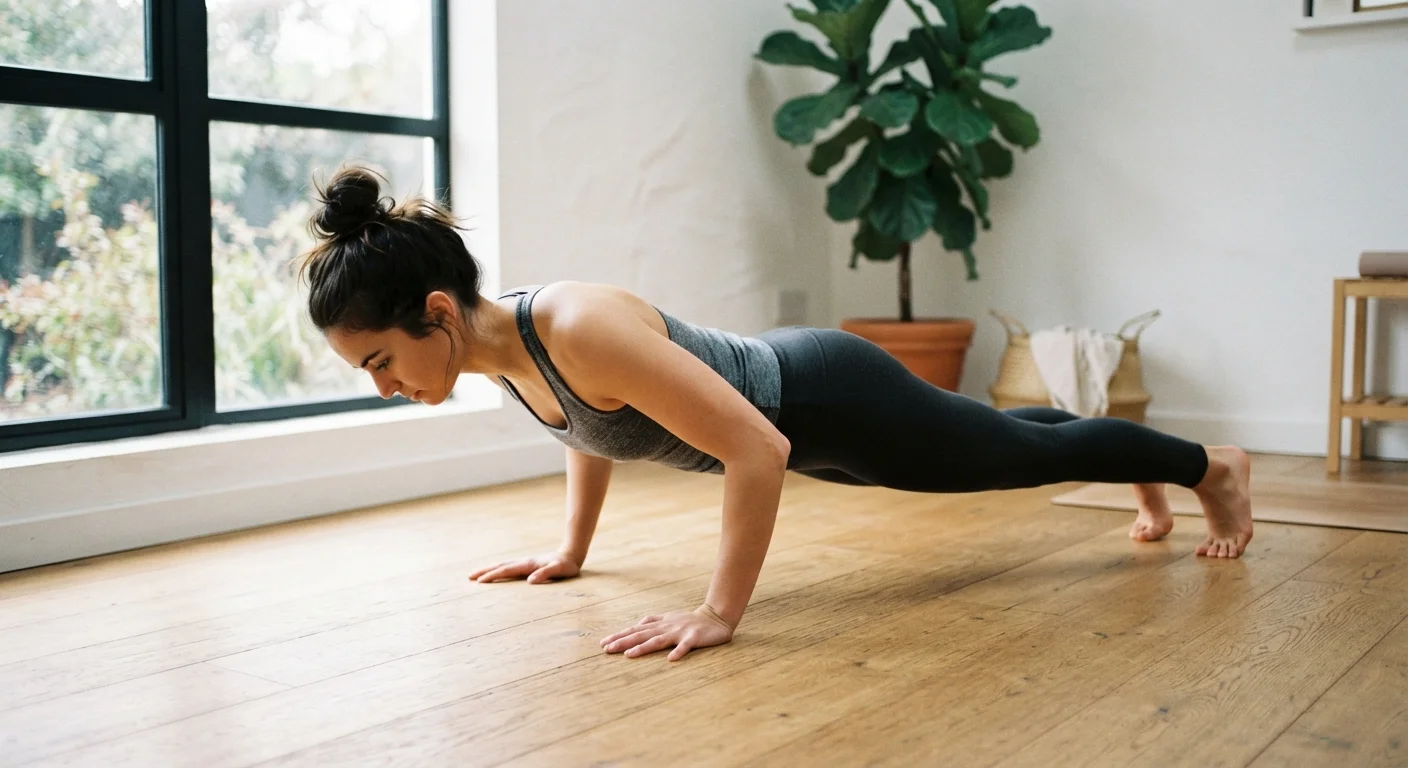
Bodyweight training uses your own body as resistance - no barbells, dumbbells, or machines required. Push-ups, squats, lunges, planks, pull-ups, and dips are common examples. The category also includes more advanced movements like single-leg squats (pistol squats) and explosive plyometrics such as jump squats.
The appeal is obvious: you can train in a living room, a hotel room, or a park. But the real question for anyone building or restarting a fitness routine is whether bodyweight exercise can do the heavy lifting on its own - or whether it needs to be one piece of a larger puzzle. The honest answer involves both genuine strengths and real ceilings.
If you are weighing how to structure your training overall, see our guide on cardio vs. strength training for beginners for broader context on balancing different training types.
What Bodyweight Training Does Well
No equipment or gym membership required
Bodyweight training can be done in almost any space, eliminating cost and logistical barriers that cause many people to skip workouts.
Builds functional, real-world strength
Movements like squats, push-ups, and lunges closely mirror everyday physical tasks, making the strength gains directly applicable to daily life.
Highly accessible for beginners
The learning curve is gradual, and most foundational bodyweight exercises can be modified to suit nearly any fitness level or physical limitation.
Improves body awareness and joint stability
Controlling your body through space develops proprioception and balance - qualities that reduce injury risk and support long-term movement health.
Progression is possible without added weight
Changing leverage, tempo, range of motion, and exercise complexity allows continued challenge well beyond the beginner stage.
One of bodyweight training's clearest strengths is its low barrier to entry. There is no cost, no commute, and no learning curve steep enough to stop a true beginner. Research consistently shows that compound bodyweight movements - exercises engaging multiple muscle groups simultaneously - improve muscular endurance, functional strength, and cardiovascular fitness in people who are new to structured exercise.
Bodyweight training also develops relative strength, the ability to move and control your own body efficiently. That kind of strength translates directly to daily life: getting up off the floor, carrying groceries, climbing stairs without fatigue. It also builds a foundation of body awareness and joint stability that makes learning weighted exercises safer later.
Progression is possible without adding external weight. By manipulating leverage (elevating feet for push-ups), range of motion (deep squats), tempo (slow eccentrics), or complexity (one-arm progressions), you can continue challenging muscles well past beginner levels.
Where Bodyweight Training Falls Short
Load ceiling limits muscle growth potential
Once adapted to supporting their own body weight, advanced trainees cannot easily replicate the progressive overload that external resistance provides for hypertrophy.
Lower-body training is particularly constrained
Single-leg variations can increase difficulty, but they still cannot match the absolute load of barbell or machine-based lower-body exercises for strength development.
Difficult to measure and track progress precisely
Unlike adding a plate to a barbell, progressing to a harder exercise variation involves a significant and sometimes unpredictable jump in difficulty.
Not optimal for maximum strength or size goals
People whose primary goal is significant muscle hypertrophy or maximal strength will find bodyweight training insufficient as a sole training method beyond intermediate levels.
The most important limitation is the load ceiling. Once your body adapts to supporting its own weight, adding meaningful resistance without equipment becomes increasingly difficult. For most people, this ceiling becomes relevant when pursuing significant muscle hypertrophy (size) or maximal strength gains.
Exercise science generally supports the idea that progressive overload - consistently increasing the challenge placed on muscles - is essential for continued adaptation. External weights make that progression straightforward and measurable. With bodyweight-only training, continuing to find harder variations requires creativity and, eventually, hits genuine mechanical limits.
~60%
Body weight lifted in a standard push-up
Biomechanical analyses suggest a standard push-up loads the chest and arms with roughly 60-70% of body weight, a useful but fixed resistance.
2x+
Body weight achievable in barbell back squat
Experienced strength trainees regularly squat more than twice their body weight - a loading level impossible to replicate with bodyweight-only lower-body exercises.
Lower-body training is particularly constrained. Squatting your own bodyweight is a meaningful stimulus for a beginner, but an experienced trainee who can back-squat twice their body weight is working at a very different intensity. Replicating that stimulus without a barbell is extremely difficult.
Making It Work: Getting More Out of Bodyweight Exercise
The difference between a stagnating bodyweight routine and one that produces lasting results usually comes down to structured progression. Simply adding more reps of the same movement rarely drives continued improvement after the early adaptation phase. Instead, consider:
- Harder exercise variations: Move from a standard push-up toward archer push-ups or eventually one-arm push-ups.
- Tempo manipulation: A three-second lowering phase on a push-up creates far more muscular tension than a fast rep.
- Reduced rest: Shortening rest periods increases cardiovascular demand without changing the movement.
- Plyometrics: Jump variations (jump squats, clap push-ups) add power development to a bodyweight program.
A Note on Special Populations
Older adults, people managing chronic conditions, and those recovering from injury should approach any new exercise program with professional guidance. A physical therapist or physician can help tailor bodyweight exercises to your specific needs and flag movements that may not be appropriate. This article provides general educational information only and is not personalized medical advice.
For people with specific health conditions, joint concerns, or who are returning from injury, even low-load bodyweight movements deserve a conversation with a physical therapist or physician before beginning. This is general fitness information, not personalized medical guidance.
Who Gets the Most - and Least - From Bodyweight-Only Training
Beginners and people returning to fitness after a break get an outsized return from bodyweight training. The initial adaptations - improved neuromuscular coordination, basic strength, better cardiovascular efficiency - happen readily and do not require heavy loads to trigger.
Intermediate exercisers can still make meaningful progress with a well-structured bodyweight program, especially if they are deliberate about progression. The approach pairs well with other fitness goals like flexibility and mobility work.
Advanced athletes and those whose goals specifically center on building significant muscle mass or competitive strength will find bodyweight-only training insufficient on its own. That is not a criticism of the method - it simply reflects the physics of progressive overload.
It is also worth noting that bodyweight training says nothing about broader health factors like nutrition, sleep, or stress management, all of which influence fitness outcomes. For context on how body weight and health intersect beyond exercise, our examination of common weight and health misconceptions is worth a read.
This article is for general informational purposes only and is not a substitute for personalized medical or fitness advice. Consult a qualified healthcare or fitness professional before starting a new exercise program, particularly if you have an existing health condition or injury.