

Key Takeaways
Why Age Is a Critical Factor in Sleep Health
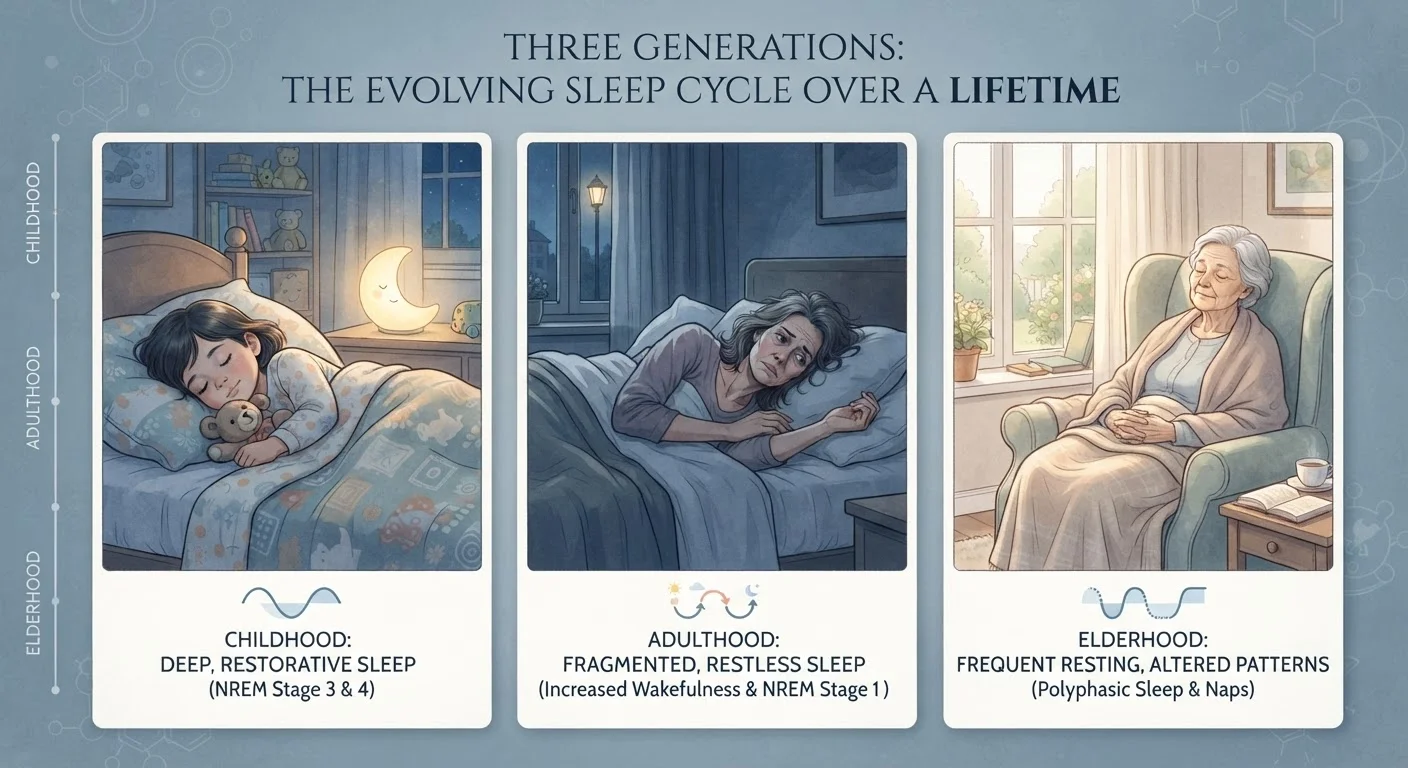
Sleep is not a fixed, uniform process. The architecture of sleep — how long we spend in each stage, how easily we fall asleep, and how well we stay asleep — evolves continuously from infancy through late adulthood. So do the sleep disorders that are most likely to emerge at each stage of life.
Understanding this relationship between age and sleep risk is more than academic. It can help parents recognize warning signs in their children, prompt working-age adults to take persistent fatigue seriously, and encourage older adults to report troubling symptoms to a doctor rather than dismissing them as an inevitable part of aging. For a broader overview of what qualifies as a sleep disorder and why early recognition matters, see Sleep Disorders Explained.
The five life stages below each carry distinct sleep disorder profiles, shaped by biology, behavior, and health status.
Infants and Toddlers: Fragmented Sleep and Behavioral Insomnia
Sleep in the first years of life is naturally fragmented and polyphasic — meaning infants cycle through sleep and wakefulness many times in a 24-hour period. However, when settling to sleep or staying asleep becomes persistently difficult due to learned associations or inconsistent schedules, clinicians may identify behavioral insomnia of childhood.
This condition typically involves a child who can only fall asleep under specific conditions — such as being held or fed — and wakes repeatedly during the night needing those conditions re-created. The American Academy of Sleep Medicine recognizes this as a distinct, treatable disorder. Caregiver-guided behavioral interventions are generally the first-line approach, and pediatricians can help families develop appropriate sleep routines.
Behavioral insomnia of childhood is a distinct, treatable condition — not simply a difficult sleeper.
School-Age Children: The Peak Years for Parasomnias
The elementary school years represent the developmental peak for parasomnias — a category of sleep disorders involving abnormal behaviors or experiences during sleep. Sleepwalking (somnambulism), sleep terrors, and confusional arousals are most prevalent in children aged 4 to 12, largely because slow-wave (deep NREM) sleep is especially abundant during this period.
These events tend to occur in the first third of the night, during transitions out of deep sleep. Most children outgrow parasomnias as their nervous systems mature, but episodes that are frequent, involve injury risk, or significantly disrupt the family warrant a clinical evaluation. Understanding sleep science — including why NREM sleep dominates early in the night — can help parents contextualize these events without alarm.
Sleepwalking and sleep terrors peak in childhood because deep NREM sleep is most abundant at this age.
Adolescents: Circadian Misalignment and Delayed Sleep Phase
Puberty triggers a well-documented biological shift in circadian timing. Teenagers' internal body clocks — regulated by the suprachiasmatic nucleus and melatonin release patterns — naturally push sleep onset later, often past 11 p.m. When early school start times require waking at 6 a.m. or earlier, the result is chronic, cumulative sleep deprivation.
In some adolescents, this circadian delay is severe enough to qualify as delayed sleep-wake phase disorder (DSWPD), in which falling asleep before 2–3 a.m. is genuinely difficult regardless of effort. Teens with DSWPD are often mislabeled as lazy or noncompliant. Diagnosis and management typically involve light therapy, careful sleep scheduling, and in some cases clinical guidance around melatonin timing — always under a healthcare provider's supervision.
Delayed sleep phase in teens reflects a real biological circadian shift, not simply poor discipline.
Adults: Insomnia, Sleep Apnea, and Occupational Pressures
Insomnia disorder — defined as difficulty initiating or maintaining sleep at least three nights per week for three or more months, with associated daytime impairment — is the most prevalent sleep disorder in working-age adults. Stress, shift work, anxiety, and depression are frequent contributors. For those whose schedules involve rotating or overnight shifts, shift work sleep disorder presents an additional, distinct challenge to the circadian system.
Obstructive sleep apnea (OSA) also becomes increasingly common in adults, particularly in those with excess weight, large neck circumference, or anatomical features that narrow the upper airway during sleep. OSA involves repeated partial or complete airway obstructions during sleep, causing oxygen desaturation and sleep fragmentation. It is substantially underdiagnosed. For a full reference on how common these conditions are across the U.S. population, see our mapped overview of adult sleep disorders.
Obstructive sleep apnea is substantially underdiagnosed in adults, particularly in those with excess weight.
Older Adults: Insomnia, REM Sleep Behavior Disorder, and Medication Effects
Sleep architecture changes considerably after age 60. Slow-wave sleep decreases, sleep becomes lighter and more fragmented, and early morning awakening becomes more common. These changes are real — but they do not make sleep disorders inevitable or untreatable.
Chronic insomnia remains highly prevalent in this group, often intertwined with pain, nocturia (waking to urinate), or mood disorders. REM sleep behavior disorder (RBD) — in which the normal muscle paralysis of REM sleep fails, causing individuals to physically act out vivid dreams — emerges predominantly in adults over 50 and is more common in men. Clinically, RBD carries significance beyond disrupted sleep: research has linked it to an elevated risk of certain neurodegenerative conditions, making evaluation by a sleep specialist important. Additionally, many medications commonly prescribed in older adults can fragment sleep or suppress key sleep stages. Caregivers and older adults should flag sleep concerns to a physician rather than attributing them entirely to aging. Practical habits that support sleep quality at any age are covered in our Sleep Habits hub.
REM sleep behavior disorder, most common after age 50, warrants evaluation due to its potential neurological associations.
Recognizing the Signs and Knowing When to Act
Across every age group, the core challenge is distinguishing normal variation in sleep from a pattern that warrants clinical attention. Occasional difficulty falling asleep is common; chronic, distressing sleeplessness that impairs daily functioning is not something to simply endure. Similarly, a child's occasional nightmare differs meaningfully from frequent, disruptive sleepwalking episodes.
Track Sleep Patterns Before Your Appointment
If you're concerned about a sleep disorder — in yourself or a child — keeping a simple sleep diary for one to two weeks before seeing a provider can be genuinely useful. Record bedtime, wake time, nighttime disruptions, and daytime energy levels. This objective record helps clinicians identify patterns that might not emerge from memory alone and can support a more accurate evaluation.
If you or someone you care for is experiencing persistent sleep difficulties — regardless of age — learn the warning signs that suggest professional evaluation may be needed. A healthcare provider or a board-certified sleep specialist can perform the appropriate assessment and recommend evidence-based treatment. Sleep disorders are medical conditions, not personal failures, and most respond well to targeted care.
This article is for general informational and educational purposes only and does not constitute medical advice. Always consult a qualified healthcare professional for concerns about your sleep or health.