

Key Takeaways
Option A
Mindfulness
A quality of attention you can carry anywhere.
Best for: People who want to bring more presence and awareness into ordinary daily moments without carving out dedicated practice time.
Option B
Meditation
A structured practice that trains the mind.
Best for: People who want a deliberate, time-set exercise to systematically build focus, calm, or self-awareness.
If you have very little time but want more calm in your day
Mindfulness
Mindfulness can be practiced in the middle of any activity — eating, commuting, or talking — without setting aside extra time in your schedule.
If you want a consistent, structured mental fitness routine
Meditation
Formal meditation sessions give you a dedicated container to train attention and build skills that gradually extend into daily life.
If you want to reduce stress and improve emotional regulation long-term
Mindfulness
Research consistently links mindfulness-based approaches to reduced stress reactivity; both practices can help, but informal mindfulness integrates more continuously into everyday life.
If you're curious about contemplative or relaxation practices and want a clear starting point
Meditation
A guided meditation session provides concrete structure and a defined beginning and end, making it easier to know what you're actually doing when you start out.
Why the Confusion Exists — and Why It Matters
Walk into any wellness app, workplace retreat, or self-help aisle and you'll find mindfulness and meditation treated as synonyms. It's an understandable mix-up: the words often appear side by side, and many practices blend both. But conflating them creates a real problem — people try one, have a certain experience, and draw conclusions that don't apply to the other.
Getting clear on what each term actually means isn't an exercise in semantics. It helps you choose the right tool for what you're actually looking for, set realistic expectations, and understand the research you read. Our plain-language explainer on what mindfulness actually means goes deeper on this, but the short version: these two concepts overlap significantly without being identical.
Defining Each Term Clearly
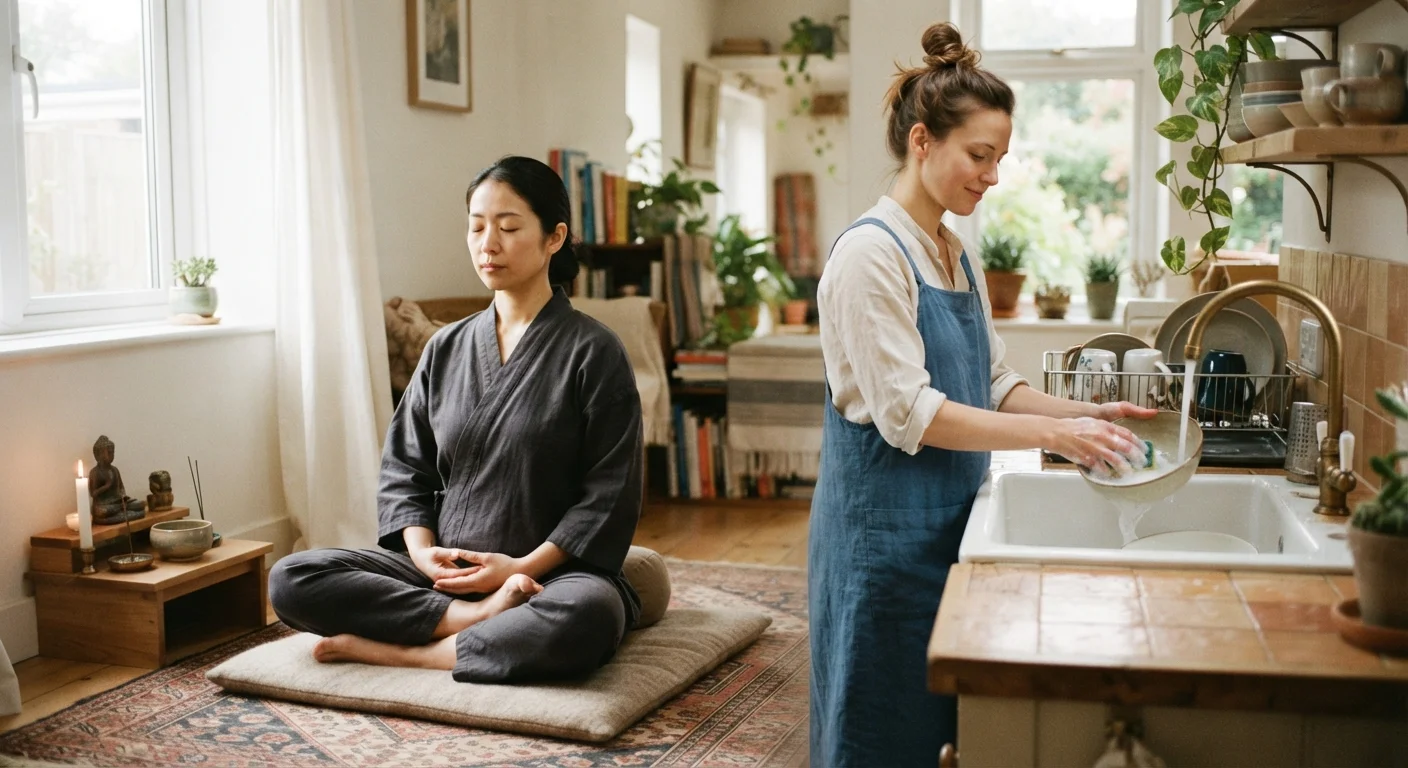
Mindfulness is a quality of attention — specifically, the capacity to pay attention to what's happening right now, in your experience, without immediately judging or reacting to it. It's not a technique or a session. It's a mental mode you can enter while washing dishes, waiting in traffic, or having a difficult conversation. Mindfulness has roots in Buddhist psychology and was adapted into secular clinical frameworks beginning in the late 1970s, most notably through Jon Kabat-Zinn's Mindfulness-Based Stress Reduction (MBSR) program at the University of Massachusetts Medical School.
Meditation is a broad category of deliberate mental exercises — practices you sit down (or lie down, or move) to do on purpose, for a set period, with a specific aim. Some meditation traditions have nothing to do with mindfulness: loving-kindness meditation focuses on cultivating compassion; transcendental meditation uses a mantra to reach a restful state; visualization practices direct attention to imagined scenes. Mindfulness meditation is simply the subset of meditation techniques designed specifically to train mindful attention.
| Criterion | Mindfulness | Meditation |
|---|---|---|
| What it is | A quality of attention | A structured practice or exercise |
| Requires dedicated time | No — woven into daily activity | Yes — a set session with a defined period |
| Always involves mindfulness | Yes, by definition | No — many forms don't emphasize it |
| Needs instruction to begin | Not necessarily | Guidance is helpful, especially at first |
| Research support | Strong, especially for stress and emotion regulation | Strong across multiple techniques and outcomes |
| Best entry point | Pause and notice your surroundings right now | A guided 5–10 minute breath-focused session |
How They Relate — and Where They Diverge
Think of it this way: mindfulness is the destination, and certain forms of meditation are a vehicle for getting there. But you don't always need the vehicle, and the vehicle can take you to other destinations too.
Formal mindfulness meditation — sitting quietly, focusing on your breath, and gently returning your attention when it wanders — is one of the most reliable ways to strengthen your capacity for mindfulness over time. Research published in journals like Psychological Science and JAMA Internal Medicine suggests that consistent meditation practice can meaningfully change how people respond to stress, pain, and difficult emotions. These effects appear to build gradually, not instantly.
But mindfulness itself doesn't require a session. It can be practiced informally throughout the day: noticing the texture of what you're eating, observing the quality of your breath during a tense meeting, or simply pausing before replying to a frustrating email. These micro-practices don't replace formal meditation for everyone, but they extend the same mental quality into waking life continuously. If you're curious about how informal mindfulness applies to stress specifically, see our piece on mindfulness for stress — including what it can and can't do.
It's also worth noting that not all meditation cultivates mindfulness. If you're using a body scan primarily to relax, or a breath-counting practice mainly as a sleep aid, you may be meditating in a therapeutic sense without specifically training mindful awareness. That's not a flaw — it just means the two concepts are genuinely distinct.
Practical Implications for Everyday Life
Understanding the difference changes how you approach both. If your goal is to feel less reactive during a busy workday, informal mindfulness practices — brief sensory check-ins, conscious breathing before a meeting — may be more immediately workable than trying to carve out a 20-minute sit. If your goal is to build lasting attentional control or work through a specific issue like anxiety or chronic pain, a structured meditation practice (ideally one taught by a qualified instructor or through an evidence-based program) may offer more systematic training.
Many people find the two work best together: formal meditation builds the skill, and informal mindfulness puts it to use. If you've tried meditation and found it frustrating, you might actually be seeking mindfulness — and vice versa. The common myths that keep people from trying mindfulness are worth reviewing if you've hit walls with either approach.
As with any wellness practice, what works depends heavily on the individual. People with certain mental health conditions, trauma histories, or medical concerns should speak with a qualified healthcare professional before beginning formal meditation programs, as some forms of intensive practice may not be appropriate for everyone.
This article is for general informational and educational purposes only, and is not a substitute for professional medical advice, diagnosis, or treatment. Always consult a qualified healthcare professional with questions about your mental or physical health.