

Key Takeaways
Body Weight
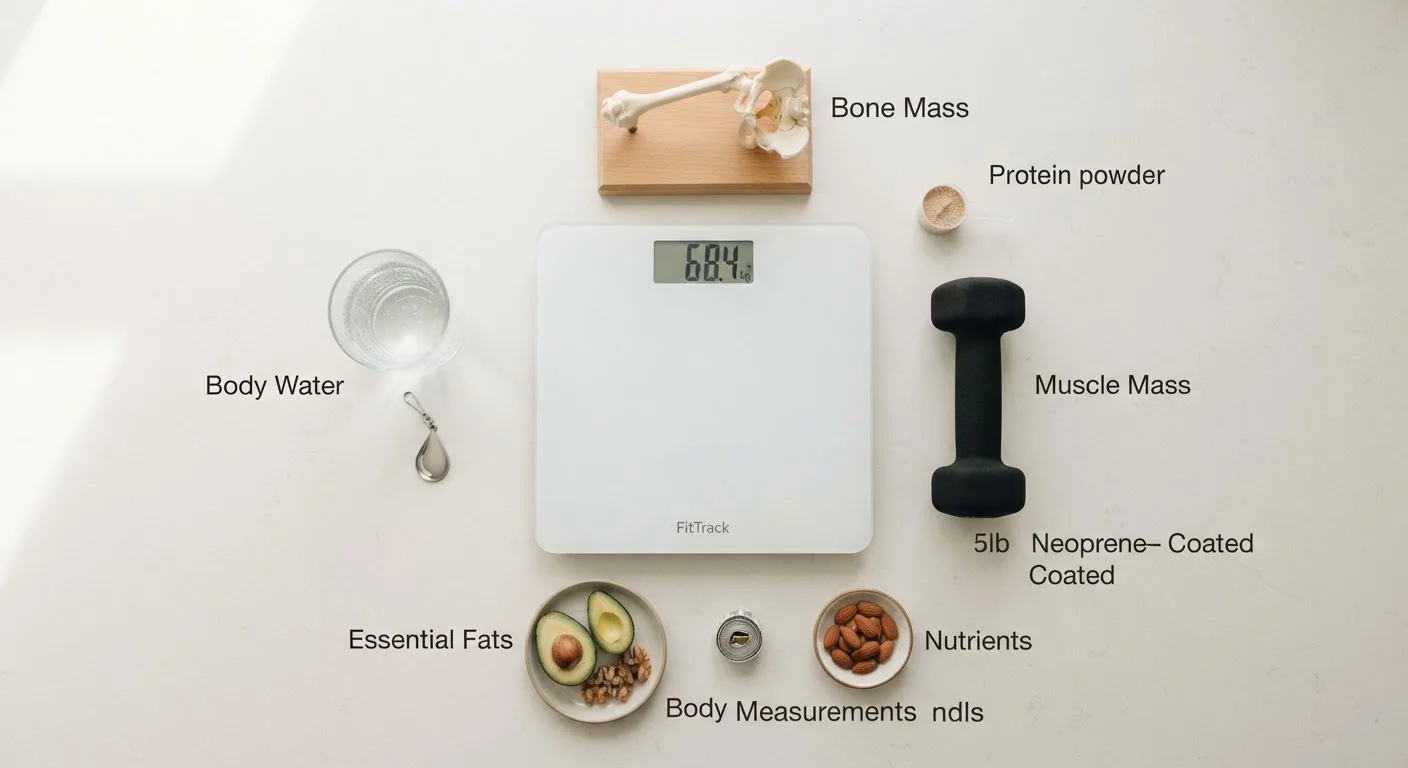
Body weight is the total mass of everything inside your body measured at a single point in time - including bones, muscles, organs, water, fat, and the contents of your digestive tract. It is not a direct measurement of body fat or health status. The number reflects a sum of many components, each of which can shift independently from one day or hour to the next.
In clinical settings, body weight is typically expressed in kilograms or pounds and is most meaningful when tracked as a trend over weeks rather than interpreted as a single data point.
The Six Components Your Scale Is Summing Up
When you step on a scale, the device measures gravitational force - nothing more. What that force represents is far more complex. Researchers and clinicians recognize that total body weight is the sum of at least six distinct tissue compartments:
- Skeletal muscle - typically the largest contributor to lean body mass in adults
- Body fat - both the fat stored beneath the skin (subcutaneous) and around internal organs (visceral)
- Bone mineral - denser bones contribute meaningfully to weight, particularly in individuals who strength-train
- Organs - the brain, liver, heart, lungs, kidneys, and other organs collectively account for several pounds
- Body water - water makes up roughly 50-60% of total body weight in most adults, distributed across cells, blood, and interstitial fluid
- Gastrointestinal contents - undigested food, fluid, and waste currently moving through the gut
Because each compartment fluctuates on its own timeline, total body weight is inherently variable - even when body fat remains completely unchanged. This is why a single weigh-in reading is rarely meaningful in isolation.
~60%
Proportion of adult body weight that is water
According to established human physiology references, total body water accounts for roughly 50-60% of body weight in most adults, varying with age, sex, and body composition.
2-5 lbs
Typical daily weight fluctuation range
Physiologists commonly cite a 2-5 pound range of normal within-day weight variation driven primarily by fluid balance, food volume, and hormonal changes.
~3g
Water stored per gram of muscle glycogen
Research in exercise physiology consistently documents that glycogen storage in muscle and liver is accompanied by approximately 3 grams of water per gram of glycogen.
Why Water Dominates Short-Term Weight Shifts
Of all the components above, water is by far the most dynamic on a day-to-day basis. Sodium intake, carbohydrate consumption, hormonal cycles, sweat, and kidney output all influence how much water your body retains at any given hour. Consuming a higher-sodium meal, for example, can cause the kidneys to temporarily retain fluid, producing a measurable increase on the scale by the following morning that has nothing to do with body fat.
Carbohydrate storage also plays a role: each gram of glycogen (the form in which your body stores carbohydrates in muscle and liver) is stored alongside roughly 3 grams of water. Eating a carbohydrate-rich meal after a period of restriction can rapidly restore glycogen stores - and their accompanying water weight - sometimes showing as a 2-4 pound gain overnight.
For a detailed breakdown of the mechanisms behind this, see our article on why the scale changes every single day.
What Body Weight Cannot Tell You
Understanding what the scale cannot measure is just as important as knowing what it captures. Standard scales provide no information about:
- The proportion of your weight that is fat versus lean tissue
- Where body fat is distributed (which affects metabolic risk differently)
- Bone density or muscle quality
- Hydration status
Two people of the same height and weight can have dramatically different body compositions - one may carry a higher proportion of muscle, the other a higher proportion of fat - with meaningfully different health profiles. This is one reason that metrics such as body fat percentage, waist circumference, and waist-to-hip ratio exist alongside weight. You can explore how these measures compare in our reference on BMI, body fat percentage, and waist circumference.
It's also worth noting that several widely repeated beliefs about body weight - including the idea that BMI reliably determines health - don't hold up well under scrutiny. Our article on common misconceptions about weight and health examines these claims carefully.
Reading Your Scale More Usefully
None of this means body weight is an irrelevant number. Tracked consistently - same time of day, same conditions, over weeks or months - it can reveal genuine trends in body composition change, fluid shifts, or other physiological patterns worth paying attention to. The key is interpreting it as one data point within a broader picture, not as a verdict on health or progress.
When evaluating weight trends, clinicians often look for changes that persist across multiple weeks and cannot be explained by obvious factors like hydration or dietary changes. An unexplained, significant, or rapid shift in either direction - without changes in lifestyle - is generally worth discussing with a healthcare professional.
Similarly, the psychological relationship with the scale matters. Frequent checking paired with strong emotional reactions can, for some people, fuel anxiety or disordered patterns of thinking about food and body. If that resonates, it may be worth reflecting on what role the number plays in your day. Our article on what body image actually means explores that dimension in more depth.
This article is for general informational and educational purposes only and is not a substitute for professional medical advice, diagnosis, or treatment. Always consult a qualified healthcare provider with questions about your health.