

Key Takeaways
Hip Tightness
Hip tightness refers to a reduced range of motion in the hip joint and surrounding muscles-particularly the hip flexors, glutes, and external rotators. It often feels like stiffness, pulling, or restricted movement during walking, bending, or sitting. The condition is extremely common and is most often a result of daily habits rather than injury.
Clinically, hip tightness may involve passive insufficiency of muscles like the iliopsoas or rectus femoris, reduced joint capsule mobility, or neuromuscular holding patterns-each requiring different approaches to address.
The Modern Lifestyle Connection
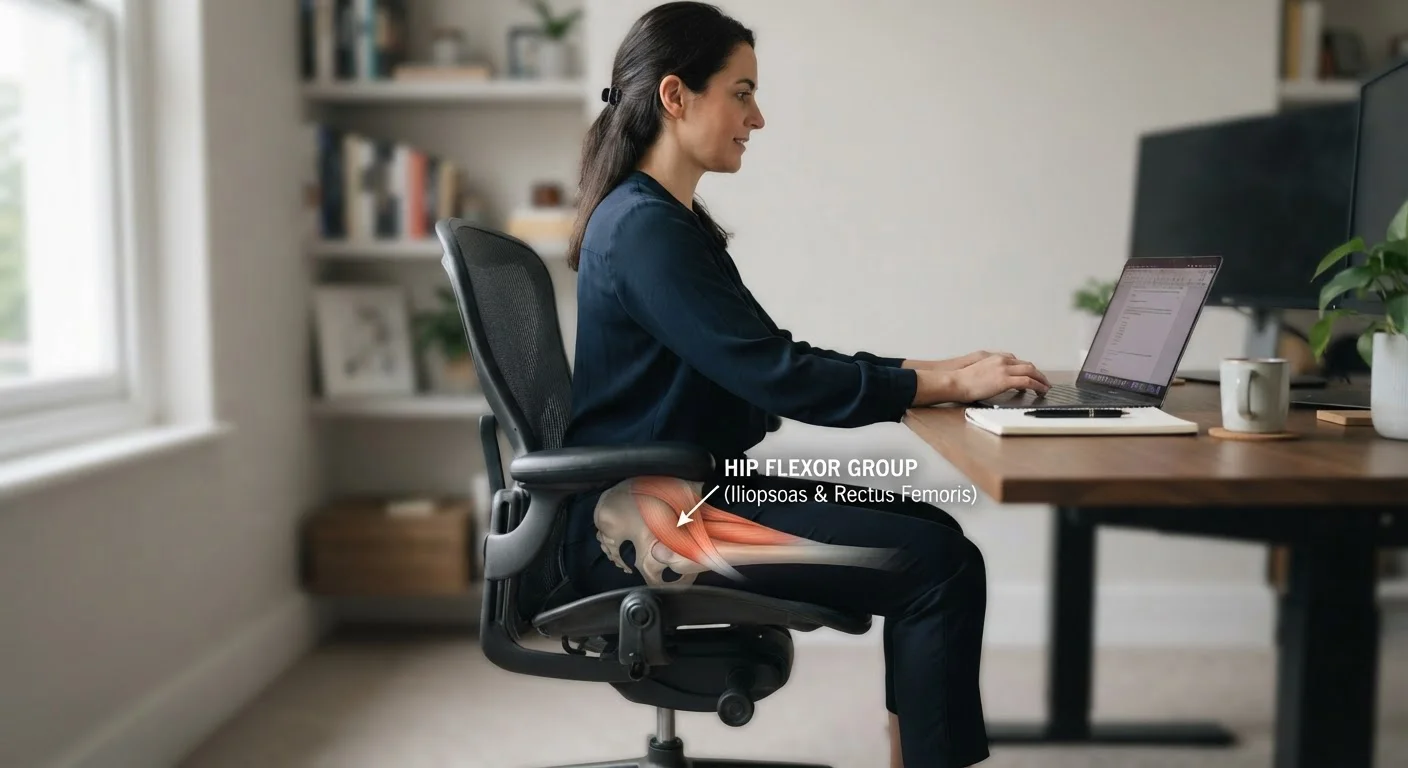
Tight hips have become one of the most commonly reported movement complaints among American adults-and the explanation largely comes down to how we spend our days. The average U.S. adult sits for roughly 6 to 8 hours daily, according to data from the American Heart Association. When the hip is held in a flexed position for extended periods, the hip flexor muscles-primarily the iliopsoas and rectus femoris-adapt by shortening. Over time, this adaptive shortening becomes the new resting length.
This isn't a flaw in the body's design. Muscles respond to the demands placed on them. The problem arises when a sedentary posture becomes the dominant position and active movement becomes the exception rather than the rule.
6-8 hrs
Average daily sitting time for U.S. adults
Reported by the American Heart Association based on population-level activity data.
~65%
Adults reporting musculoskeletal pain linked to sedentary habits
General estimates from physical therapy and occupational health literature suggest the majority of sedentary adults experience movement-related discomfort.
4-6 weeks
Typical timeframe for noticeable mobility improvements
Exercise science research generally suggests consistent, targeted mobility work produces measurable changes within this window for most healthy adults.
It's Not Just About Flexibility
A common misconception is that tight hips are purely a flexibility issue-something solved by stretching more. In reality, hip tightness often reflects a more complex picture involving muscle weakness, movement compensation, and neuromuscular habits.
When the gluteal muscles-particularly the gluteus maximus and gluteus medius-are underactive, the body may compensate by over-relying on the hip flexors during movement. This imbalance can make the hip flexors feel perpetually tense, because they're being asked to do more work than their share. Strengthening the posterior chain (glutes and hamstrings) is therefore just as important as stretching the front of the hip.
Additionally, what feels like tightness is sometimes the nervous system guarding a joint it perceives as unstable. In those cases, adding more forceful stretching can backfire-producing no lasting change or even discomfort.
What Actually Helps: An Evidence-Informed Approach
Improving hip mobility sustainably involves several complementary strategies:
- Movement variety throughout the day: Short movement breaks-standing, walking, or performing a few hip circles every hour-help interrupt the adaptive shortening cycle without requiring a dedicated workout.
- Hip flexor lengthening: Low-load positions held for 30-60 seconds, such as a half-kneeling hip flexor stretch, allow the nervous system time to accept a longer range without triggering a protective response.
- Glute and core strengthening: Exercises like glute bridges, deadlifts (performed with proper form), and clamshells address the muscular imbalances that often drive tightness.
- Full range-of-motion movements: Squatting to depth, lunging, and hip hinge patterns performed through a complete range reinforce functional mobility in ways that isolated stretching cannot replicate.
Consistency matters more than intensity here. Frequent, low-effort sessions outperform occasional aggressive stretching.
Anatomy Shapes Your Baseline
It's worth acknowledging that hip anatomy varies considerably between individuals. The depth of the hip socket, the angle of the femoral neck, and the orientation of the acetabulum all influence how much natural range of motion a person has. Two people following the same mobility program will not end up with the same range of motion-and that's entirely normal.
This means that comparing your hip flexibility to others, or chasing extreme ranges seen in yoga or athletic content online, is rarely a useful benchmark. A more productive goal is achieving functional hip mobility-enough to move comfortably through the activities that matter to your daily life.
Make Movement Breaks a Daily Habit
You don't need a gym session to maintain hip health. Setting a timer to stand and move for 2-3 minutes every hour can meaningfully reduce the cumulative effect of prolonged sitting. Even simple movements like standing hip circles, a brief walk, or a half-kneeling stretch at your desk can interrupt the tightening cycle before it becomes entrenched.
This article is for general informational purposes only and does not constitute medical advice. If you are experiencing hip pain, significant restriction, or discomfort that affects daily activities, please consult a qualified healthcare professional.