

Key Takeaways
Option A
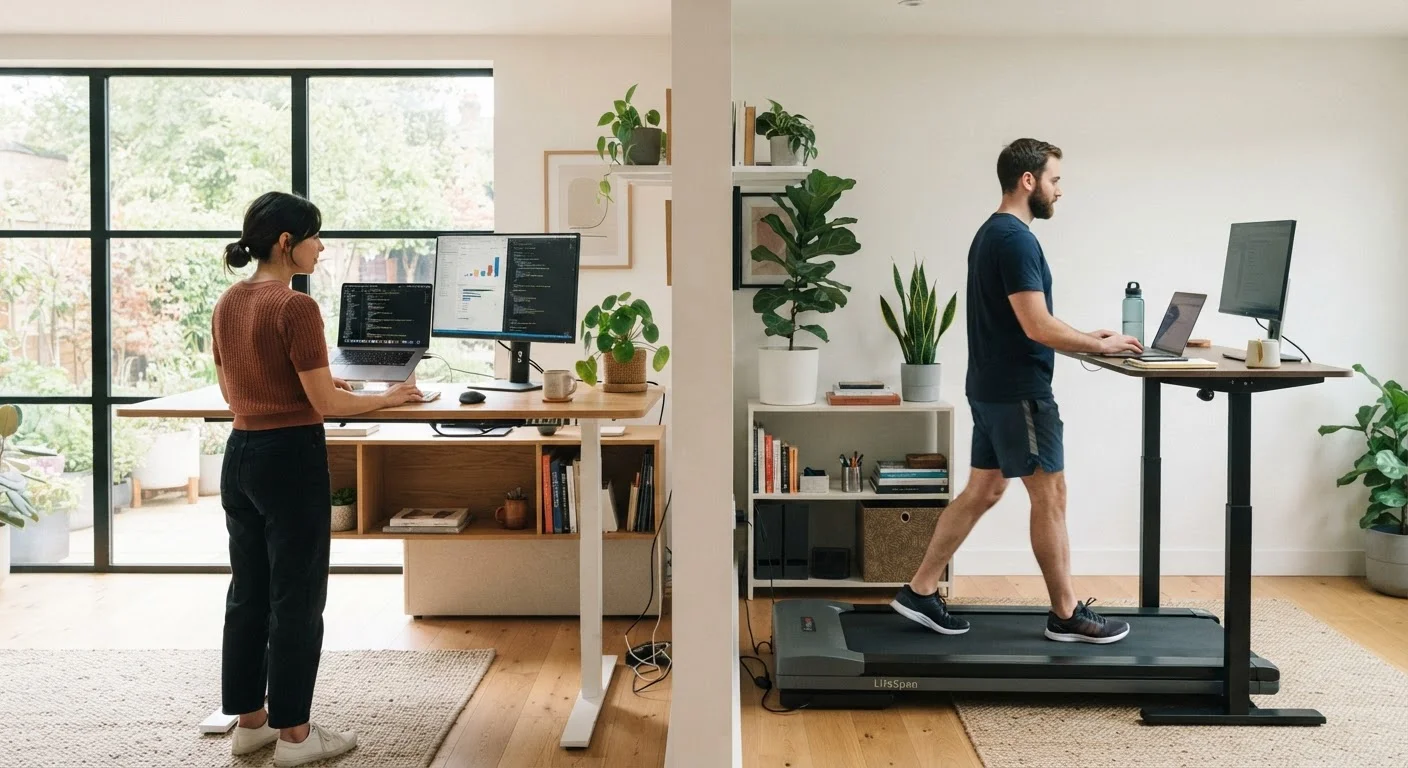
Standing Desk
The accessible, low-disruption way to break up sitting.
Best for: Workers who want a simple, affordable way to stand more throughout the day without interrupting focused tasks.
Option B
Treadmill (Walking) Desk
The active option for adding real movement during work hours.
Best for: People who want to accumulate meaningful daily steps during routine, low-concentration tasks like emails or calls.
If you do mostly focused, screen-heavy cognitive work
Standing Desk
Standing desks let you reduce sitting time without the distraction of walking, keeping concentration intact during complex tasks.
If you spend significant work time on calls, listening, or email
Treadmill (Walking) Desk
Low-intensity walking is well-tolerated during routine tasks and can meaningfully increase your daily step count over time.
If budget and space are primary concerns
Standing Desk
Standing desks - especially converter models - are widely available at a range of price points and require far less floor space than a treadmill setup.
If you already have a standing desk but want to move more
Treadmill (Walking) Desk
Adding a under-desk treadmill to an existing standing desk is one practical way to layer actual movement on top of reduced sitting time.
What Problem Are These Desks Actually Solving?
Most American office workers - remote or in-person - spend the majority of their workday seated. Research consistently links prolonged sitting with increased risks for cardiovascular disease, blood sugar dysregulation, and musculoskeletal discomfort, independent of how much formal exercise a person gets. If you want to understand why this matters even for people who do work out regularly, see our article on why sitting less matters even when you already work out.
Both standing desks and treadmill desks are designed as responses to this same problem: too much unbroken sitting. But they address it very differently, and understanding that distinction helps you set realistic expectations before investing in either.
| Criterion | Standing Desk | Treadmill (Walking) Desk |
|---|---|---|
| Primary benefit | Reduces unbroken sitting time | Adds genuine low-intensity movement |
| Calorie impact | Minimal increase over sitting | Moderate increase; accumulates over day |
| Effect on focus | No significant cognitive interference | Can reduce performance on complex tasks |
| Space required | Same footprint as standard desk | Requires additional floor space for treadmill |
| Typical cost range | Lower; wide range of options | Higher; treadmill adds significant cost |
| Best task pairing | Any task - reading, writing, calls | Low-demand tasks: calls, email, audio |
| Setup complexity | Simple; converter models need no installation | More complex; requires stable treadmill unit |
Standing Desks: What They Do (and Don't Do)
A standing desk - whether a fixed-height model or a motorized sit-stand converter - allows you to work on your feet instead of in a chair. The primary benefit is straightforward: breaking up continuous sitting. Studies published in occupational health journals suggest that sit-stand desks can reduce sitting time by roughly one to two hours per workday when used consistently.
However, standing is not exercise. Calorie expenditure while standing is only marginally higher than sitting - estimates generally put it at around 8-10 additional calories per hour. Standing for long, uninterrupted periods also carries its own drawbacks, including lower-limb fatigue and discomfort, particularly without an anti-fatigue mat or proper footwear.
The real value of a standing desk is behavioral: it introduces a cue to shift posture and interrupt sedentary patterns. Used as part of a broader strategy - alternating sit, stand, and move - it's a meaningful tool. Used in isolation with no other movement habits, its benefits are limited. For additional low-barrier options that don't require any equipment at all, see everyday movement for desk workers.
Treadmill Desks: Genuine Movement With Trade-Offs
A treadmill desk pairs a slow-moving treadmill belt (typically 1-2 mph) with a work surface above it. Unlike standing, walking at even a modest pace meaningfully increases heart rate, oxygen consumption, and calorie burn compared to sitting or standing. Over a full workday, those incremental gains can add up to several thousand additional steps.
The catch is cognitive interference. Research in human factors and ergonomics literature indicates that walking - even slowly - can reduce performance on tasks requiring fine motor control (like precise typing or complex data entry) and high-demand cognitive work. For tasks like reading, listening to audio, taking phone calls, or reviewing straightforward emails, the impact on performance is generally minimal.
This makes the treadmill desk most practical as a partial-day tool rather than an all-day solution. Pairing it intentionally with lower-demand tasks is the strategy most likely to succeed. You can apply the same logic of pairing movement with existing routines - a principle explored in depth in our piece on stacking movement into routines you already have.
The Most Practical Strategy: Variety Over Any Single Tool
Exercise scientists and occupational health researchers broadly agree that the goal is not to replace sitting with one alternative posture - it's to interrupt sitting frequently and introduce varied movement throughout the day. A pattern of sitting, standing, and light walking across the workday is more beneficial than committing fully to any single mode.
That means either desk type works best when combined with intentional movement breaks: standing up every 30-60 minutes, walking to a colleague instead of messaging, or taking a short walk during a break. These habits don't require equipment at all. Our article on small movement breaks that add up outlines simple approaches that work alongside any desk setup.
If you're considering a treadmill desk specifically for meetings or calls, it's worth reviewing when walking meetings work best to understand how walking and conversation interact in different professional contexts.
This article is for general informational purposes only and does not constitute medical advice. If you have any health conditions, injuries, or concerns about changes to your physical activity, please consult a qualified healthcare professional before making adjustments to your routine.